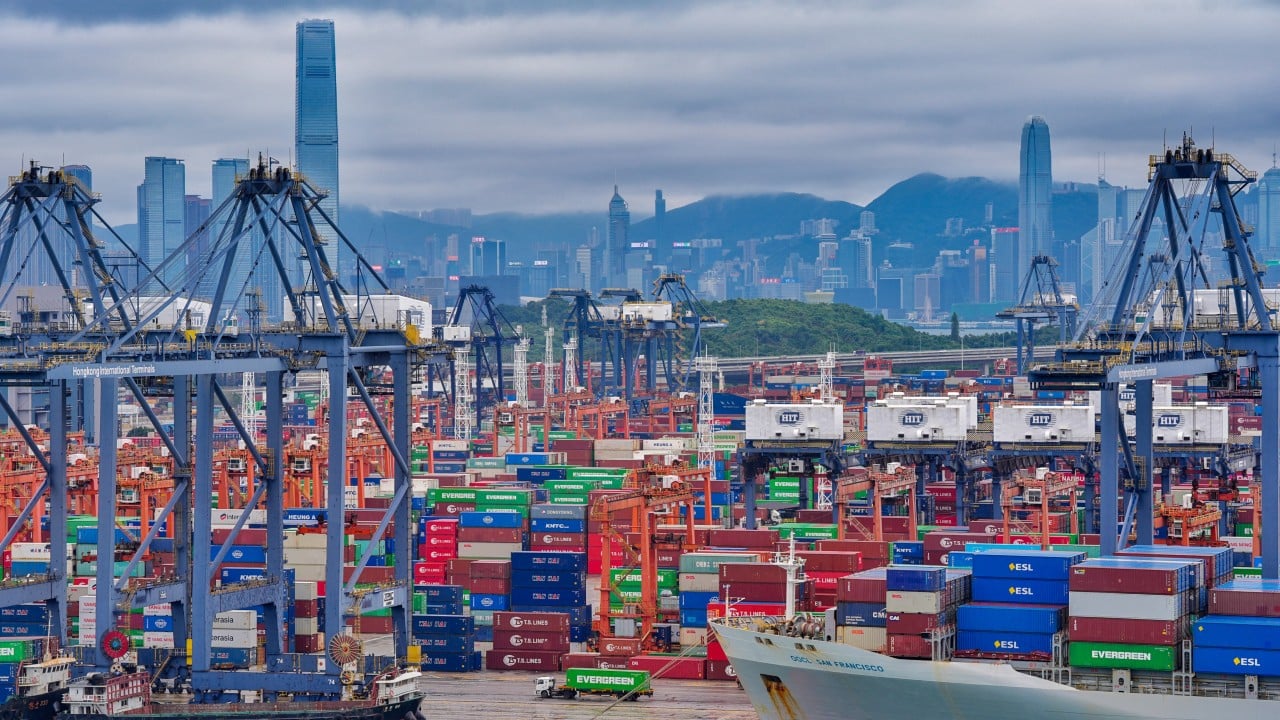
Hong Kong outward trade figures just printed a headline number that should command global attention, with total exports surging 42.9 percent year on year in April to hit HK$620.9 billion. The consensus narrative, parroted by official spokespeople and casual market observers, attributes this massive acceleration entirely to an insatiable global hunger for artificial intelligence electronics. But the raw data reveals a far more complex reality. While outbound shipments skyrocketed, imports climbed even faster at 44.4 percent to reach HK$650.4 billion, leaving the territory saddled with a visible trade deficit of HK$29.5 billion for the month. This is not a simple story of domestic industrial triumph, but rather a high-stakes demonstration of how a classic transit hub operates during a hyper-accelerated technology cycle.
Hong Kong does not design advanced silicon in homegrown labs, nor does it operate the fabrication facilities that stamp out high-bandwidth memory chips. Instead, the city serves as a critical logistical clearinghouse and re-export engine for intermediate components.
The mechanism driving this multi-billion-dollar trade spike is the regional technology pipeline. Raw or semi-finished components enter Hong Kong from global semiconductor strongholds, undergo inventory consolidation or rapid cross-docking, and cross into mainland China or secondary manufacturing hubs within the ASEAN network for final assembly.
When global tech giants demand massive volumes of information and communications technology equipment to populate data centers, Hong Kong trade ledgers expand symmetrically on both sides of the balance sheet. Electrical machinery, apparatus, and parts jumped 49.5 percent in export value during April. Telecommunications and sound equipment followed with a 54.6 percent rise. Yet, because these components must be brought into the territory before they can be shipped out, the massive export spike is effectively tethered to an equally massive import bill.
The Re-Export Machine and the Margin Illusion
To understand why a 43 percent trade surge still results in a deficit, look at the nature of transit-hub economics. A typical manufacturing economy creates wealth by transforming cheap raw materials into expensive finished goods, capturing the value-added spread. Hong Kong operates under a different financial geometry.
The territory functions primarily as a high-velocity distributor. Components arrive from places like Taiwan, South Korea, and Japan, then get routed to factories across Shenzhen, Dongguan, and Vietnam. This means the territory is highly exposed to transactional price inflation.
Bruce Pang, a director of research at the Hong Kong Trade Development Council, noted that supply chain reconfigurations across Asia and elevated commodity costs have driven up the unit prices of these advanced components. In simpler terms, the trade surge is heavily inflated by price effects rather than pure volume growth. The chips passing through the Kwai Chung container terminals are simply more expensive than they were a year ago, artificially boosting the headline export numbers.
April 2026 Trade Ledger (HK$ Billions)
+------------------+------------------+------------------+
| Total Exports    | Total Imports    | Net Trade Balance|
+------------------+------------------+------------------+
| 620.9            | 650.4            | -29.5            |
+------------------+------------------+------------------+
This dynamic creates an structural reliance on razor-thin processing margins. When international semiconductor input costs rise due to supply chain complexities, the total value of goods handled by Hong Kong spikes, but the local economy only retains a sliver of that wealth in logistics fees, financing costs, and warehousing revenues.
Regional Realignment and The True Destination of AI Silicon
The breakdown of export destinations highlights exactly where the international technology infrastructure buildout is concentrated. Shipments to mainland China grew by 40.7 percent in April, demonstrating that the mainland remains the primary engine for advanced hardware integration.
Even more striking are the gains registered across the wider Asian manufacturing ecosystem. Consider these regional shifts:
- Singapore: Up 126.3 percent, driven by the city-state's rapid expansion of localized data center capacity and advanced testing facilities.
- Thailand: Up 84.7 percent, reflecting its growing role in printed circuit board assembly.
- Taiwan: Up 72.7 percent, highlighting a circular trade of components returning to the origin point of advanced silicon for final system validation.
- Vietnam: Up 69.3 percent, fueled by the ongoing diversification of consumer electronics assembly lines away from traditional industrial zones.
Beyond Asia, the Western economies are pulling massive volumes through the Hong Kong pipeline to satisfy their own infrastructure requirements. Exports to the United Kingdom rose by 88.8 percent, while shipments to the United States grew by 37.5 percent. This cross-border flow confirms that despite long-term geopolitical posturing and policy efforts aimed at decoupling supply lines, the plumbing of the global technology sector remains fundamentally dependent on South China transit corridors.
The Asymmetry of the Trade Deficit
The underlying risk for the territory is that its current growth model is deeply cyclical. The first four months of the year saw total export values climb 35 percent, but imports outpaced that growth at 38.9 percent.
"Resilient global demand for tech products supports the headline numbers, but the trade gap shows the territory is importing massive overhead to sustain this momentum."
If global capital expenditure on data centers cools, or if corporate software profits fail to justify the massive hardware outlays of the current infrastructure build, the drop in component demand will hit transit hubs first. Because Hong Kong holds vast amounts of intermediate inventory in transit, a sudden deceleration in global tech spending could leave local logistics networks holding overvalued components that are depreciating rapidly.
Geopolitical Risks Facing the Transit Hub
A primary vulnerability for this ongoing trade surge sits entirely outside the commercial sphere. The shipping lanes and air freight corridors that make this rapid transit possible are highly sensitive to global instability.
Spokespeople from the Census and Statistics Department have openly warned that heightened geopolitical tensions, particularly in the Middle East, remain a critical threat. These disputes disrupt maritime shipping lanes, forcing cargo vessels onto longer, more expensive routes around Africa. The resulting increase in bunker fuel prices and container leasing rates directly inflates the import costs of intermediate goods.
For an economy that runs a negative trade balance despite a 43 percent export boom, any external factor that raises transport costs without a corresponding increase in final product value pinches local operating margins even tighter. The territory is running faster just to stay in the same place, handling unprecedented volumes of high-value cargo while remaining highly vulnerable to external supply chain shocks.
The structural reality is clear. The current technology boom has transformed the territory into a critical artery for international hardware distribution, but it has not insulated the local economy from the risks of a shifting global landscape. High headline growth cannot obscure the structural deficit built into a transit economy during an inflationary cycle.