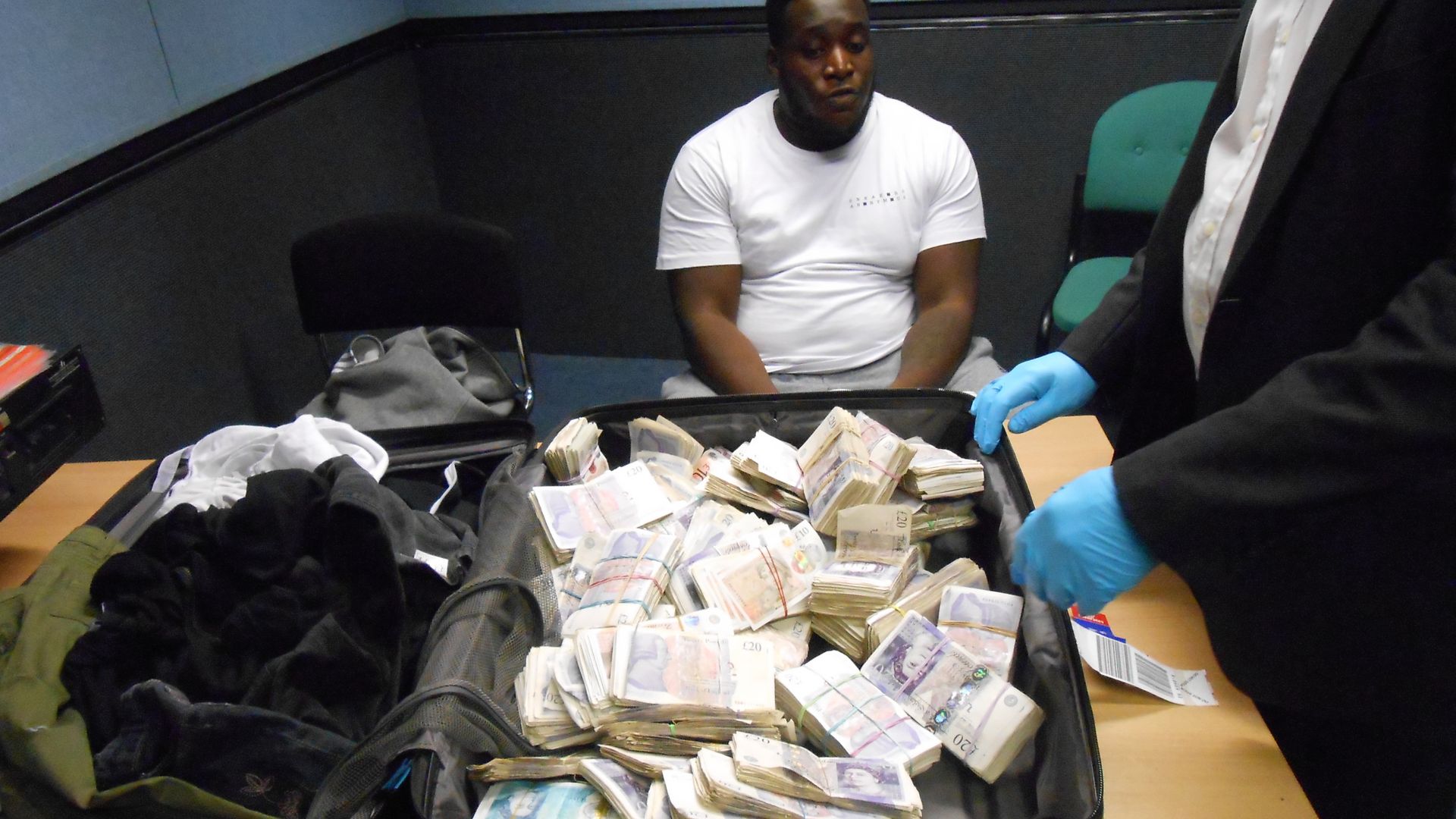
Transnational organized crime syndicates rely heavily on physical bulk cash smuggling to bypass systemic anti-money laundering (AML) controls embedded within the global banking architecture. When regulatory oversight and automated financial transaction monitoring trigger high probability alerts for digital illicit transfers, syndicates revert to physical capital flight. To successfully move tens of millions in hard currency across sovereign borders, these networks require precise execution across a distinct, three-part logistical chain: regional aggregation, insider-enabled airport injection, and regulatory arbitrage at the destination terminal.
An analysis of the National Crime Agency (NCA) investigation into a northern England crime family—which utilized a corrupt airline check-in attendant to smuggle approximately £30 million to the United Arab Emirates (UAE)—reveals how vulnerabilities within commercial aviation architecture are systematically exploited. By analyzing the structural mechanics of this operation, security professionals and regulatory bodies can map the precise economic cost functions and operational bottlenecks that govern insider threat vulnerability.
The Three Pillars of Bulk Cash Export Logistics
The survival of a physical cash-smuggling ring depends on mitigating risk across three independent operational phases. A failure in any single phase compromises the entire capital pipeline.
Regional Aggregation and Procurement
Before cash reaches an international departure terminal, it must be gathered from distributed illicit retail nodes. In the evaluated NCA case, the syndicate established supply networks across northern English municipal hubs, including Manchester, Liverpool, Southport, Sheffield, and Huddersfield.
The primary operational challenge at this stage is volume and weight optimization. Because physical currency possesses high mass and volume per unit of value—particularly when comprised of street-grade, mixed-denomination bank notes—it presents a significant physical footprint. Syndicates mitigate this by establishing localized processing safehouses where currency is sorted, counted, and compressed using industrial vacuum-packaging hardware. This increases density and minimizes the volumetric profile of the cargo, allowing hundreds of thousands of pounds to fit within standard commercial check-in luggage.
Insider-Enabled Terminal Injection
The check-in counter represents the first critical regulatory filter where commercial baggage is reconciled with passenger manifests and weight restrictions. Under standard operating protocols, international baggage is weighed to enforce structural safety limits and commercial tariffs. Highly aberrant baggage weights serve as an immediate behavioral and operational red flag for airline management and airport security.
The syndicate circumvented this automated filter by compromising an internal node: an Emirates airline check-in attendant based at Manchester Airport. The operational function of the insider was twofold:
- Weight Metric Falsification: The insider manually overrode weight alerts at the desk terminal, waiving through multiple suitcases filled with high-density cash packages that significantly exceeded standard commercial allowances.
- Procedural Decentralization: When the primary insider was not on active roster shifts, she acted as a logistical coordinator. By instructing uninformed colleagues to process specific couriers or bypass excess baggage protocols under administrative pretexts, she extended the network's operational window beyond her physical shift patterns.
This internal manipulation effectively blinded the carrier's primary weight-reconciliation data systems, transforming a high-risk security checkpoint into a friction-free intake node.
Destination Regulatory Arbitrage
The final phase leverages systemic asymmetries between the export controls of the departing nation and the import frameworks of the arriving jurisdiction.
Couriers boarded commercial flights from Manchester, Birmingham, or Brussels bound for Dubai. The operational logic relied on a specific regulatory loophole: while the unauthorized export of cash exceeding £10,000 from the UK constitutes a criminal offense under the Proceeds of Crime Act, arriving in certain international hubs allows travelers to legally declare vast sums of cash upon entry. By declaring the cash to customs at the destination terminal, the couriers obtained legitimate documentation certifying the physical currency's presence within the local ecosystem, effectively completing the first phase of integration into the legitimate financial stream.
The Cost Function of Insider Malfeasance
The economic structure of a cash-smuggling enterprise can be modeled by analyzing its human capital costs, operational overhead, and seizure thresholds. Criminal syndicates treat couriers and insiders as depreciable assets with distinct risk-premium structures.
[Illicit Cash Sourcing]
       │
       ▼
[Regional Safehouses] ──► (Vacuum Compression & Packing)
       │
       ▼
[Manchester/Birmingham Airport] ──► [Corrupt Check-In Node] ──► (Bypasses Weight & Manifest Filters)
       │
       ▼
[Commercial Flight Transit]
       │
       ▼
[Destination Airport (UAE)] ──► [Regulatory Declaration] ──► (Legitimized Asset Integration)
Courier Compensation Matrix
Network couriers are exposed to the highest probability of interdiction and legal liability. To maintain a steady supply of human mules, the network's Dubai-based organizer structured a dual-incentive model balancing direct liquid compensation with lifestyle subsidies.
Couriers received a baseline flat fee of approximately £3,000 per transit cycle. To lower behavioral friction and ensure loyalty, the syndicate covered all operational overhead, including business-class or high-tier economy airfare, luxury accommodation in international resorts, and all auxiliary entertainment expenses. This high-margin subsidy model shifts the courier's internal risk reward calculation, framing a high-risk illicit enterprise as a low-risk corporate travel perk.
The velocity of transit across the network was highly asymmetric:
| Courier Identity | Aggregate Transits | Documented Cash Exported |
|---|---|---|
| Courier A | 38 Trips | £2.2 Million |
| Courier B | 18 Trips | £3.1 Million |
| Courier C | Variable | £4.05 Million |
| Courier D | Variable | £5.89 Million |
The data demonstrates that individual currency payloads varied significantly per trip, ranging from roughly £57,000 to over £320,000 per suitcase cluster. This variability indicates that flight frequency and asset availability dictate shipment sizes rather than static, standardized batching.
The Vulnerability Bottleneck
The second limitation of this infrastructure is its complete reliance on the insider's operational availability. An airline check-in attendant operates within rigid scheduling constraints determined by carrier algorithms and airport roster managers.
When the primary insider is absent, the syndicate's risk of interdiction spikes exponentially. The operational breakdown of this specific network began when the system attempted to push currency through alternative nodes without direct insider oversight, resulting in two separate baggage interceptions totaling £788,455. These failures provided law enforcement with the initial data points needed to map the network's systemic footprint.
Systemic Vulnerabilities in Aviation Security Architecture
The exploitation of airport check-in infrastructure exposes fundamental design flaws in how commercial aviation separates counter-terrorism screening from anti-smuggling enforcement.
The Data Silo Problem
Modern airport terminals are designed around distributed access control systems. The airline's departure control system (DCS)—which manages passenger check-in, seat assignment, and baggage tag generation—operates independently from the baggage handling system (BHS) and the state-level customs screening network.
When a corrupt check-in agent inputs a fraudulent weight metric or overrides an excess baggage warning, that data remains siloed within the airline's operational database. Because state border forces and airport security agencies primarily screen checked baggage for explosive devices, organic threats, and prohibited weapons using automated inline X-ray systems, dense organic materials like currency paper can pass through undetected if they lack the distinct shape or signature of an improvised explosive device (IED).
The system relies on the assumption that the airline's commercial weight check acts as a secondary proxy control for anomalous luggage contents. When an insider subverts this proxy, the security architecture loses its primary filter for volumetric anomalies.
Operational Vulnerabilities of the Bag-Drop Node
The check-in counter is one of the few points in an airport terminal where an individual can manipulate physical luggage after it has been weighed but before it enters the automated, secure sorting track.
By utilizing manual overrides, a corrupt agent can generate legitimate baggage tags that misrepresent the actual weight and identity of the cargo. This creates a critical data mismatch: the digital manifest matches security requirements, but the physical weight of the aircraft hold reflects a significant payload deviation. This vulnerability undermines the auditability of commercial manifests, introducing both financial and aviation safety risks.
Hardening the Aviation Interface Against Capital Flight
To eliminate the operational space required for insider-assisted cash smuggling, aviation authorities and transport hubs must implement structural, automated oversight mechanisms that bypass human discretion at the terminal perimeter.
The first strategic priority is the mandatory integration of real-time weight cross-reconciliation. The weight captured by the scale at the physical check-in desk must be immutable; the DCS software must be re-engineered to block manual administrative overrides for international flights unless authorized by a secondary, independent supervisor dual-key protocol.
Furthermore, this weight profile must be cross-checked automatically at the inline baggage sorting system. If the physical weight measured by the automated conveyor sensors deviates by more than a 1% margin from the weight recorded at the check-in desk, the baggage handling system must automatically divert the suitcase to a secure containment spur for immediate inspection by border enforcement personnel. This digital and physical triangulation completely neutralizes the utility of a corrupt check-in agent.
The secondary strategic play requires the deployment of advanced imaging algorithms tailored for financial crime detection within the inline screening pipeline. Current explosive detection systems (EDS) use computed tomography (CT) to generate 3D volumetric profiles of luggage contents. Training neural networks to recognize the highly specific density signatures, geometric packing patterns, and layered organic profiles of vacuum-packed currency blocks allows automated systems to flag suspected cash reserves without requiring manual tip-offs or relying on human observational integrity. Hardening these digital filters is the only definitive methodology for disrupting the physical logistics of international shadow banking networks.