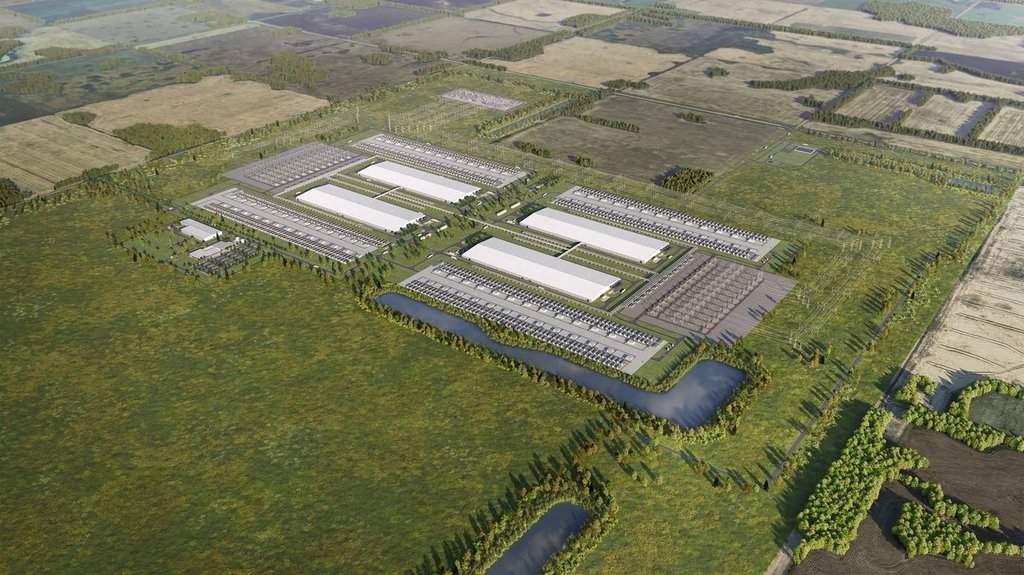
Alberta's proposed Bill 42 imposes a 600-metre residential setback, bans construction on Class 1 and Class 2 agricultural soils and irrigated acreage, mandates near-zero cooling water consumption, and forces heat-recovery architecture on all new data centres rated at 10 megawatts or higher. Rather than merely pacifying rural opposition, these spatial and engineering mandates function as a capital filter that shifts infrastructure development away from greenfield agricultural parcels toward brownfield industrial corridors and retired power generation sites.
For two years, provincial officials marketed Alberta as an unconstrained destination for hyperscale artificial intelligence infrastructure, attracting dozens of active proposals and billions in pledged capital. That rapid influx collided with physical and political ceilings: municipal pushback over industrial noise, localized fears regarding electricity rate hikes, and acute anxiety over water allocation in southern irrigation districts. Bill 42 attempts to resolve this friction by codifying hard boundary conditions while preserving a carve-out for legacy projects already holding development permits, most notably Meta's $13-billion campus in Sturgeon County.
The Four Pillars of Spatial and Technical Filtering
Standard media coverage treats Alberta's regulatory package as a simple compromise between rural residents and technology developers. From an infrastructure planning perspective, the policy operates through four distinct mechanical constraints that alter project feasibility:
- The 10-Megawatt Regulatory Threshold: Facilities drawing less than 10 megawatts remain under traditional municipal permitting jurisdictions. Projects at or above 10 megawatts trigger centralized oversight by the Alberta Utilities Commission (AUC). This bifurcates the market, allowing edge-computing nodes and small enterprise facilities to bypass provincial delays while subjecting hyperscale AI training clusters to utility-grade scrutiny.
- The 600-Metre Acoustic and Visual Setback: Developers must maintain at least 600 metres between the edge of a qualifying facility's site boundary and the nearest residential dwelling. Because sound pressure drops by roughly 6 decibels for every doubling of distance in free-field conditions, a 600-metre buffer significantly attenuates low-frequency hum from continuous cooling fans and backup diesel generators before reaching property lines. However, municipalities retain the legal authority to impose wider local setbacks, introducing localized regulatory variance across counties.
- Soil Capability and Irrigation Exclusions: The legislation walls off roughly 14 million acres of prime farmland. It prohibits facilities on Class 1 and Class 2 soils under the Canada Land Inventory system, extends protection to Class 3 soils in municipalities lacking higher-grade land, and places a blanket ban on currently irrigated parcels. By tying land eligibility to soil classification and irrigation status, the province removes flat, cleared, easily graded agricultural land near existing rural transmission lines from the addressable real estate pool.
- Closed-Loop Thermal and Water Mandates: New builds must meet forthcoming cooling standards designed to drive consumptive water use toward zero, alongside physical architecture capable of exporting waste heat to adjacent greenhouses, industrial plants, or district heating networks. While developers are not forced to secure an active thermal offtaker prior to construction, they must absorb the upfront capital expenditure of installing heat-exchange manifolds and piping infrastructure.
The Cost Function of Greenfield Displacement
Blocking access to prime and irrigated farmland changes the unit economics of hyperscale site selection in Alberta. Agricultural parcels adjacent to high-voltage transmission corridors historically offered the lowest total installed cost for data centre operators because they required minimal site remediation, flat grading, and short interconnection tie-ins.
Removing those parcels forces developers into two alternative siting pathways, each carrying distinct capital and operational penalties:
- Transmission Extension to Marginal Land: Developers seeking greenfield sites must move onto lower-grade Class 4 through Class 7 soils or non-irrigated grazing land. These parcels frequently sit farther from bulk transmission substations. Under Alberta's regulatory framework, developers must fund the electrical wiring within their project boundaries and absorb steep interconnection upgrades. Extending high-voltage tie-lines over longer distances adds millions of dollars in civil engineering costs and introduces multi-year supply chain delays for high-voltage transformers and switchgear.
- Brownfield Industrial Co-Location: The legislation explicitly exempts designated industrial zones, previously disturbed industrial sites, and existing power-generation locations, with cabinet-level override authority available for exceptional agricultural cases until September 20, 2027. This aligns with Alberta's Mature Asset Strategy, steering server farms toward decommissioned coal-fired power plants or heavy industrial heartlands. While brownfield sites offer pre-existing high-voltage grid interconnects and established industrial zoning, they often require environmental remediation, demolition of legacy structures, and complex land assembly.
A conceptual comparison illustrates this trade-off. A 100-megawatt AI data centre built on a hypothetical greenfield farm parcel near an existing substation might spend minimal capital on land preparation while relying on evaporative cooling towers. Under Bill 42, that same 100-megawatt facility pushed onto a marginal parcel 15 kilometres from a substation faces heavy capital outlays for dedicated transmission lines, closed-loop dry coolers or liquid-to-chip heat exchangers, and secondary thermal piping—all while experiencing higher parasitic power loads during peak summer temperatures when dry-cooling efficiency drops.
Acoustic Physics Versus Political Perception
The 600-metre residential buffer sits at the center of political friction between provincial ministers and rural advocacy groups. Provincial officials selected 600 metres by benchmarking existing industrial setbacks, such as gas-fired power plants operating near Calgary suburbs, and pairing the distance with mandatory noise studies and physical sound barriers. Conversely, grassroots organizations such as Little Town Big Data have demanded buffers of two to five kilometres, citing persistent low-frequency acoustic emissions and quality-of-life degradation.
This dispute stems from a mismatch between A-weighted decibel (dBA) regulations and low-frequency noise propagation:
- Standard Regulatory Metrics: Industrial noise bylaws typically measure sound using dBA scales, which filter out low-frequency bass tones to mimic human ear sensitivity at moderate volumes. Enclosing chillers and installing acoustic louvers can easily bring a facility into compliance with provincial dBA thresholds at 600 metres.
- Low-Frequency Attenuation: Data centre mechanical arrays generate continuous tonal hums in the 31.5 Hz to 125 Hz octave bands. Low-frequency sound waves have long wavelengths that diffract over standard perimeter sound walls and travel efficiently across flat prairie terrain, particularly during nocturnal temperature inversions when cold air near the ground traps sound waves and refracts them downward.
Consequently, a facility can achieve strict technical compliance with AUC noise limits at 600 metres while still generating perceptible indoor structural vibration or low-frequency drone for residents living 800 to 1,200 metres away. By granting the AUC post-construction enforcement authority to intervene on noise and lighting violations, the province created a mechanism to address operational exceedances, yet it left the baseline spatial buffer vulnerable to municipal overreach. Because counties can legislate larger setbacks independently, developers face a patchwork of local zoning rules that can render entire rural municipalities functionally off-limits regardless of provincial minimums.
Water Allocation and Thermodynamic Trade-Offs
Alberta's southern river basins, particularly the South Saskatchewan River Basin, operate under closed water-allocation regimes where agricultural irrigation districts hold senior water licenses. Allowing open-loop evaporative cooling for multi-hundred-megawatt server campuses would directly threaten agricultural water security during multi-year drought cycles.
Mandating near-zero cooling water consumption solves the hydrological conflict by shifting the cooling burden from water evaporation to electricity consumption and capital expenditure:
- Evaporative Cooling Mechanism: Traditional data centres spray water over heat-exchange coils, leveraging the latent heat of vaporization to reject thermal energy efficiently. This keeps Power Usage Effectiveness (PUE) low—often near 1.15—but consumes millions of litres of water annually.
- Zero-Water Alternatives: Eliminating water consumption requires closed-loop dry coolers, air-side economizers, or closed-loop liquid cooling systems paired with dry heat rejection. During cold Alberta winters, ambient air provides free cooling with minimal energy penalty. During summer ambient peaks above 25°C, dry coolers require massive fan arrays and mechanical chillers to reject heat, driving up electrical draw and increasing peak grid demand at the exact moment provincial air-conditioning loads peak.
The secondary mandate—designing facilities for waste-heat recovery—attempts to monetize this concentrated thermal output. However, thermodynamic reality limits its practical application. Data centres produce large volumes of low-grade heat, typically water or air warmed to between 25°C and 45°C. While commercial greenhouses and aquaculture operations can utilize low-grade heat directly, heavy industrial processes require high-grade steam, necessitating expensive industrial heat pumps to upgrade the thermal energy. Forcing developers to build heat-recovery interconnects without guaranteeing an industrial co-locator adds stranded capital cost unless the facility sits directly inside an integrated industrial park.
Grid Interconnection and Ratepayer Insulation
Beyond land and water, Bill 42 intersects with electricity market stability. The Alberta Electric System Operator (AESO) previously established a 1,200-megawatt connection allowance through 2028 to manage dozens of gigawatt-scale interconnection requests. Adding massive, flat-load data centres to an energy-only electricity market tightens reserve margins and risks driving up wholesale pool prices and transmission tariffs for residential and industrial ratepayers.
The provincial strategy relies on two mechanisms to insulate existing ratepayers:
- Behind-the-Meter Generation: Steering projects toward existing power-generation sites encourages developers to co-locate with natural gas turbines or renewable generation assets. By drawing power directly behind the meter, data centres reduce strain on the bulk transmission grid, though they still require grid backup agreements or battery storage to maintain 99.999% uptime.
- Direct Cost Assignment: Requiring developers to pay for internal site electrical infrastructure and dedicated grid upgrades prevents socialization of connection costs across general utility bills.
However, exemptions granted to early movers create a two-tier market. Facilities that secured development permits prior to Bill 42's introduction—such as Meta's Sturgeon County project—are grandfathered out of the new spatial and technical restrictions. These early entrants lock in lower capital costs and established grid queue positions, while subsequent competitors must absorb higher compliance costs, restricted land options, and stricter AUC scrutiny.
Limitations of the Regulatory Framework
While Bill 42 establishes clear guardrails, three structural vulnerabilities remain unresolved until supporting regulations are finalized:
- Regulatory Deferral Risk: Key operational metrics—specifically the exact numerical threshold for near-zero water usage, technical specifications for waste-heat readiness, and precise land classification maps—are deferred to future regulations rather than codified in primary legislation. Investors cannot finalize engineering procurement construction (EPC) budgets until these subordinate rules are published.
- Municipal Fragmentation: Allowing counties to set setbacks wider than 600 metres invites a race to the bottom in rural zoning. If politically organized municipalities adopt two-kilometre buffers, developers will abandon rural counties entirely, concentrating all new capacity into a handful of industrial municipalities and creating localized transmission bottlenecks.
- Sub-Threshold Arbitrage: Setting the AUC oversight trigger at 10 megawatts creates an incentive for developers to disaggregate large campuses into multiple 9.9-megawatt modular facilities across adjacent parcels to remain under municipal jurisdiction and evade centralized provincial scrutiny. Without strict anti-clustering aggregation rules in the final regulations, modular circumvention could undermine the intent of the buffer zone.
Tactical Site Selection Strategy
Infrastructure developers and institutional capital allocators targeting Alberta must immediately abandon greenfield agricultural land acquisition strategies and pivot exclusively toward pre-permitted brownfield industrial assets.
- Target Retired Thermal Generation Sites: Prioritize land acquisition at decommissioned coal or aging natural gas power plants. These locations possess existing high-voltage transmission switchyards, industrial zoning exemptions, water licenses, and flat graded footprints that bypass Bill 42's agricultural bans and minimize interconnection lead times.
- Audit Municipal Land-Use Bylaws Before Optioning Land: Screen target counties for local setback ordinances exceeding the 600-metre provincial baseline. Execute option agreements only in municipalities with established heavy industrial overlay zones, such as Alberta's Industrial Heartland, where residential encroachment is legally restricted.
- Engineer for Closed-Loop Liquid-to-Air Cooling: Standardize facility designs around closed-loop rear-door heat exchangers or direct-to-chip liquid cooling paired with adiabatic-free dry coolers. Design mechanical manifolds with flanged external tie-in points to satisfy waste-heat readiness rules at minimal upfront capital cost while avoiding dependence on uncontracted third-party thermal offtakers.
- Lock In Behind-the-Meter Power Purchase Agreements: Structure joint ventures with independent power producers to co-locate behind existing generation meters, bypassing AESO bulk transmission queue bottlenecks and insulating project operating expenses from future provincial transmission tariff escalations.