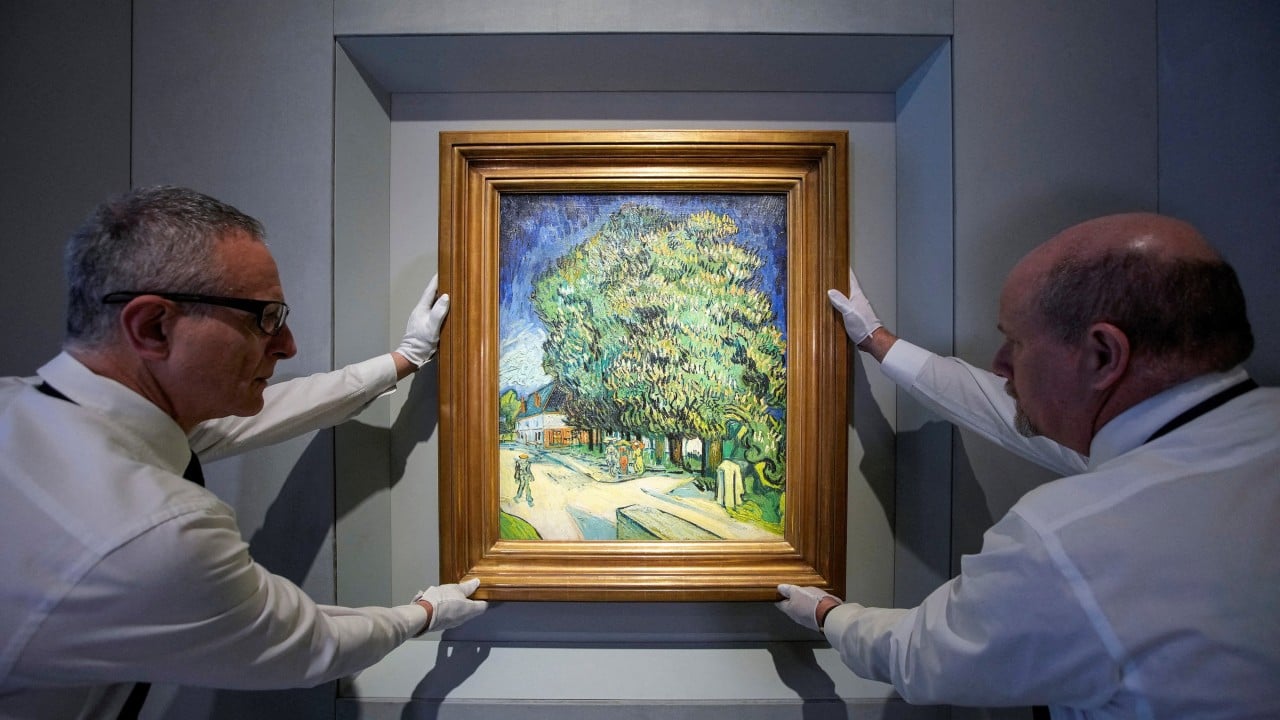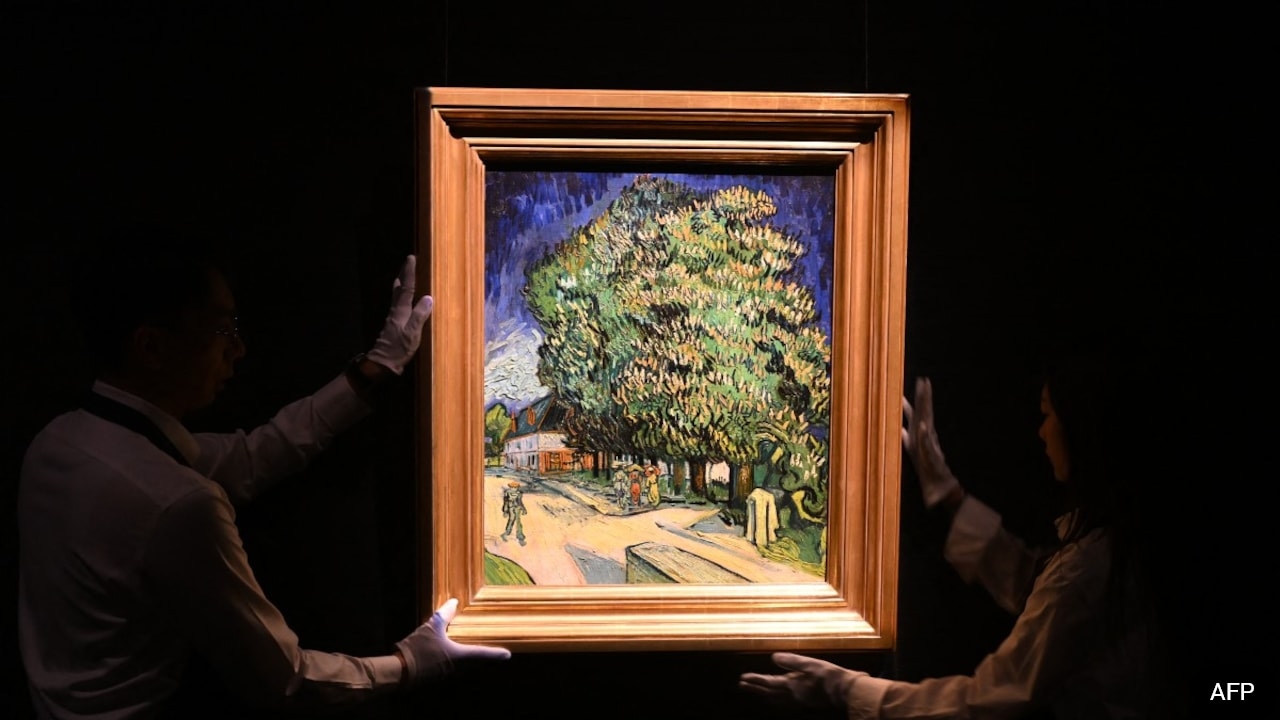
A $190.4 million hammer price for an 1890 Vincent van Gogh canvas is not an anomaly of irrational exuberance; it is the predictable output of an ultra-thin, supply-constrained market governed by Veblen dynamics and non-fungible scarcity. Standard coverage of nine-figure art transactions relies on biographical romanticism—focusing on the artist's mental decline in Auvers-sur-Oise or the tragic irony of posthumous wealth. That framing obscures the financial mechanics driving capital allocation at the top decile of the global wealth pyramid. To understand how an oil painting crosses the $190 million threshold, analysts must discard traditional discounted cash flow models and evaluate the asset through the lenses of terminal supply inelasticity, geopolitical capital flight, and institutional liquidity signaling.
The Valuation Function of Terminal Scarcity
In standard equity or real estate markets, price appreciation triggers a supply response. Higher valuations incentivize developers to build or corporations to issue equity, eventually establishing an equilibrium. Fine art produced by deceased masters operates under absolute supply inelasticity. When Vincent van Gogh died in July 1890, his total lifetime output was permanently capped at roughly 900 paintings.
The investable float of this catalog is drastically smaller than the total production volume. Over the past century, major public institutions—including the Van Gogh Museum in Amsterdam, the Musée d'Orsay in Paris, and the Museum of Modern Art in New York—have absorbed the majority of his surviving works. Once a canvas enters a permanent museum collection, legal covenants and institutional mandates remove it from commercial circulation indefinitely.
The market for private acquisition is restricted to the remaining fraction of works held in private estates, corporate collections, or sovereign wealth funds. Within this narrow float, works executed in 1890 carry a distinct valuation premium driven by three structural factors:
- Chronological Finality: Van Gogh spent the final seventy days of his life in Auvers-sur-Oise, producing roughly one painting per day. Works from this window represent the culmination of his impasto technique and color theory, serving as the terminal chapter of his artistic development.
- Provenance Compression: Because 1890 works were among the last to leave the immediate custody of Theo van Gogh and Johanna van Gogh-Bonger, their ownership chains are comparatively short and well-documented. Clean provenance eliminates authentication discounts, which typically shave 20% to 40% off secondary market valuations for nineteenth-century European paintings.
- Visual Velocity: Paintings from the Auvers period exhibit high chromatic contrast and aggressive brushwork. In an era where ultra-high-net-worth buyers evaluate assets both in physical galleries and via high-resolution digital transmissions, visual immediacy correlates directly with bidding aggression.
When an unencumbered 1890 masterpiece surfaces at auction, buyers are not pricing the canvas in isolation. They are pricing the probability—approaching zero—that an equivalent asset will return to the open market within their investment horizon.
Deconstructing the $190.4 Million Price Architecture
Headline auction figures frequently conflate the hammer price with the total transaction cost, obscuring the fee structures that dictate buyer liquidity requirements. In a $190.4 million transaction, the final clearing price is the sum of two distinct components: the hammer price (the winning bid accepted by the auctioneer) and the buyer's premium (the sliding-scale commission charged by the auction house).
Major auction houses operate on tiered fee schedules. For lots exceeding $5 million to $10 million, the buyer's premium typically settles at 12% to 14.5% of the hammer price, though bespoke negotiations for nine-figure lots often compress this margin via third-party guarantee structures. Working backward from a $190.4 million inclusive price suggests a hammer price in the range of $168 million to $172 million, with roughly $18 million to $22 million allocated to transaction friction.
This fee structure introduces an immediate hurdle rate for the acquirer. To break even on a nominal basis—ignoring insurance, climate-controlled storage, conservation, and the opportunity cost of capital—the asset must appreciate by approximately 13% to 15% before the buyer can clear the spread on a subsequent resale.
Because a 15% appreciation on a $190.4 million base requires finding a future buyer willing to deploy nearly $220 million, traditional short-term flipping strategies fail at this tier. Buyers operating at this altitude are not optimizing for internal rate of return (IRR). They are executing balance-sheet preservation and status signaling.
Veblen Goods and the Signaling Equilibrium
Classical microeconomics dictates that demand curves slope downward: as price increases, quantity demanded decreases. Trophy art violates this law, functioning as a textbook Veblen good where utility is positively correlated with price.
For a centibillionaire or a sovereign cultural authority, acquiring an asset at $190.4 million generates utility precisely because the price tag excludes 99.9999% of global market participants. If the painting sold for $40 million, its signaling power would dilute, placing it within reach of hundreds of mid-tier hedge fund managers and regional collectors. Crossing the $190 million mark establishes an exclusive signaling equilibrium.
This dynamic alters the auction room psychology. Bidding is not a search for intrinsic value; it is a public tournament of liquidity. When two or three ultra-high-net-worth principals compete for a single 1890 Van Gogh, the bidding increments—often jumping by $2 million to $5 million per paddle raise—serve as real-time balance-sheet disclosures. Conceding the lot signals a liquidity constraint or a lower risk tolerance, outcomes that high-ego principals actively pay to avoid.
The Role of Financial Engineering in Trophy Auctions
Modern nine-figure art sales rarely rely on unhedged public bidding. Prior to the auction date, financial engineers within the auction house structure risk-transfer mechanisms to guarantee a floor price for the consignor while capturing upside spreads.
- Irrevocable Bids (Third-Party Guarantees): To secure a prized consignment, an auction house promises the seller a minimum guaranteed price regardless of the auction outcome. To offload this balance-sheet risk, the house solicits an outside financier—often an art fund, a rival dealer, or a separate collector—to place an irrevocable bid at or near the guarantee level prior to the sale.
- Financing Fee Splits: In exchange for assuming the downside risk of owning the painting if no higher bids materialize, the third-party guarantor receives a financing fee. This fee is structured as a percentage of the upside if the painting sells above the guaranteed floor. If the guarantee was set at $150 million and the hammer price reaches $170 million, the guarantor pockets a predetermined slice of the $20 million overage, effectively generating a double-digit annualized return over a holding period of a few weeks.
- Art-Backed Lending: Once the transaction closes at $190.4 million, the asset immediately transforms into collateral. Private banks and specialized art lenders routinely extend non-recourse or full-recourse credit facilities against blue-chip Impressionist and Post-Impressionist works at loan-to-value (LTV) ratios of 40% to 50%. The buyer can immediately extract $75 million to $95 million in tax-free liquidity at favorable interest rates, redeploying that capital into cash-flowing equities or private credit while retaining physical possession of the canvas.
Geopolitical Capital Flight and Cross-Border Portability
Evaluating a $190.4 million painting strictly as a wall decoration ignores its function as a high-density store of value. Compared to commercial real estate, private equity stakes, or physical gold bullion, a nineteenth-century canvas offers superior capital portability and jurisdictional flexibility.
An oil painting measuring roughly 70 by 90 centimeters weighs less than ten kilograms. Yet it encapsulates nearly $200 million in compressed value. For global capital allocators navigating currency devaluation, capital controls, or sovereign risk, blue-chip art serves as an offshore bearer-like instrument. While anti-money laundering (AML) regulations and know-your-customer (KYC) protocols have tightened significantly across New York, London, and Hong Kong, physical art remains exempt from the daily mark-to-market volatility and automated reporting regimes that govern public securities.
Storage infrastructure supports this asset-class utility. Freeports in Geneva, Luxembourg, Singapore, and Delaware allow owners to hold, inspect, and trade multi-million-dollar works in tax-neutral, customs-exempt environments. A painting sold for $190.4 million in New York can be transferred directly to a climate-controlled vault in Zurich, deferring value-added taxes (VAT) and sales duties indefinitely until the asset enters a domestic jurisdiction for public display.
Limitations of the Trophy Art Thesis
Treating $190.4 million art acquisitions as foolproof wealth-preservation vehicles introduces severe structural risks that generalist commentators routinely overlook.
- Illiquidity Risk: While LTV credit facilities provide partial liquidity, exiting the underlying equity position requires finding a single counterparty capable of deploying $200 million. During macroeconomic contractions or interest rate spikes, the pool of active nine-figure buyers can evaporate entirely, forcing sellers to accept 30% to 50% haircuts if forced to liquidate under distress.
- Key-Person and Taste-Shift Vulnerability: Market valuations for 1890 Van Goghs rest on a consensus among Western, Asian, and Middle Eastern collectors regarding art-historical canon. While Van Gogh's canonical status appears entrenched, long-term generational shifts in aesthetic preference can erode the liquidity premium of nineteenth-century European painting relative to Post-War, Contemporary, or digital-native assets.
- Physical Degradation and Conservation Liabilities: Unlike digital ledgers or corporate shares, an 1890 canvas is a decaying organic object. Van Gogh frequently used unstable chrome yellow and eosin-based red pigments that oxidize and fade upon exposure to ultraviolet light. Thick impasto layers are susceptible to flaking and delamination during transit. An environmental failure in storage or a handling error during installation can instantly destroy tens of millions of dollars in market value, even with comprehensive fine-art insurance policies in place.
- Regulatory Friction: Global tax authorities increasingly scrutinize freeport holdings and art-backed lending structures. Changes to wealth tax legislation, capital gains treatment on collectibles (which already carry a 28% federal rate in the United States, higher than the 20% long-term equity rate), or stricter cross-border customs enforcement can rapidly compress net returns.
Capital Allocation Strategy for Ultra-High-Net-Worth Portfolios
For family offices, institutional endowments, and private collectors evaluating exposure to the ultra-prime art market following a $190.4 million benchmark sale, direct acquisition at the peak of the market cycle is rarely the optimal capital deployment.
Allocators should avoid competing directly in open-outcry public auctions where Veblen signaling inflates prices beyond historical trendlines. Instead, capital should be deployed upstream into the financial infrastructure supporting the market. Acting as a third-party guarantor on museum-grade consignments allows an investor to capture asymmetric, short-duration yield through financing fee splits without assuming long-term balance-sheet illiquidity. Where direct ownership is mandated for strategic or philanthropic positioning, acquisitions must be paired immediately with a 40% LTV credit facility to neutralize the opportunity cost of trapped equity, while locking the physical asset into a specialized conservation and freeport custody framework to preserve institutional-grade provenance for eventual estate transfer or tax-advantaged museum donation.