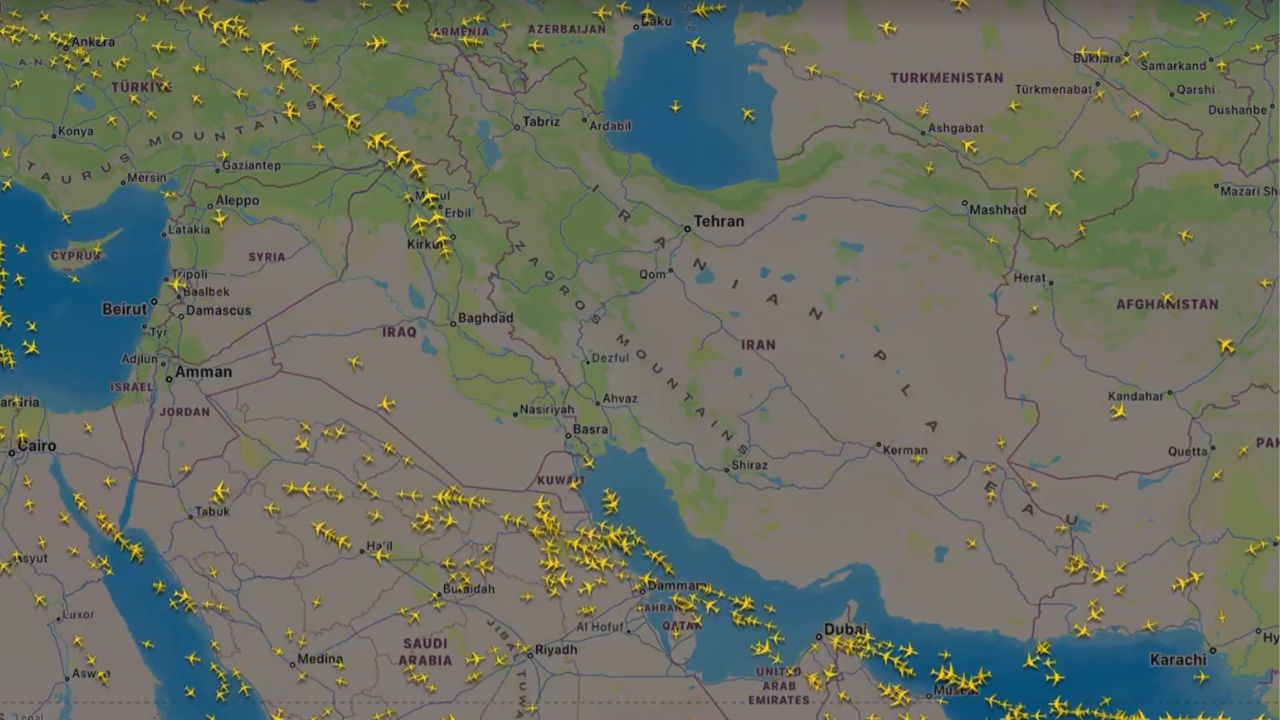
The mainstream media loves a "chaos" narrative. Every time a missile flies or a diplomatic spat shutters a corridor in the Middle East, the headlines scream about "halted flights" and "stranded passengers." They treat airspace closures like a sudden, unforeseen heart attack for the global economy.
They are wrong. Meanwhile, you can find related events here: Your Frequent Flyer Miles Are Liability Not Loyalty.
The standard industry take—that closures are an unmitigated disaster for the bottom line—is a lazy consensus built on 1990s logistics. In reality, these "disruptions" are the only thing forcing an archaic industry to innovate. Airspace closures don't break the system; they expose how broken the system already was and force a high-speed evolution that saves more money in the long run than it costs in fuel today.
The Myth of the Shortest Path
The primary complaint from analysts is the "Great Circle" deviation. When Jordan, Lebanon, or Iraq closes its sky, flights from London to Dubai have to skirt around, adding 45 minutes of flight time and burning thousands of additional kilograms of Jet A-1 fuel. To see the full picture, check out the detailed article by Condé Nast Traveler.
Here is the truth: The "optimal" routes airlines cry about losing were never actually optimal.
Aviation routing has traditionally been a mess of bureaucratic legacy agreements and fixed "highways in the sky." For decades, pilots followed rigid waypoints because that’s how the charts were drawn in the era of ground-based radar. Closing these corridors forces dispatchers to use Dynamic Airborne Reroute Procedures (DARP).
When the "easy" way is blocked, airlines finally start using the sophisticated weather-pattern modeling they’ve ignored for years. I have watched operations teams save more fuel by riding a high-altitude tailwind on a "longer" detour than they ever saved by flying the straight line through a war zone. We are seeing a forced migration toward 4D Trajectory-Based Operations. If the sky stayed open and "safe," the industry would stay stagnant, flying 1970s paths forever.
The Revenue Management Secret
Airlines don't hate closures as much as they tell their shareholders they do.
From a revenue management perspective, a localized crisis is a godsend for yield. Look at the data from any major Middle Eastern closure over the last five years. While capacity drops temporarily, Yield per Passenger-Kilometer (YPK) skyrockets.
- Supply Contraction: When three carriers cancel flights, the remaining "safe" routes become premium real estate.
- Insurance Surcharges: Carriers use the "instability" to bake in surcharges that often outlast the actual conflict.
- The "Scarcity" Rebound: Demand for travel doesn't disappear; it pent up. The moment a closure lifts, booking velocity hits a vertical line.
The industry uses these events to reset their pricing floors. It is a macro-economic "turn it off and back on again" that clears out low-margin buckets and retrains the consumer to accept higher base fares as the "cost of safety."
The Hub-and-Spoke Fallacy
The competitors' articles will tell you that hubs like Doha, Dubai, and Istanbul are the victims here. They claim the "Superconnector" model is fragile.
In reality, these closures prove why the Superconnector is the only resilient model left. A point-to-point carrier is dead if its destination is in a conflict zone. A hub carrier just swaps the puzzle pieces. If a flight from Singapore can't get to London via the usual route, the hub carrier reroutes the passenger through a secondary gateway or shifts the aircraft to a North American route where demand is peaking.
The "vulnerability" of Middle Eastern airspace is actually a stress test that these airlines pass every single year. While US domestic carriers collapse because of a light dusting of snow in Chicago, the Gulf carriers have built the world’s most sophisticated contingency engines. They operate in a state of permanent "tactical flexibility."
Stop Asking "When Will It Reopen?"
The "People Also Ask" section of Google is filled with one question: When will flights return to normal?
This is the wrong question. "Normal" was an illusion of geopolitical stability that never existed. The right question is: Why aren't you pricing for permanent volatility?
If you are a corporate travel manager or a logistics lead complaining about "unexpected" closures in one of the most historically volatile regions on Earth, you aren't a victim; you're incompetent.
The Industry Insider's Playbook for Volatility
If you want to survive the next decade of aviation, stop praying for open skies and start betting on the detours.
- Avoid the "Straight Line" Trap: If your logistics depend on a single corridor (like the Afghan or Iraqi corridors), you have zero redundancy. Start diversifying your wet-lease options now.
- Leverage the "Extended Range" Surplus: The shift toward ultra-long-haul aircraft like the A350-1000 and the 777X isn't just about comfort. It’s about "Closure Immunity." These planes have the legs to fly around entire continents without a fuel stop. If you aren't transitioning your fleet to high-margin, long-range frames, you are letting the map dictate your profit.
- The Insurance Hedge: Stop treating war-risk insurance as a sunk cost. High-tier carriers use their safety records to negotiate fixed-rate premiums that don't spike during closures, giving them a massive price advantage over smaller players who get slaughtered by spot-market insurance rates the moment a missile is sighted.
The Safety Theater of Avoidance
Let’s talk about the uncomfortable truth regarding flight safety. There is a massive gap between "closed airspace" and "dangerous airspace."
Often, a country closes its airspace not because a civilian airliner is at risk, but as a political statement of sovereignty or to hide military movements. Conversely, some of the most "dangerous" paths remain open because the transit fees are too lucrative for the local government to give up.
I’ve sat in rooms where executives weighed the risk of a $200 million airframe against the $50,000 saved in fuel by taking a "shady" shortcut. When the authorities finally step in and close the airspace, they are doing the airlines a favor by removing the temptation to gamble with lives. The closure is the guardrail that saves the industry from its own greed.
The Carbon Accounting Lie
Environmental groups claim rerouting is a climate disaster. It’s a convenient talking point, but it ignores the Contrail Impact.
Atmospheric science is starting to show that the location of a flight matters more for global warming than the raw fuel burn. Forcing planes out of traditional "wet" corridors and into different altitudes or latitudes to avoid closed airspace can actually reduce the formation of persistent warming contrails.
We are accidentally conducting the largest atmospheric experiment in history every time a conflict forces a reroute. We might find that the "efficient" routes were actually the most environmentally damaging ones all along.
Stop Mourning the Map
The map of the world is not a static document. It is a living, breathing negotiation.
Airspace closures are not a "halt" to progress. They are the friction that generates heat, and heat is what burns away the inefficiencies of 20th-century aviation. Every time a pilot has to bank left because a border is closed, the industry gets a little smarter, the software gets a little faster, and the weak players get a little closer to bankruptcy.
The "Golden Age" of flying through peaceful, open skies was a historical anomaly. We are returning to a period of tactical navigation, where the best airlines win not by flying the shortest distance, but by managing the most complex detours.
If you can't handle the detour, get off the runway.
Aviation was never meant to be easy. It was meant to be fast. And as it turns out, the long way around is the only way forward.