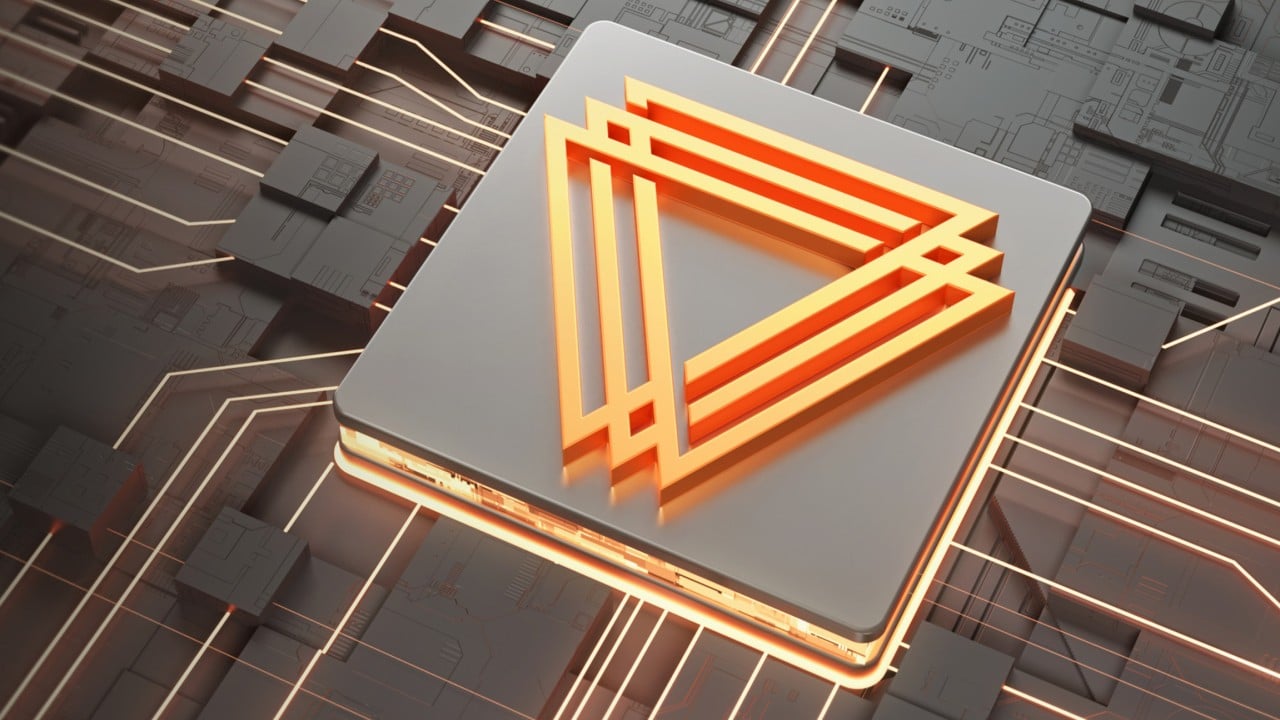
The air inside the server room carries a distinct, dry warmth, smelling faintly of ozone and expensive cooling fluid. For years, the engineers walking these narrow aisles in Shenzhen and Beijing shared a common, almost religious reverence for a single piece of hardware. It was a heavy, metallic brick adorned with a familiar green logo. To hold a top-tier American AI chip was to hold the future itself.
Then came the silence of the supply lines.
When export restrictions first clamped down, the reaction among local tech firms wasn't triumphant defiance; it was quiet panic. Engineers knew the harsh reality. Building a massive artificial intelligence model is not just about raw code; it is an unforgiving physical equation. If your processors cannot talk to each other at blinding speeds, your software simply chokes on its own data. For a long time, trying to train a world-class AI on anything other than Western hardware was considered an algorithmic suicide mission.
But geopolitical friction has a strange way of bending economic necessity.
Consider a mid-level infrastructure architect we will call Chen. Six years ago, Chen’s job was straightforward: order high-bandwidth silicon from Silicon Valley, plug it into local racks, and watch the system fly. When those orders were abruptly blocked, his team tried using early domestic alternatives. The experience was brutal. The local software platforms were riddled with bugs. Systems overheated. Servers crashed in the middle of expensive, multi-week training runs. Chen’s team openly detested the early local hardware, viewing it as a clunky, mandated downgrade.
Yet, Washington’s blockade did something unexpected. By removing the option to buy the world's gold-standard silicon, it forced Chinese enterprises into an arranged marriage with domestic chipmakers.
What followed was a forced evolutionary leap. Driven by this captive market, companies like Huawei and Cambricon began pouring billions into refining their hardware. Fast forward to 2026, and the financial tables have turned with astonishing velocity. Huawei’s AI chip revenue is projected to surge by at least 60% this year, bound for an estimated $12 billion on the back of massive domestic orders. The company's latest processor, the Ascend 950PR, entered mass production in March and has become the new backbone for local data centers.
The pivot is no longer just about survival; it is about scaling. When the software group DeepSeek unveiled its latest V4 models, running seamlessly on domestic hardware, it sent a shockwave through the local ecosystem. Suddenly, giants like Alibaba, Tencent, and ByteDance weren't just testing domestic alternatives out of political obligation. They were buying them because they actually worked.
To understand why this matters, one must look past the individual chips and look at the architecture of the clusters themselves. A single processor is just a solitary worker. The real magic lies in how you link thousands of them together. Because local manufacturers couldn't match the ultra-fine nanometer transistors produced in Taiwan or the US, they pivoted toward system-level engineering. They built massive, all-optical networking arrays that allowed hundreds of slightly less powerful chips to cooperate with unprecedented efficiency. It is a heavier, more energy-intensive solution, but it achieves the one thing that matters: raw, undeniable compute scaling.
The irony is thick enough to cut with a silicon wafer. By attempting to starve a competitor of the tools required for the future, the global market inadvertently funded the creation of a completely independent, parallel tech ecosystem.
Even the recent, highly controlled easing of restrictions—allowing a trickle of American H200 chips to enter the market under heavy tariffs and strict case-by-case reviews—feels like an attempt to close a stable door long after the horse has bolted. The local cloud providers have already rewritten their software stacks. They have debugged the compilers. They have built the foundries.
Back in the server room, Chen no longer looks at the domestic chips as an unwelcome compromise. They are simply the tools that keep the lights on, humming steadily in the rack, processing billions of parameters a second, entirely indifferent to the borders drawn on a map.