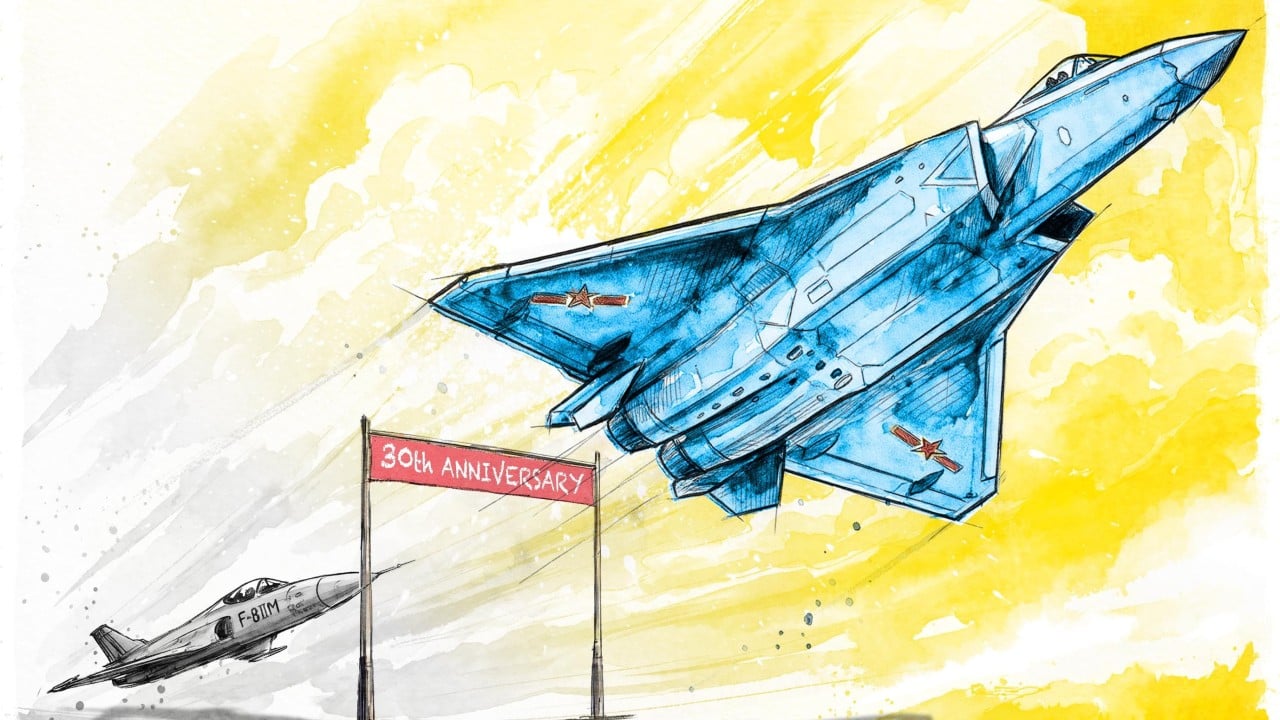
Walk onto the tarmac in Guangdong Province every two years and you'll see an uncomfortable truth for Western defense contractors. The Zhuhai air show—officially the China International Aviation & Aerospace Exhibition—started in 1996 as a slightly awkward trade fair where Beijing mostly begged foreign buyers to look at aging Soviet knockoffs. Today, it's the clearest public scoreboard of how fast China's aerospace industry went from copying homework to writing the test.
Most casual observers miss the real story here. They look at the shiny new stealth jets doing tight turns over the South China Sea and treat it like a standard air show spectacle. That's a mistake. If you actually track the hardware rolled out at Zhuhai over the past three decades, you aren't just looking at airplanes. You're watching a deliberate, multi-decade industrial blueprint play out in real time.
Why the Zhuhai Air Show Matters More Than Farnborough or Paris
Western aviation geeks still obsess over Farnborough in the UK and Le Bourget in Paris. Those shows are great if you want to see Boeing and Airbus trade billion-dollar commercial press releases. They're terrible if you want to understand where military aviation is actually heading in the Indo-Pacific.
Beijing doesn't have an open defense budget or freewheeling congressional hearings where generals complain about cost overruns. Because the People's Liberation Army (PLA) operates behind thick walls of secrecy, the Zhuhai air show serves as the state's primary signaling mechanism. When the Aviation Industry Corporation of China (AVIC) puts a new drone, engine, or fighter on the static display line, it isn't just trying to sell hardware to Pakistan or Saudi Arabia. It's telling Washington, Tokyo, and Taipei what capabilities have officially moved from the lab to active service.
I've followed defense procurement cycles for years, and the shift in tone at Zhuhai is unmistakable. In the late 1990s and early 2000s, Chinese booths were filled with scale models and hopeful brochures. Russian exhibitors like Sukhoi and Mikoyan drew the biggest crowds because their jets were the ones that actually worked. By the mid-2010s, the Russians were still there, except now they were looking nervously at Chinese booths displaying aircraft that looked suspiciously like upgraded versions of their own designs.
The Humble Beginnings of 1996
To appreciate how absurd the recent displays are, you have to remember what 1996 looked like. The inaugural Zhuhai air show happened right after the Third Taiwan Strait Crisis, a moment when the PLA realized just how badly outgunned it was by American carrier strike groups.
At that first show, China's premier domestic fighter on display was the J-8IIM—an upgraded version of a 1960s twin-engine interceptor that wouldn't have lasted ten minutes against an F-15. The engines were underpowered. The avionics were clunky. Honestly, the biggest crowd-pleasers at early Zhuhai shows weren't Chinese at all; they were the Russian Knights aerobatic team flying Su-27 Flankers, showing off maneuvers Chinese pilots could barely dream of executing in domestic airframes.
Back then, Beijing's strategy was survival and absorption. Chinese engineers bought Russian airframes, studied every rivet, and tried to figure out why their own metallurgy couldn't handle high-heat turbine blades. Western analysts at the time routinely laughed off Chinese aviation timelines. The consensus in Washington was that China was at least twenty to thirty years behind and lacked the institutional creativity to catch up.
That consensus aged terribly.
Cracking the Jet Engine Bottleneck
For twenty years, every serious conversation about Chinese military aviation ended with the same punchline: "Yeah, but they can't build engines."
Airframes are relatively easy to shape. Radar-absorbing coatings can be formulated in a lab. High-bypass turbofans and afterburning military engines, however, require insane precision in single-crystal turbine blade casting and extreme thermal resistance. For decades, China's flagship fighters—including early batches of the J-10 and J-11—had to rely on Russian Saturn AL-31F engines. Even the early prototypes of the stealthy J-20 took to the skies powered by Russian imports, an embarrassing vulnerability that meant Moscow effectively held a veto over Beijing's air force expansion.
You could track the slow death of that vulnerability directly through Zhuhai's flight schedules.
- 2018: A J-10B equipped with a thrust-vectoring WS-10B engine performed a Cobra maneuver over the Zhuhai runway. That was the first public proof that domestic engines weren't just working—they were durable enough for extreme aerodynamic stress.
- 2021: The J-20 flew at Zhuhai powered by domestic WS-10C engines, officially cutting the umbilical cord to Russian fighter propulsion.
- 2022 and 2024: Focus shifted toward the WS-15, the high-thrust engine specifically designed to let the J-20 supercruise without afterburners, alongside the WS-20 high-bypass engine finally giving the massive Y-20 transport plane its intended range.
Anyone still claiming China can't build reliable jet engines hasn't been paying attention since 2018. They solved the metallurgy problem through brute-force state investment, aggressive industrial espionage, and relentless iteration.
The Stealth Era and the J-35A Reveal
The 2016 Zhuhai show changed the global conversation permanently. Two J-20 Mighty Dragons screamed over the airfield for barely sixty seconds, did a steep climb, and vanished into the clouds. They didn't land for public inspection. They didn't need to. Until that exact minute, the United States was the only nation on earth fielding operational fifth-generation stealth fighters.
Fast forward to the 15th Zhuhai air show in November 2024, and China wasn't just showing off one stealth fighter anymore—it became the second country in history to field two distinct fifth-generation designs simultaneously.
The public debut of the J-35A, built by the Shenyang Aircraft Corporation, was the headline grabber for good reason. While the heavy, twin-engine J-20 is built for long-range air superiority and hunting tankers or AWACS planes across the vast Pacific, the J-35A is a sleeker, medium-weight multirole fighter clearly optimized for both land-based operations and future aircraft carrier decks. Looking at the J-35A's diverterless supersonic inlets and internal weapons bays, the visual echoes of the American F-35 are impossible to ignore.
Yet dismissing the J-35A as a mere copy misses the operational reality. China doesn't need the J-35A to be individually superior to an F-35 in a vacuum. It needs the J-35A to be producible at scale, compatible with the electromagnetic catapults on the new Type 003 Fujian aircraft carrier, and attractive enough to export to countries that Washington refuses to sell F-35s to.
Drones, Loyal Wingmen, and the Unmanned Swarm
If you only watch the fighter jets at Zhuhai, you miss where AVIC and the China Aerospace Science and Technology Corporation (CASC) are actually placing their biggest bets. Over the last four shows, unmanned systems have quietly eaten up more and more floor space until they practically dominate the indoor exhibition halls.
China looked at American drone dominance in the 2000s and decided to out-manufacture the US at every tier of unmanned warfare. At Zhuhai, you see the entire ecosystem laid out side by side:
- Export workhorses: The Wing Loong and Caihong (Rainbow) series drones, which have already seen extensive combat across the Middle East and Africa because Beijing sells them without the strict end-user human rights restrictions Washington attaches to MQ-9 Reapers.
- High-altitude stealth reconnaissance: The WZ-7 Soaring Dragon and the WZ-8—a rocket-powered, near-space reconnaissance drone designed to be air-launched from an H-6N bomber and scream over carrier strike groups at Mach 3+ where surface-to-air missiles can't easily touch it.
- Loyal wingmen: Platforms like the FH-97A, an unmanned stealth combat drone designed to fly alongside twin-seat J-20S fighters, acting as forward sensor nodes and carrying extra missiles into heavily contested airspace.
By 2024, the unmanned displays had expanded beyond the skies to include heavily armed robotic ground vehicles ("robot wolves") and autonomous unmanned surface vessels like the Orca combat trimaran. The message is blunt. Beijing isn't trying to match the US military plane-for-plane; it's building an integrated kill web designed to overwhelm regional defenses through sheer mass and sensor saturation.
Commercial Aviation and the C919 Gamble
Military hardware gets the loudest applause, but the commercial side of Zhuhai reveals an equally ambitious play. For decades, global commercial aviation has been a comfortable duopoly split between Boeing in Seattle and Airbus in Toulouse. China—the world's fastest-growing aviation market—hated paying tens of billions of dollars every year to Western manufacturers.
Enter COMAC (Commercial Aircraft Corporation of China) and the C919 narrow-body airliner.
After years of delays and skeptical Western commentary, the C919 finally entered commercial service with China Eastern Airlines in 2023 and took center stage at Zhuhai as a proven passenger jet rather than an experimental prototype. At the 2024 show, COMAC rebranded its smaller regional jet (formerly the ARJ21) as the C909 and inked fresh domestic orders pushing the C919 order book well past 1,000 aircraft.
Is the C919 truly an all-Chinese airplane? Not yet. Look under the hood and you'll find LEAP-1C engines made by CFM International (a US-French joint venture), avionics from Honeywell, and landing gear from Liebherr. If Washington ever decided to impose crippling export controls on COMAC, the C919 production line would grind to a halt overnight.
Beijing knows this. That's exactly why the CJ-1000A—China's domestic commercial turbofan meant to replace the Western LEAP engines—is one of the highest-priority engineering projects in the country. Even without Western certification from the FAA or EASA, COMAC doesn't need to sell a single plane to Delta or Lufthansa to succeed. China's domestic airlines alone will buy thousands of narrow-body jets over the next twenty years, giving COMAC a captive market large enough to fund its next generation of wide-body jets like the C929.
What Most Analysts Still Get Wrong About Zhuhai
Watching the Western media coverage every time Zhuhai rolls around is kinda fascinating because the commentary usually swings between two useless extremes. Either commentators dismiss everything on display as cheap plastic mockups and propaganda, or they panic and claim the US Air Force is suddenly obsolete.
Both takes are lazy.
First, yes, Zhuhai features plenty of vaporware. Every show includes wild concept models—space planes, sixth-generation tailless fighter mockups, bizarre hypersonic gliders—that may never leave a wind tunnel. Treating every fiberglass model in Hall 1 as an operational weapon system is bad analysis.
Second, hardware on a tarmac doesn't automatically equal combat proficiency. The PLA Air Force hasn't fought a major air war since the Korean War in the 1950s. You can build a phenomenal stealth fighter, put an AESA radar in the nose, and load it with long-range PL-15 air-to-air missiles, yet still struggle with the messy realities of complex joint-force command, pilot initiative, and logistics under fire. The US military still holds a massive advantage in institutional combat experience and global basing.
Yet underestimating the trajectory shown at Zhuhai is far more dangerous than overestimating it. The sheer speed of iteration between shows—going from struggling with basic 1960s copies in 1996 to fielding dual stealth fighters, domestic high-bypass engines, and carrier-capable electromagnetic launch systems in less than thirty years—has no modern industrial parallel.
How to Read Future Zhuhai Air Shows Like an Insider
If you want to cut through the hype the next time footage from Guangdong floods your feed, stop looking at the aerobatic stunts and watch three specific indicators instead:
- Watch the tail numbers and unit markings. When an aircraft appears in primer yellow or carries prototype numbers (like 2001 or 3501), it's still in testing. When it shows up wearing low-visibility grey paint with operational brigade serials, it's in mass production and sitting on active alert bases.
- Look at the munitions pylons, not just the airframes. A fighter jet is basically just a flying truck for sensors and missiles. Pay close attention to compact internal weapons like the PL-15E or folding-fin missiles designed to squeeze six shots into an internal stealth bay instead of four.
- Track the engine nozzles. Serrated edges, distinct petal designs, and subtle shifts in exhaust coloration tell you immediately whether an aircraft has transitioned from a foreign import to a mass-produced domestic powerplant.
The Zhuhai air show stopped being a curiosity a decade ago. Today, it's the single best window into how industrial scale, state-directed capital, and relentless reverse-engineering reshaped global air power in a single generation.


