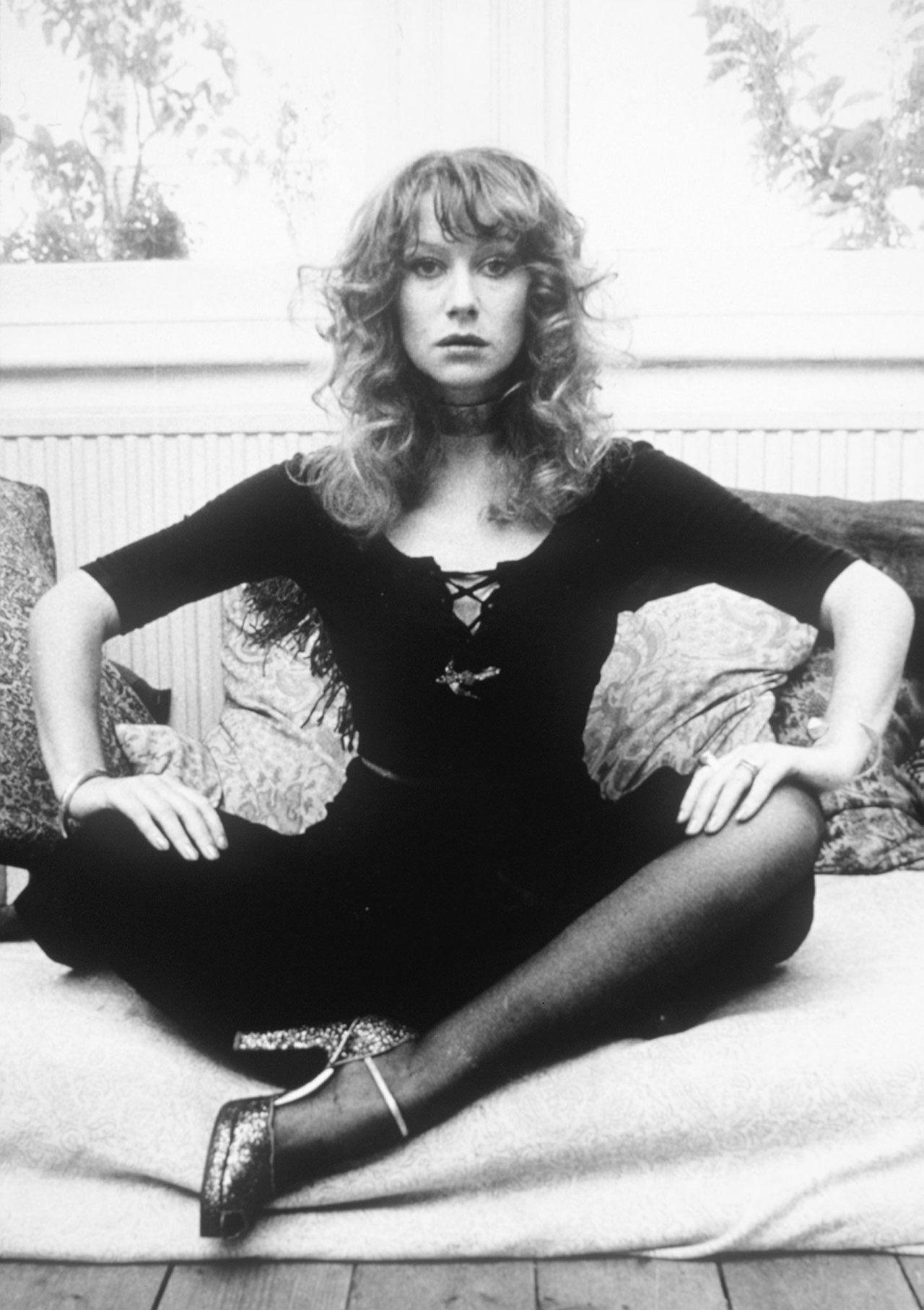
If you’ve spent any time on Pinterest or Reddit lately, you've probably seen them. Those grainy, high-contrast, black-and-white young pictures of Helen Mirren from the mid-sixties. She’s usually rocking a massive Cleopatra headpiece or lounging on a beach in Australia with a look that says she’s already bored of your questions.
It’s a vibe. Honestly, it’s more than a vibe; it’s a masterclass in how to be a "bombshell" without actually caring if people think you’re one.
Most people know Dame Helen Mirren as the definitive Queen Elizabeth II. They know her as the fierce, silver-haired icon of the 21st century who looks better at 80 than most of us do after a full night’s sleep. But there is this whole other era—the "Mironoff" years—where she was basically the cool girl every indie director was obsessed with.
The Cleopatra Moment That Started Everything
Before she was a Dame, she was an 18-year-old from Southend-on-Sea with a Russian-born father and a serious amount of ambition. In 1965, she landed the role of Cleopatra for the National Youth Theatre.
Look at the photos from those rehearsals at the Old Vic. She’s barely out of her teens, but she has this presence that feels heavy. Not heavy as in sad, but heavy as in significant. There’s one specific shot where she’s leaning back, eyes lined with thick kohl, looking every bit the Egyptian queen. It wasn’t just a school play; it was the moment the industry realized she was a force.
That production is what got her into the Royal Shakespeare Company (RSC). Think about that for a second. Most actors spend years in drama school trying to get an RSC audition. She just walked in because she played a queen so well at 18 that the gatekeepers couldn't say no.
Breaking the Shakespearean Mold
By 1967, she was at Stratford-upon-Avon. If you find young pictures of Helen Mirren from this period, you’ll see her as Castiza in The Revenger's Tragedy or Cressida in Troilus and Cressida.
She wasn't a "dainty" actress.
She had this raw, earthy energy that was kinda scandalous for the stuffy theater world of the sixties. People didn't know where to put her. Was she a serious classical actress? Was she a sex symbol? She was both, and she refused to apologize for it.
Age of Consent and the Great Barrier Reef
If there is one set of photos that defines the "Young Helen" aesthetic, it’s the stills from the 1969 film Age of Consent.
She was 22.
The movie was directed by Michael Powell and filmed on location in the Great Barrier Reef. She played Cora, a wild, free-spirited girl who becomes the muse for an aging painter (played by James Mason).
"I was very much a creature of the sixties. I didn't want to be a 'star.' I wanted to be an artist." — Helen Mirren (paraphrased from various memoirs).
The film is famous (or infamous) for its nudity, which was pretty shocking for the time. But if you look at the pictures of her as Cora, she doesn't look exploited. She looks like she owns the island. She’s wearing wet, purple-pink dresses, her hair is a tangled mess of blonde, and she has this "don't mess with me" stare.
It’s worth noting that the film was actually censored in many countries. They cut out about six minutes of footage because distributors were "aghast" at the sensuality. Looking at those photos today, it feels less like a "sex romp" and more like a document of someone who was totally comfortable in her own skin before the world told her she shouldn't be.
The Long Good Friday and the 70s Shift
As the 1970s rolled in, the photos changed. The "flower child" softness of the late 60s hardened into something sharper.
Style Evolution
- 1965-1968: Heavy eyeliner, bohemian dresses, theatrical costumes.
- 1969-1974: The "Natural" phase. Lots of beach photos, minimal makeup, very RSC-focused.
- Late 70s: Power suits, shorter hair, and the transition into "Victoria" from The Long Good Friday.
In 1980, she starred in The Long Good Friday opposite Bob Hoskins. If you haven't seen it, go watch it tonight. It’s one of the best British gangster films ever made.
There’s a specific photo of her in that movie—leaning against a car, cigarette in hand, wearing a sophisticated 80s blazer. She isn't the "muse" anymore. She’s the brains of the operation. That shift in her young pictures shows the trajectory of her career: from the girl being looked at to the woman who controls the room.
Why We Are Still Obsessed With These Photos
There is a reason why "Young Helen Mirren" is a recurring search term. It’s not just about her being beautiful. A lot of actresses were beautiful in 1968.
It’s the authenticity.
In an era where every starlet was being molded by a studio into a specific "type," Mirren was doing her own thing. She lived with Liam Neeson in the early 80s (they met on the set of Excalibur). She traveled across Africa with a theater troupe led by Peter Brook, performing in front of audiences who had never seen a play before.
She wasn't chasing the Hollywood "It Girl" status. She was chasing the work.
The Russian Connection
Her birth name was Helen Lydia Mironoff. Her grandfather was a Russian aristocrat and diplomat who got stranded in London after the Russian Revolution. That heritage comes through in her early photos. There’s a certain "steely" quality to her eyes, even when she’s smiling.
It’s that combination of British grit and Russian soul.
What Most People Get Wrong
People often look at young pictures of Helen Mirren and think she was an "overnight success."
Not true.
She worked tirelessly in repertory theater for decades. For every glamorous photo of her on a red carpet in 1970, there are a hundred photos of her in a cold rehearsal hall in Manchester. She did the "un-glamorous" work for a long time before she became a household name with Prime Suspect in the 90s.
Realizing the Power of the Image
Mirren has often spoken about how she felt about being labeled a "sex symbol" in her youth. She hated it. She felt it diminished her talent. But when you look at those photos now, you don't just see a "sex symbol." You see an intellectual who happens to be stunning.
You see someone who was playing the long game.
Takeaways from the Mirren Archives
If you’re looking at these photos for style inspiration or just a bit of nostalgia, here are a few things to keep in mind:
- Confidence is the main accessory. In almost every shot, she’s looking directly at the lens. No "damsel in distress" poses.
- Embrace the "natural" look. Some of her most iconic 1970s photos feature messy hair and zero foundation. It’s timeless.
- Don't be afraid of the transition. Mirren didn't try to stay 22 forever. She allowed her style and her roles to evolve as she aged, which is why she’s still relevant today.
If you want to dive deeper into this era, I highly recommend tracking down a copy of her autobiography, In the Frame. It’s filled with her own personal photos and her actual thoughts on what was happening behind the scenes during those legendary 1960s shoots.
You can also look for the original 1969 cut of Age of Consent on Criterion or similar platforms. Seeing her in motion gives those still photos so much more context. It wasn't just about the look; it was about the movement and the voice.
Ultimately, those young pictures of Helen Mirren serve as a reminder that "cool" isn't something you can manufacture. You either have that fire, or you don't. And she definitely had it.