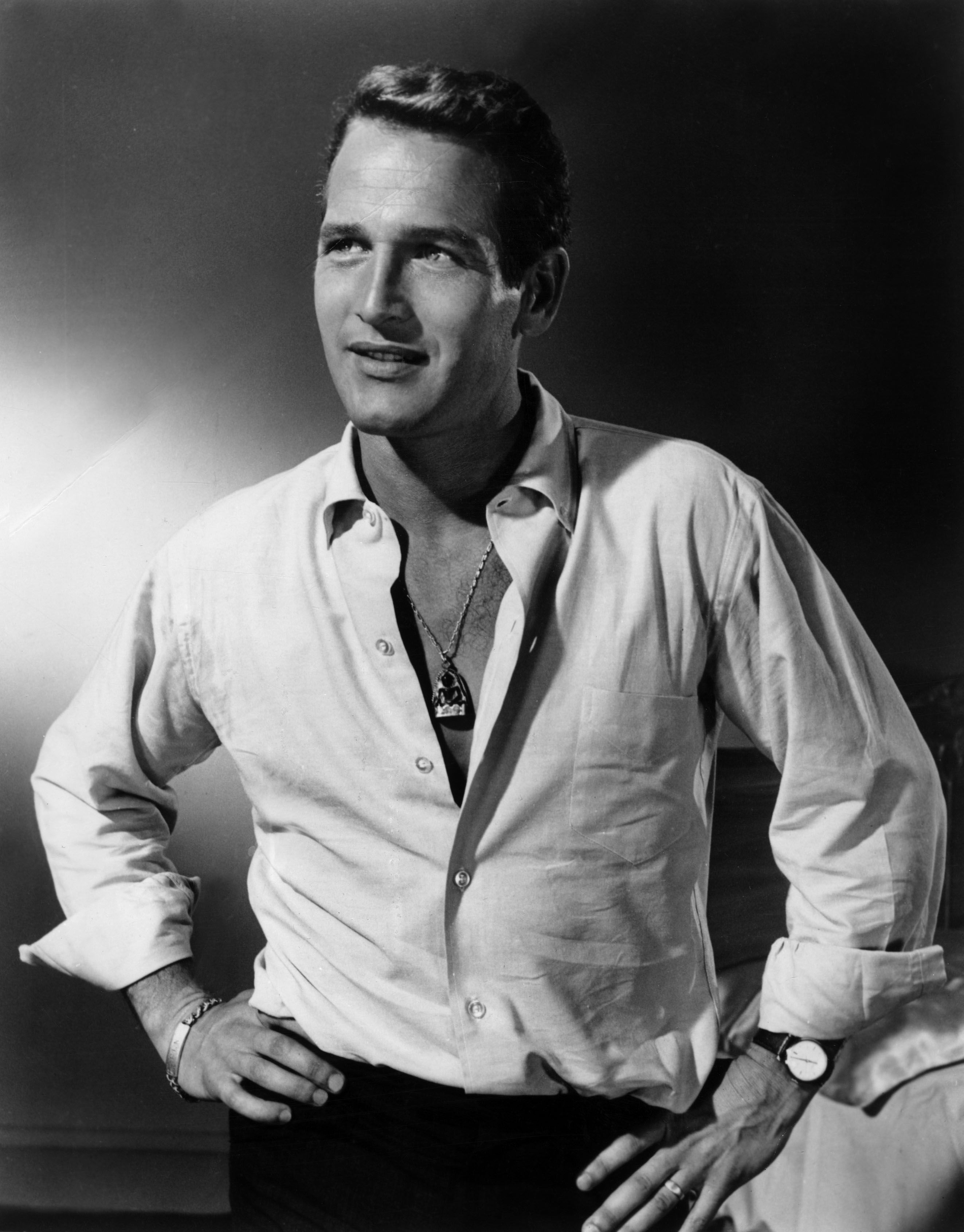
That face. It’s the first thing anyone notices. Before the salad dressing, before the Philanthropy, and even before the Oscar wins, there were the eyes. Specifically, those piercing blue eyes that seemed to jump right off the celluloid. If you spend even five minutes looking at young Paul Newman pictures, you start to realize why Hollywood basically trip-over-its-feet trying to turn him into the next big thing. Honestly, he wasn't just a "pretty boy," though he spent a good portion of his early career worried that's all he was.
Newman arrived in Hollywood at a weird time. The old-school, rigid leading men were on their way out. The "Method" was in. Marlon Brando and James Dean were the kings of the broody, sensitive anti-hero. Paul? He was right there in the mix, often competing for the exact same roles that Dean eventually landed.
The Screen Test That Almost Changed Everything
Did you know there’s a legendary screen test from 1954? It’s basically the "Holy Grail" for fans of classic cinema. It features a very young, slightly nervous Newman alongside James Dean. They were both testing for East of Eden. If you find the stills from this session, the chemistry is wild. Dean is slouching and playful; Newman is more composed but clearly fascinated.
Dean got the part. Newman didn't.
But losing out to Dean actually paved the way for Newman's breakthrough. After Dean's tragic death in 1955, Newman was the natural choice to step into the roles Dean had left behind. It’s a bit morbid, sure, but that’s how he ended up as Rocky Graziano in Somebody Up There Likes Me (1956). Those pictures of him in boxing gloves? Pure gold. They showed a grit that his "Greek God" features usually hid.
Why Young Paul Newman Pictures Are More Than Just Eye Candy
It’s easy to get distracted by the aesthetics. I get it. But if you look closely at the photography from his early years at the Actors Studio, you see a guy who was kind of a nerd about his craft. He didn't think he was a natural. He actually told people he was "cerebral" rather than intuitive.
He'd spend hours dissecting scripts. He worried his legs were too skinny for the toga he had to wear in his first (and notoriously bad) movie, The Silver Chalice (1954). He hated that movie so much he eventually took out a newspaper ad apologizing for it. That tells you a lot about his character. He wasn't just there for the paycheck or the fame; he actually cared if the work was any good.
The Military Years: A Different Kind of Portrait
Before the tuxedos and the red carpets, Newman was a radioman and gunner in the Navy. You won't find many "glamour" shots from this era, but the photos of him in uniform are striking for a different reason. He served in the Pacific during WWII.
A crazy bit of history: He narrowly avoided a kamikaze attack on the USS Bunker Hill because his pilot had an ear infection, which grounded their plane while the rest of their unit flew out. Most of his unit didn't come back. When you look at his later roles—the cynical, slightly detached guys like Hud—you can't help but wonder if that brush with mortality in his twenties shaped that "cool" exterior.
The Iconic Photographers
A huge reason why we have such high-quality young Paul Newman pictures today is because of the guys behind the lens.
- Mark Kauffman: He shot Newman for LIFE magazine and captured those candid moments that feel so human.
- John R. Hamilton: Known for capturing the "Golden Age" of Hollywood, Hamilton’s shots of Newman on sets like The Left Handed Gun (1958) are masterpieces of lighting and mood.
- Milton Greene: Famous for his work with Marilyn Monroe, Greene also captured Newman’s transition from a Broadway actor to a full-blown movie star.
Breaking Down the "Cool"
What most people get wrong is thinking Newman was always "cool." He wasn't. Early on, he was actually described as being quite bashful and self-critical. He felt like a "decoration" to his mother, who was an artist and obsessed with his looks.
That tension—the guy who looks like a statue but feels like a struggling artist—is what makes those early photos so magnetic. You see the internal gears turning. Whether he’s leaning against a brick wall in New York or sitting on a water taxi in Venice in 1963, there’s a sense that he’s not entirely comfortable with the attention.
Practical Ways to Appreciate Newman’s Early Era
If you're looking to dive deeper into this specific period of his life, don't just scroll through Pinterest. There's better stuff out there.
- Watch the East of Eden Screen Test: It’s available on YouTube. It’s the best way to see his raw, unpolished energy before Hollywood "processed" him.
- Read His Posthumous Memoir: The Extraordinary Life of an Ordinary Man. He’s brutally honest in it about his insecurities and his early years. It’s a great companion piece to the photos.
- Look for the "Method" Portraits: Search specifically for photos of him at the Actors Studio from 1951 to 1953. These are much more authentic than the staged studio headshots.
- Track the "Boxing" Sessions: The promotional photos for Somebody Up There Likes Me are legendary. They mark the exact moment he stopped being "the guy who looks like Brando" and started being Paul Newman.
Newman eventually grew into his face, as they say. The lines and the gray hair only made him more distinguished. But there's something about those early years—the 1950s transition from Ohio kid to Navy vet to Broadway hopeful—that remains the definitive "cool" for a reason. He wasn't trying to be an icon yet. He was just a guy trying to prove he was more than a pair of blue eyes.
For your next steps, seek out the digital archives of LIFE Magazine or the Getty Images collection specifically filtered for the years 1953–1959. You’ll find high-resolution scans that show the texture of his performances way better than a standard social media post. Pay attention to the lighting in the black-and-white shots; it’s where the real storytelling happens.



