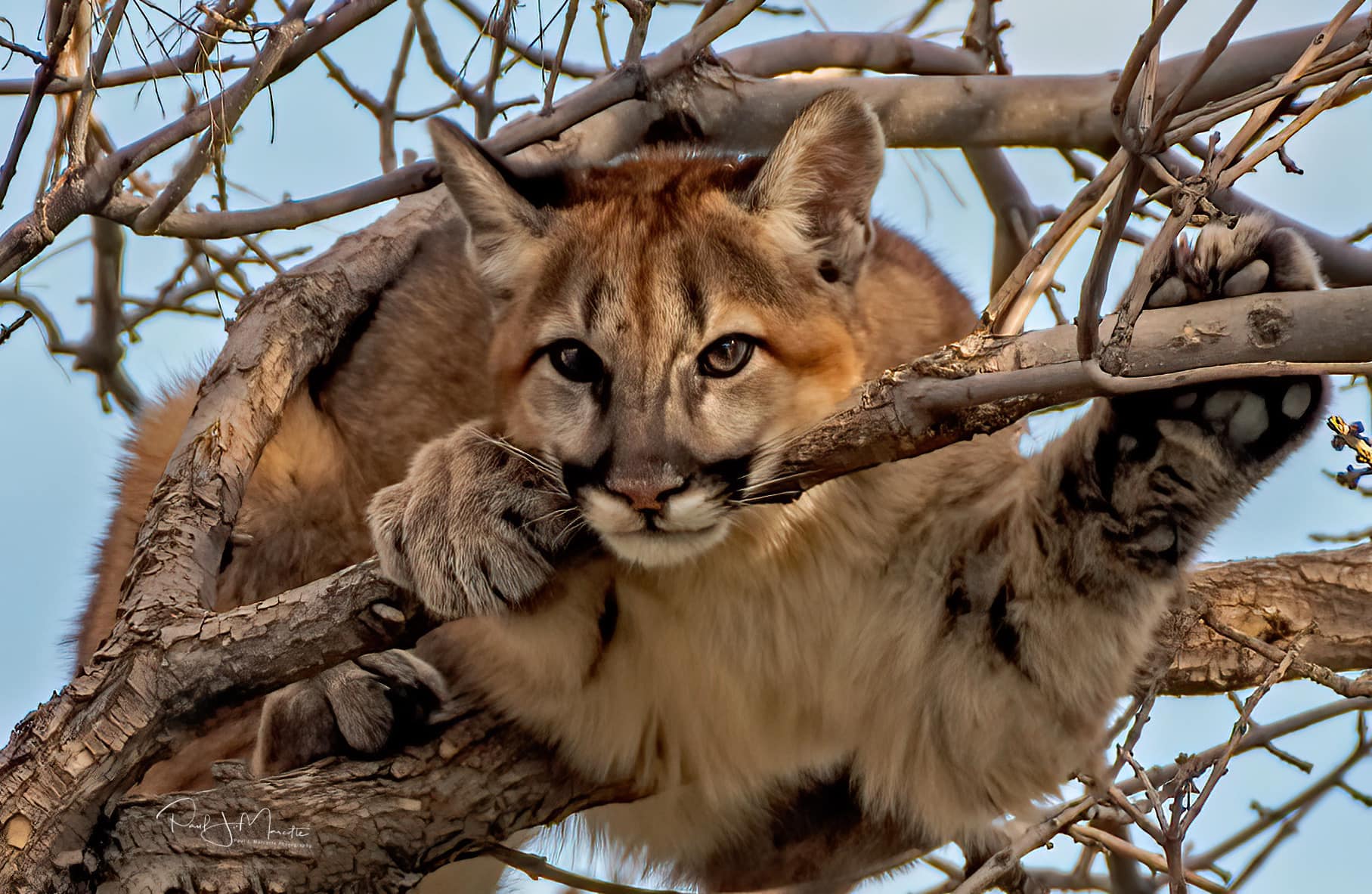
You’ve probably seen the viral clips of "house cat" sized predators screaming like humans in the woods. But when you actually go looking for young mountain lion photos, the reality is a lot weirder than a miniature version of a tan cougar.
Most people expect a small, sleek, tawny cat. Honestly, what you get looks more like a bizarre hybrid between a leopard and a bobcat that had a very rough morning. They are covered in these chaotic, dark spots. They have bright blue eyes that eventually turn a piercing yellow or hazel. They look... different.
If you're trying to identify one in the wild—or more likely, on your backyard trail cam—you need to know that these spots aren't just for show. They're a survival mechanism. Basically, a kitten that stays still in the dappled light of a forest floor becomes invisible. It's nature’s camouflage at its most aggressive. By the time they hit six months, those spots start to fade. By a year? They’re mostly gone, leaving just a few faint shadows on the legs.
Identifying the "Spotty" Phase in Young Mountain Lion Photos
If you find a photo of a mountain lion and it has a ringed tail, you might think you're looking at a different species entirely. You aren't. Young mountain lions, or Puma concolor, carry heavy black rings on their tails for the first few months of their lives.
It’s easy to confuse them with bobcats. Seriously. People do it all the time. But there is one massive giveaway you'll notice in any clear shot: the tail length. A bobcat has a "bobbed" or short tail, usually tipped with white. A young mountain lion has a thick, heavy tail that almost reaches the ground. Even when they’re tiny, that tail is a structural powerhouse.
Why the eyes change color
When they’re born, their eyes are a deep, almost mystical blue. It’s striking. Around the eight-week mark, you’ll see the transition start. In high-quality photography, you can often catch them in this "in-between" phase where the eyes look muddy or greenish. It’s a sign they are moving from the nursing stage to eating meat brought back by the mother.
The spots are the big thing, though. They aren't uniform. They are irregular, dark brown or black splotches that break up the outline of the body. Biologists like those at the Teton Cougar Project or the Santa Cruz Puma Project use these unique markings to track individuals before they are old enough for radio collars. No two kittens have the exact same spot pattern. It’s basically a fingerprint.
Where People Get It Wrong With Trail Cam Footage
Most "young mountain lion photos" circulating on community forums like Nextdoor are actually just large house cats. It sounds insulting, but it’s true. Perspective is everything. Without a log or a rock for scale, a 15-pound tabby can look like a 40-pound cougar cub.
Look at the ears.
Mountain lions have rounded ears with black backing. House cats often have more pointed ears. Also, look at the gait. A mountain lion kitten moves with a heavy-pawed, almost clumsy deliberate track. They have massive paws compared to their body size. They have to grow into them. It’s like a teenager wearing size 14 shoes while they’re still five feet tall.
"A mountain lion kitten’s paws are nearly the size of an adult’s by the time they are six months old," notes various field research from the California Department of Fish and Wildlife. This helps them navigate rugged terrain long before they have the muscle mass of an apex predator.
The Reality of Seeing Them in the Wild
If you’re lucky enough to snap your own young mountain lion photos, you’re likely in a dangerous spot. Not because the kitten will hurt you—they’re mostly just curious and awkward—but because the mother is absolutely nearby.
Female cougars are notoriously protective. They cache their kittens in "nurseries" which are usually thick brush, rocky crevices, or fallen timber. If you see a kitten wandering alone, it’s usually because Mom is off hunting. She can be gone for 12 to 24 hours at a time.
Do not "rescue" them.
Every year, well-meaning hikers find a "lone" kitten and think it’s orphaned. They take a photo, pick it up, and drive it to a vet. Most of the time, they’ve just kidnapped a healthy cub. If the kitten looks fat and healthy in your photo, leave it alone. Its mom is coming back with a deer.
Photography Tips for Wildlife Enthusiasts
Getting a clear shot of a young mountain lion is notoriously difficult. They are crepuscular. That means they are most active at dawn and dusk. The light is terrible. You’re dealing with high ISOs and motion blur.
- Focus on the eyes. If the eyes aren't sharp, the photo is a throwaway.
- Use a fast shutter speed. Even when they’re sitting, their tails are often twitching. You need at least 1/500th of a second to freeze that movement.
- Don't use flash. Aside from the ethical implications of blinding a nocturnal predator, it flattens the image and makes those beautiful spots look like mud.
The best photos usually come from remote cellular trail cameras. These allow you to monitor a "scrape" or a kill site without leaving your human scent all over the place. Brands like Browning or Reconyx are the gold standard here because they have fast trigger speeds. If your camera is slow, you’ll just get a photo of a tail disappearing into the brush.
Growth Milestones to Look For
- 0-3 Months: Heavy spots, blue eyes, very clumsy. Usually stay within 100 yards of the den.
- 4-8 Months: Spots begin to fade on the back but remain on the belly and legs. Eyes turn yellow. They start following Mom to kills.
- 12-18 Months: They look like small adults. This is the "transient" phase where they start looking for their own territory.
- 2 Years: Fully independent. The spots are gone, replaced by a sleek, uniform coat that ranges from silvery-grey to reddish-brown.
The Ethics of Sharing Location Data
When you post young mountain lion photos online, strip the EXIF data. Seriously.
Poaching is still a thing. Even in areas where it's illegal, "trophy" hunters or people who simply fear the animals might use your geotags to find the den. Most social media platforms strip this automatically now, but if you’re posting to a personal blog or a photography site, be careful.
Keep the location vague. "Pacific Northwest" is fine. "The north side of Bear Creek Trail, 2 miles in" is a death sentence for those cats.
The conservation of these animals depends on them remaining "ghosts." We want to see them, we want to document them, but we don't want to interfere with their development. A kitten that becomes too comfortable with humans is a kitten that eventually gets euthanized by a state agency for being a "nuisance animal."
Actionable Steps for Wildlife Observers
If you’ve captured images of a young mountain lion or want to find them responsibly, here is how you should proceed:
- Report sightings to local conservancies: Organizations like the Cougar Fund or local Fish and Wildlife offices use these photos to track population health. Your photo might be the only evidence of a new litter in a specific corridor.
- Check for ear tags: If your photo is clear enough to show a plastic tag in the ear, note the color and number. This is vital data for researchers studying urban encroachment.
- Invest in a long lens: Never attempt to get close for a "selfie" or a phone shot. A 400mm lens is the bare minimum for safe, ethical mountain lion photography.
- Look for tracks first: Before you set up a camera, learn to distinguish mountain lion tracks from large dogs. A lion track usually lacks claw marks (they’re retractable) and has a distinct M-shaped heel pad with three lobes at the bottom.
If you find yourself in the presence of a kitten while hiking, back away slowly. Do not run. Running triggers their chase instinct. Make yourself big, keep your eyes on the kitten (and the surrounding brush), and leave the area. Your life—and the kitten's future—is worth more than a viral photo.
The most successful young mountain lion photos are the ones taken from a distance, where the animal has no idea you are there. That’s when you see their true behavior: the play-fighting, the stalking practice, and the incredible bond they have with their mothers before they head out into the world alone.



