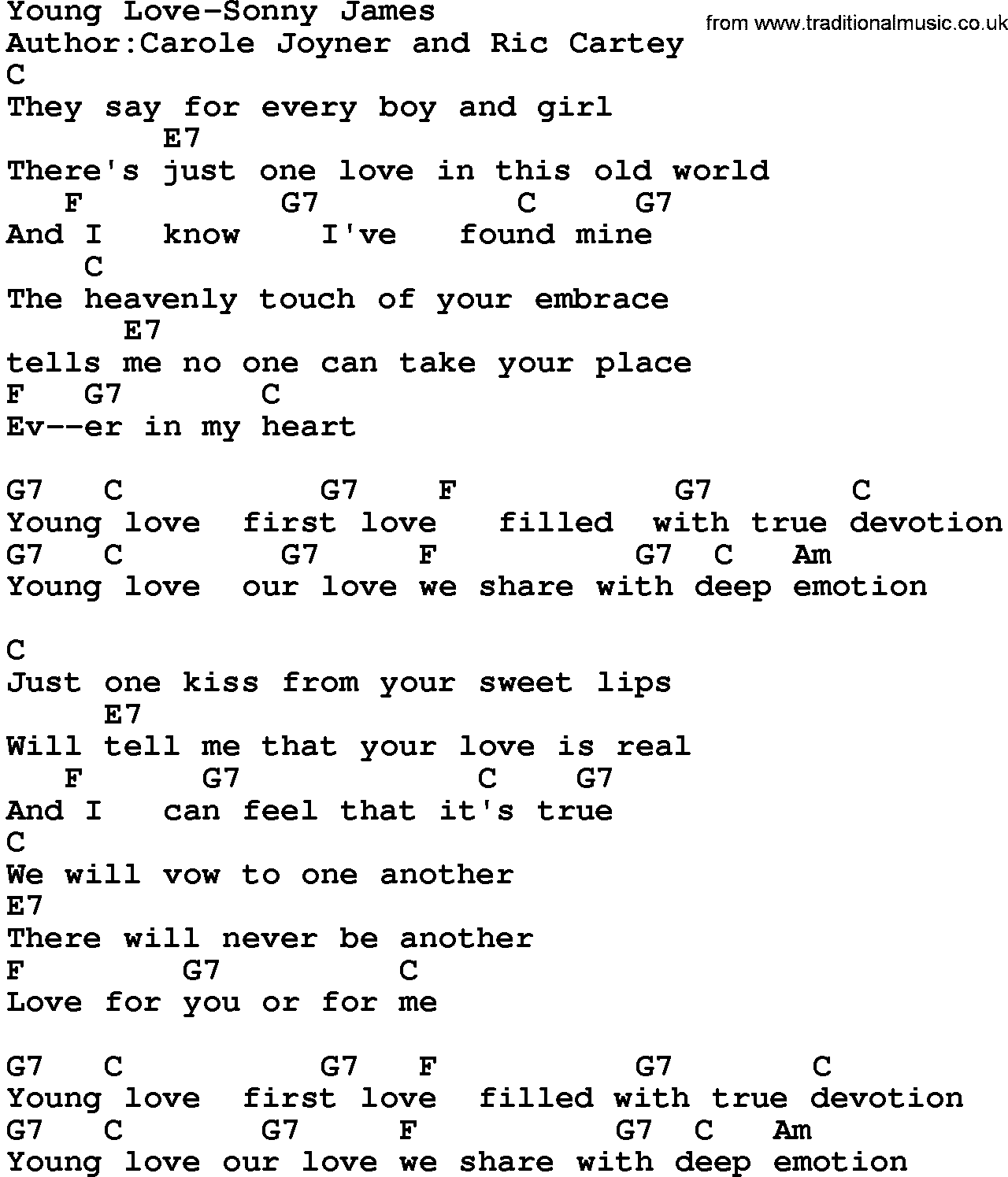
When you think about the late 1950s, your mind probably goes straight to Elvis swiveling his hips or Buddy Holly’s thick-rimmed glasses. But there was another guy, a soft-spoken Alabamian known as the "Southern Gentleman," who quietly staged a revolution on the airwaves. His name was Sonny James. In late 1956, he walked into Bradley Studio in Nashville and recorded a track called "Young Love."
He didn't just record a hit. He basically invented the modern crossover.
"Young Love" by Sonny James wasn't just a country song. It was a cultural bridge. It’s the kind of record that makes you feel like you're standing on a porch on a humid July evening, even if it's freezing outside. While the rock-and-roll kids were getting loud, Sonny kept it smooth, and the result was a nine-week residency at the top of the Billboard country charts.
The Song That Changed Everything for Sonny James
Most people don't realize that "Young Love" wasn't even Sonny’s own song to begin with. It was actually penned by Ric Cartey and Carole Joyner. Cartey was a rockabilly guy from Atlanta, and Carole was actually his high school girlfriend at the time. Can you imagine? A high schooler co-writing one of the most enduring ballads in American history.
Ric Cartey recorded it first with the Jiva-Tones. It went nowhere. Absolutely nowhere.
Then, Ken Nelson, a producer at Capitol Records, heard something in the melody. He handed it to Sonny James. On October 30, 1956, they cut the track. They didn't use a massive orchestra or fancy effects. It was just Sonny, a sparse arrangement, and backing vocals by Gordon Stoker and Harlan Powell.
The simplicity was the secret sauce.
By January 1957, the song was everywhere. It hit #1 on the Billboard Country & Western Best Seller chart. It hit #1 on the Disk Jockey chart. It even climbed to #2 on the pop charts, only kept from the top spot by... well, a different version of the same song by Tab Hunter.
Talk about a weird week for music.
Breaking Down the Nine-Week Streak
Nine weeks. That is a long time to stay at number one. To put that in perspective, "Young Love" remains the longest-reigning hit of Sonny James’s entire career, and the man had twenty-six #1 singles in total. That’s more than almost anyone in the history of the genre.
- Release Date: Late 1956 (Capitol 3602)
- Peak Position: #1 (Country), #2 (Pop)
- Weeks at #1: 9 weeks on the Country charts
- Total Sales: Over 3 million copies sold in its initial run
Honestly, the success of "Young Love" was a double-edged sword for Sonny. It made him a superstar, leading to him becoming the first country artist to ever appear on The Ed Sullivan Show in 1957. But it also pigeonholed him a bit. People wanted that "Young Love" sound—that gentle, crooning vibe—even as the rest of the world was turning up the distortion.
The Battle of the Versions: Sonny James vs. Tab Hunter
This is where the story gets kinda messy. Back in the fifties, "covering" a song wasn't just a tribute; it was a war. While Sonny’s version was climbing the charts, Dot Records saw the potential and rushed actor Tab Hunter into the studio.
Hunter was a Hollywood heartthrob. He couldn't really sing as well as Sonny, but he had the "look." His version actually beat Sonny's on the pop charts, reaching #1. It’s one of those historical footnotes that drives music purists crazy. Sonny had the vocal chops, but Hunter had the teen idol machinery behind him.
Even so, Sonny’s version is the one that lasted. If you turn on an oldies station or a classic country playlist today, you’re hearing the Capitol Records version. Why? Because Sonny’s delivery felt authentic. He lived that southern gentleman persona. He wasn't just an actor playing a singer; he was a musician who understood the "heart" in a heartbreak ballad.
Why "Young Love" Sounded Different
If you listen to the track today, notice the lack of a heavy drum beat. In 1956, country music was still figuring out how to deal with the "percussion" problem. Many Nashville traditionalists hated drums. Sonny and Ken Nelson solved this by using vocal harmonies to provide the rhythm.
It felt like a lullaby for teenagers.
The backing vocals weren't just "oohs" and "aahs." They were the heartbeat of the song. This "Nashville Sound" was just beginning to take shape, moving away from the twang of honky-tonks and toward something more polished and "pop-friendly." Sonny was the pioneer of that transition.
The Long-Term Impact on Country Music
You can't talk about the history of crossover artists without mentioning Sonny James. Before him, country was often seen as "hillbilly music"—something niche for people in the South or rural Midwest. "Young Love" proved that a country singer could have a sophisticated, universal appeal.
It paved the way for guys like Jim Reeves and eventually the "Countrypolitan" era.
Sonny later went on a legendary streak, starting in 1967, where he had 16 consecutive #1 singles. It was a record that stood for years. But even during that run, he kept coming back to the themes of "Young Love." He understood that people wanted songs about the purity and the pain of first experiences.
The Cover Legacy
The song didn't die in the fifties. Not by a long shot.
- Donny Osmond revived it in 1973, taking it to #1 in the UK.
- Connie Smith and Nat Stuckey turned it into a country duet in 1969.
- Lesley Gore even gave it a shot in 1966.
Every time someone covers it, they're chasing that lightning in a bottle that Sonny James caught back in '56.
How to Appreciate the Song Today
If you really want to understand the genius of "Young Love," you’ve got to listen to it on vinyl or a high-quality remaster. Ignore the background noise of modern production. Just listen to the way Sonny holds the notes.
He doesn't over-sing. He doesn't show off.
It’s a masterclass in restraint. In a world where every singer wants to hit a five-octave range and use ten tons of Auto-Tune, Sonny’s "Young Love" is a reminder that a good melody and a sincere voice are all you really need.
Actionable Insight for Music Fans: To get the full picture of Sonny’s influence, don't stop at "Young Love." Check out his 1964 hit "You're the Only World I Know." It shows how he evolved the crossover sound into something even more mature while keeping that signature "Southern Gentleman" warmth. If you're a guitar player, try to figure out the fingerpicking style on his early Capitol recordings; it’s deceptively simple but incredibly hard to replicate with that much soul.



