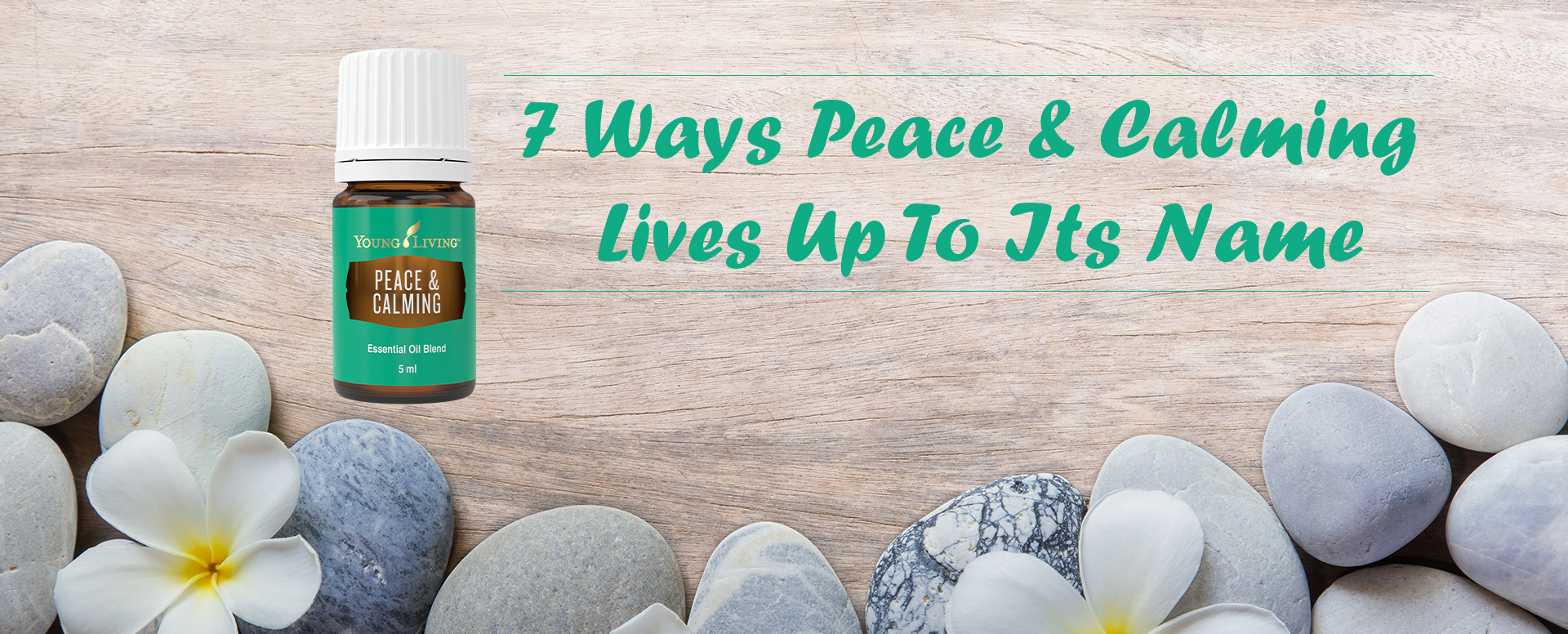
You know that feeling when the house is too loud, your brain has twenty tabs open, and you just need the world to stop spinning for five minutes? Honestly, that’s usually when people reach for Young Living Peace and Calming. It’s one of those "legacy" essential oil blends that has been around forever, yet it still manages to be the one thing people hoard during a restock. But here’s the thing: most people use it wrong, or they don’t actually know what’s inside the bottle that makes it work.
It isn't just "smell-good juice."
Gary Young, the founder of Young Living, formulated this specific blend back in the early days of the company. He wasn't just throwing random florals together. He was looking for a very specific chemical profile—mostly sesquiterpenes—to interact with the limbic system. If you look at the label, you'll see Tangerine, Orange, Ylang Ylang, Patchouli, and Blue Tansy. It sounds simple. It’s not. The Blue Tansy alone is a game-changer because of its chamazulene content, which is why the oil has that weird, slightly blue-green tint.
The Chemistry Behind Young Living Peace and Calming
Most people think of "calming" and immediately go to Lavender. Lavender is great, don't get me wrong, but Peace and Calming hits different.
Tangerine and Orange are the top notes. They provide that immediate hit of d-limonene. Research, including studies often cited in the Journal of Dietary Supplements, suggests that limonene can have a significant impact on occasional anxiety and stress markers. It’s bright. It’s cheery. But the "peace" part of the name comes from the heavier hitters at the bottom of the blend.
Patchouli is polarizing. Some people think it smells like a 1970s basement. Others love its grounding, earthy vibe. In this blend, it acts as a fixative. It slows down the evaporation of the lighter citrus oils. Then there is the Ylang Ylang. This floral is heavy. It's intense. It’s known in aromatherapeutic circles for its ability to help regulate a racing heart rate during moments of high stress.
Then we get to the Blue Tansy. This is the expensive stuff. Tanacetum annuum is a rare Mediterranean plant. When it's distilled, a chemical reaction creates chamazulene, which is a powerful anti-inflammatory agent—not just for the body, but arguably for the nervous system's response to external stimuli. When you combine these five specific oils, you get a synergistic effect that a single oil just can't mimic.
Why the Blue Tansy Matters So Much
If you’ve ever opened a bottle of Young Living Peace and Calming and noticed it looked a bit different than the last one, that’s because of the Blue Tansy harvest. Natural products aren't like synthetic perfumes made in a lab; they change based on the soil and rain.
Blue Tansy is what gives the blend its slightly sedative edge. It’s why parents have been diffusing this in nurseries for decades. It’s also why it’s often more expensive than your basic lemon or peppermint oils. You're paying for a crop that is finicky to grow and even harder to distill correctly without destroying the delicate chamazulene.
Common Misconceptions and What People Get Wrong
One big mistake? Thinking Peace and Calming and Peace and Calming II are the same thing. They aren't.
A few years back, there was a massive shortage of certain ingredients. Young Living created "Peace and Calming II" as a permanent alternative. The second version uses Tangerine, Orange, Ylang Ylang, Patchouli, Northern Lights Black Spruce, Matricaria, Vetiver, Cistus, Bergamot, Cassia, and Davana.
It’s a much more complex recipe.
Some people swear by the original. Others find the addition of Northern Lights Black Spruce in the second version makes it more "forest-like" and grounding. If you want the classic, "sweet" scent that made the blend famous, you want the original Young Living Peace and Calming. If you want something that feels a bit more rugged and deep, the II is your best bet.
Another misconception is that you can just buy a "Peace and Calming" knock-off at a big-box grocery store for five dollars. You can't. Most of those "essential oils" are actually fragrance oils diluted with synthetic carriers. They might smell "nice," but they lack the therapeutic constituents like chamazulene or d-limonene in high enough concentrations to actually do anything for your stress levels. In fact, breathing in synthetic fragrances can often trigger headaches, which is the exact opposite of what you're trying to achieve.
The "Overuse" Trap
You don't need to dump half the bottle in your diffuser.
In fact, the olfactory system can get "fatigued." If you run a diffuser with ten drops of Peace and Calming for eight hours straight, your brain eventually just stops processing the scent. It’s called olfactory adaptation. You’re literally wasting money.
The "sweet spot" is usually 4 to 6 drops for a standard-sized room, run on an intermittent setting (30 minutes on, 30 minutes off). This keeps the stimulus "fresh" for your brain, which helps maintain the calming effect throughout the day or evening.
Real-World Ways to Use It (Beyond Just Diffusing)
Most people just stick this in a diffuser and call it a day. That’s fine, but you’re missing out on the best ways to use it.
The Epsom Salt Soak: Don't just drop the oil into the bathwater. It will just float on top and potentially irritate your skin. Instead, mix 5 drops of Young Living Peace and Calming with a cup of unscented Epsom salts. The salt acts as a carrier and helps the oil disperse throughout the water. The magnesium in the salts works with the oils to relax your muscles while the steam carries the scent to your brain. It’s a double whammy.
The "Tantrum" Tamer: Parents have been calling this "Liquid Gold" for years. For kids who are overstimulated, dilute one drop of the oil with a teaspoon of a carrier oil (like coconut or jojoba) and rub it on the bottoms of their feet. The skin on the feet is thick and less likely to be sensitive, but the absorption is still effective.
The Pillow Mist: Get a small glass spray bottle. Fill it with distilled water and a splash of witch hazel. Add 10 drops of the blend. Shake it up and mist your linens about ten minutes before you go to bed. By the time you lay down, the "wet" smell is gone, leaving just the grounding scent of patchouli and ylang ylang.
Pet Stress: High-strung dogs? Sometimes, putting a drop of diluted Peace and Calming on your hands and letting your dog sniff it (don't force it) can help during thunderstorms. Always check with a vet first, especially with cats, as their livers process oils differently.
What Science Says (and Doesn't Say)
It’s important to be real here: Essential oils are not a "cure" for clinical anxiety or medical conditions. They are tools for self-regulation.
When you inhale the molecules in Young Living Peace and Calming, they travel through the nasal cavity to the olfactory bulb. This bulb is part of the limbic system, the "emotional" part of the brain that handles things like heart rate, blood pressure, and memory.
A 2014 study published in Phytomedicine looked at the effects of various essential oil constituents on GABA receptors in the brain. GABA is a neurotransmitter that tells your body to "slow down." While that study wasn't specifically on this blend, the individual components like Ylang Ylang and Orange have been shown in various clinical trials to support a decrease in cortisol levels.
Basically, you aren't imagining it. There is a physiological reason why smelling this blend makes you take a deep breath.
Ethical Sourcing and Why it Matters
The essential oil industry is kind of a mess. There’s a lot of "greenwashing" going on.
Young Living uses a "Seed to Seal" standard. This means they control the planting, cultivation, and distillation of the plants. For a blend like Peace and Calming, which relies on the purity of Blue Tansy and Ylang Ylang, this is crucial. If the Ylang Ylang is harvested at the wrong time of day, the chemical profile changes. If the Blue Tansy is sprayed with pesticides, those chemicals can end up concentrated in the oil.
Is it more expensive than the stuff at the health food store? Yes. But when you’re dealing with the nervous system, purity isn't just a marketing buzzword—it’s a safety requirement.
Practical Steps for Getting Started
If you're looking to integrate Young Living Peace and Calming into your life, don't overcomplicate it. You don't need a massive kit or a degree in aromatherapy.
Start by using it during one specific "transition" time in your day. For most people, that's the "witching hour" between 5:00 PM and 7:00 PM when work is ending, dinner needs to happen, and the house feels chaotic.
- Step 1: Get a high-quality ultrasonic diffuser.
- Step 2: Add 5 drops of the oil and 150ml of water.
- Step 3: Turn it on before the chaos peaks.
- Step 4: Create a "scent memory." Every time you feel calm while smelling the oil, your brain creates a link. Eventually, just smelling the bottle will trigger a relaxation response before the oils even hit your bloodstream.
You should also keep a "roller bottle" in your bag. Mix 10 drops of the blend with 10ml of V-6 Vegetable Oil Complex or another carrier oil. When you're stuck in traffic or a stressful meeting, roll a little on your wrists. It’s a simple, portable way to manage your environment when you can't control the world around you.
The reality is that life is always going to be a bit messy. A bottle of oil isn't going to pay your bills or fix your problems, but Young Living Peace and Calming is a legitimate, plant-based tool that can help you navigate those stressors with a little more grace. It’s about creating a "sensory anchor" that reminds your body it is safe to relax.
Next Steps for Better Results
Check your bottle to ensure you have the original blend if you prefer the sweeter profile, or "II" for a more grounded experience. Always dilute for topical use, especially with children, and try using the "intermittent" setting on your diffuser to prevent scent fatigue and maximize the therapeutic benefits of the blend.



