Leonardo wasn't born a legend. Honestly, if you saw him walking around Florence in the 1460s, you probably wouldn't have thought "there goes the greatest genius in human history." You might have just seen a tall, handsome kid with long curly hair who couldn't seem to finish anything he started. He was an illegitimate child, born out of wedlock to a notary named Ser Piero and a peasant woman named Caterina. Because of that "stain" on his birth, young Leonardo da Vinci was actually barred from following in his father’s footsteps as a lawyer or notary.
History is funny like that. If Leonardo had been "legitimate," he might have spent his life filing boring legal paperwork in a dusty office. Instead, he was forced to the margins, which meant he was free to look at trees, bugs, and the way water swirls around a rock.
The Workshop Years: Getting His Hands Dirty
By the time he was about 14, his dad realized the kid had some serious talent with a charcoal stick and shipped him off to Florence. He ended up in the workshop of Andrea del Verrocchio. Now, Verrocchio wasn't just a painter; he was a brand. His shop was basically a high-end manufacturing hub for art, jewelry, and giant bronze statues. It was loud. It smelled like linseed oil and hot metal.
This is where the real young Leonardo da Vinci started to emerge. He wasn't just sitting in a corner painting pretty pictures. He was learning chemistry. He was learning how to cast bronze and how to carve marble. Verrocchio's workshop was the 15th-century equivalent of a tech startup incubator.
There's this famous story—Vasari tells it in Lives of the Artists—about Verrocchio painting a scene of the Baptism of Christ. He let his teenage apprentice, Leonardo, paint one of the angels in the corner. When Leonardo was done, the angel looked so much better, so much more "alive" than anything Verrocchio had ever done, that the master supposedly vowed never to paint again. Whether that's 100% true or just a bit of Renaissance hype, the painting still exists in the Uffizi Gallery. If you look at it, you can actually see the difference. The angel on the left has this soft, ethereal glow—the sfumato technique that would become Leonardo’s signature.
Not Everything Was a Masterpiece
We love to imagine him as this perfect creator, but he was kind of a disaster at deadlines. Even as a young man, he was notorious for getting distracted. He’d start a massive project, get obsessed with the anatomy of a horse's leg or the way light hits a leaf, and just... stop.
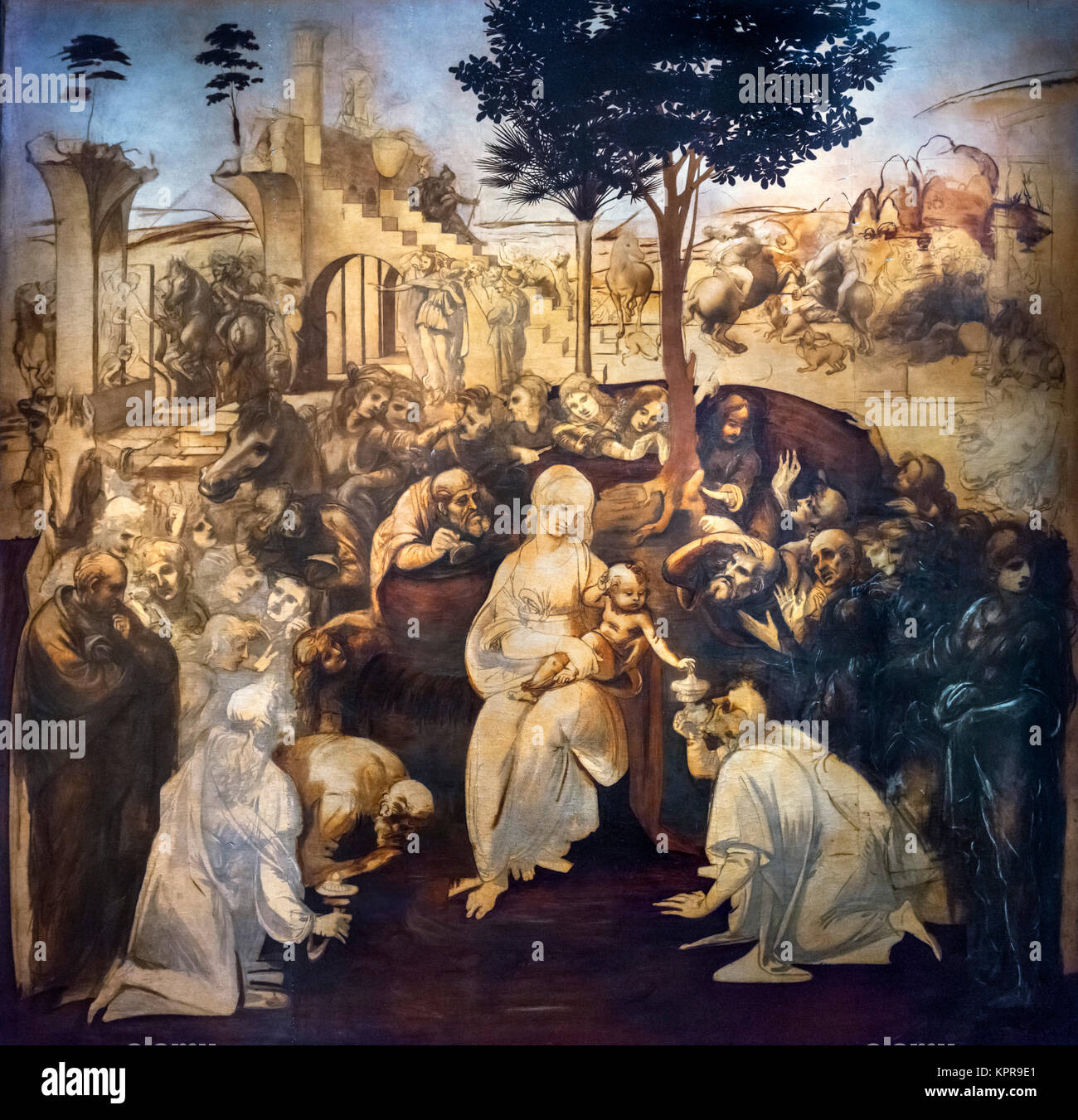
Take the Adoration of the Magi. He was commissioned to do this for the monks of San Donato a Scopeto when he was in his late 20s. It’s a huge, ambitious piece. But he left it half-finished when he decided to pack his bags and move to Milan. He basically ghosted the monks. This became a pattern. His brain moved faster than his brush could ever keep up.
Why Young Leonardo da Vinci Was Actually a "Loser" in His 20s
If you were a talent scout in 1480, you might have skipped over Leonardo. He didn't have a massive portfolio of finished work. He didn't have a big fancy studio. He was a vegetarian, which was weird back then. He dressed in short, pink tunics while everyone else was wearing long, somber robes. He was basically the original hipster.
He was also under constant scrutiny. In 1476, he and three other young men were anonymously accused of sodomy. In 15th-century Florence, that was a capital offense. The charges were eventually dropped because the accuser remained anonymous, but the experience clearly rattled him. It’s likely why he became so secretive, writing his notebooks in that famous "mirror script" that people spent centuries trying to decode.
The Milan Pivot: More Than Just Art
When he finally left Florence for Milan at age 30, he didn't even pitch himself as a painter. He wrote a letter to Ludovico Sforza, the Duke of Milan. It's one of the coolest "cover letters" in history. He listed ten things he could do.
- I can build portable bridges.
- I know how to drain moats.
- I can make armored tanks (seriously).
- I can design giant catapults.
It wasn't until the very end of the letter that he mentioned, "Oh yeah, I can also paint and sculpt as well as anyone else." He realized that in a world of war and power, being a "creative" wasn't enough. He had to be a problem solver. He had to be a "polymath."
The Notebooks: A Messy Mind
If you ever get a chance to see pages from his early notebooks, like the Codex Arundel, you'll see how his mind worked. It's chaos. He’ll have a drawing of a human heart right next to a sketch of a grocery list or a design for a flying machine. He didn't see boundaries between art and science. To him, understanding how a muscle flexed was essential to painting a man’s arm, but it was also just... interesting.
He spent hours watching birds. He wanted to know how they stayed up. He wasn't just "dreaming" of flying; he was analyzing the physics of it before physics was even a real thing.
Common Myths About His Early Life
People think he was some lonely hermit. He wasn't. Young Leonardo da Vinci was described as incredibly charming and a great singer. He used to play a silver lute shaped like a horse's head that he built himself. He was the life of the party.
Another big misconception? That he was "self-taught." While he called himself an "unlettered man" because he didn't know Latin or Greek (the languages of the elite), he was obsessively observant. He taught himself by doing. He didn't wait for a professor to tell him how water worked; he went to the river and watched it for ten hours.
How to Apply the Leonardo Method to Your Own Life
You don't have to be a genius to learn from the way he lived his youth. It's about a specific kind of curiosity.
- Stop categorizing your interests. Leonardo didn't care if a project was "art" or "engineering." If it was interesting, it was worth his time.
- Embrace the "unfinished." While finishing things is good for business, sometimes the act of starting ten different things leads to the one breakthrough that actually matters.
- Look closer. Next time you see a shadow, don't just see "darkness." Look at the edges. Are they sharp? Or are they blurry? That’s what Leonardo did, and it changed how the world looks at art.
- Write everything down. His notebooks are the most valuable things he left behind—not just the paintings. Your ideas are fleeting; catch them while they're fresh.
Leonardo's early years were defined by a lack of traditional "success." He was an outsider, a dropout from the legal track, and a guy who struggled to finish his homework. But that friction is exactly what made him the person we study 500 years later. He didn't fit the mold, so he built his own.
To truly understand his impact, start by looking at his earliest works, like the Portrait of Ginevra de' Benci. Notice how he captures the light. Then, look at his sketches of anatomy. You'll see that for him, the beauty was in the mechanics of how things worked, not just how they looked on the surface. That’s the real secret of the young Leonardo.



