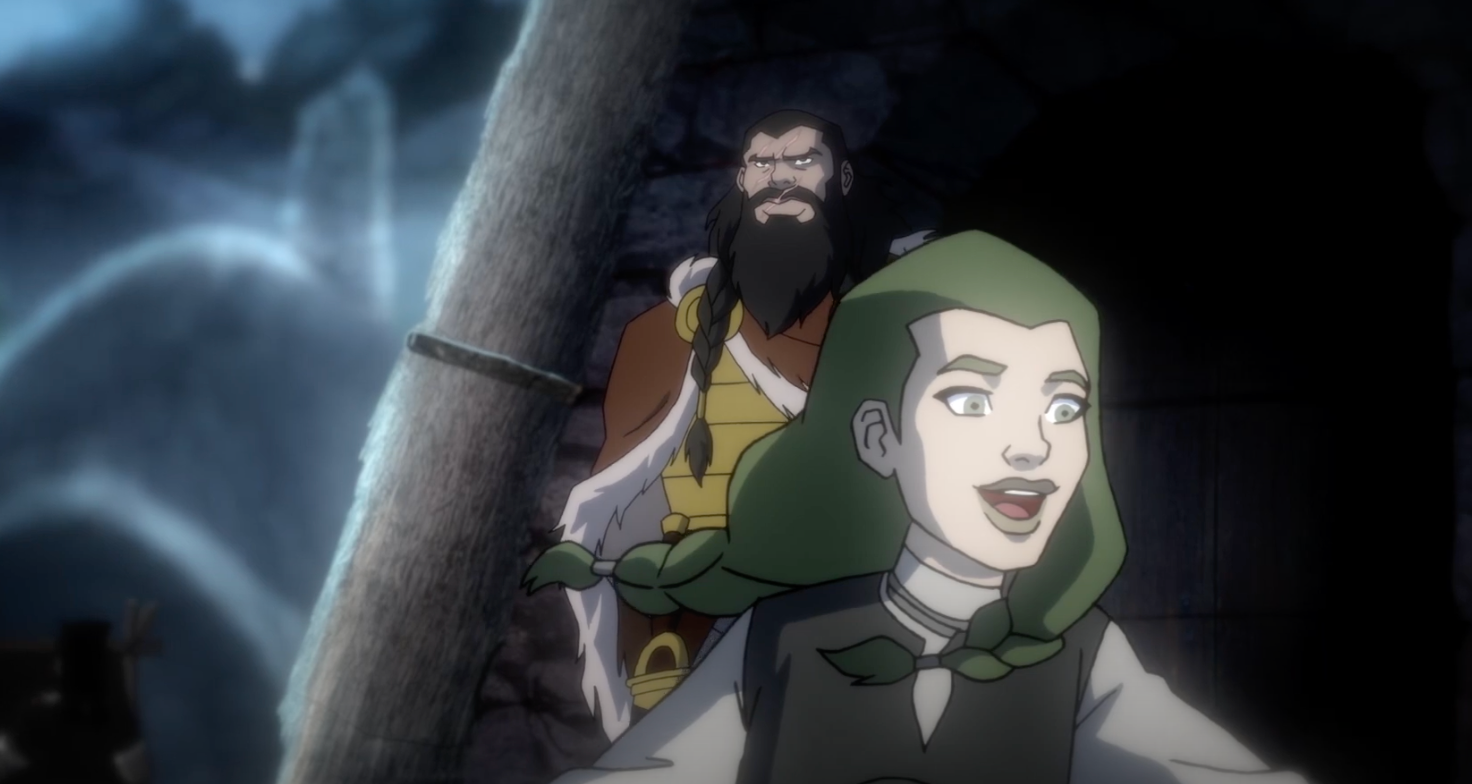
He isn't just a caveman with a healing factor. Honestly, if you grew up watching the Justice League animated series from the early 2000s, you probably remember Vandal Savage as a sophisticated, immortal dictator. But the version of Young Justice Vandal Savage we got from Greg Weisman and Brandon Vietti is a completely different animal. He’s the architect of a multi-generational conspiracy that makes every other DC villain look like they're playing checkers while he's playing intergalactic, multi-dimensional chess.
He's patient.
Most villains want to take over the world by Tuesday. Savage? He’s willing to wait ten thousand years for a plan to bear fruit. In the world of Young Justice, he isn't just a recurring bad guy; he is the protagonist of his own dark epic. He views himself as the father of humanity. He's a monster, sure, but a monster with a very specific, twisted sense of Darwinian duty.
The Origin Story That Actually Makes Sense
We’ve seen the "meteor gave him powers" bit a thousand times. But Young Justice Season 3, specifically the episode "Evolution," changed the game by grounding his immortality in the harsh reality of the Pleistocene epoch. He was Vandar Adg of the Blood Tribe. After a meteor crashed near his tribe, the radiation didn't just stop him from aging; it enhanced his mind.
He learned. He survived a bear attack that should have ended him, leaving him with those iconic three scars across his face.
The brilliance of the writing here is how they connect his personal survival to the survival of the species. Savage believes that only through conflict and hardship can humanity evolve to its rightful place as the masters of the galaxy. He saw his own children die of old age while he remained young. That kind of perspective does something to a person. It detaches them. He stopped seeing individuals and started seeing "The Light" as a necessary pruning tool for the human garden.
Why The Light Isn't Your Typical Legion of Doom
Most supervillain groups fall apart because of ego. Lex Luthor wants to be the smartest, Joker just wants chaos, and Black Manta wants revenge. Young Justice Vandal Savage manages to keep these titans in line through a shared philosophy of "Earth First."
It’s almost a dark version of patriotism.
The Light—comprising characters like Ra's al Ghul, Queen Bee, and Ocean Master—operates on the principle of secrecy and incremental gains. They don't want to destroy the Justice League immediately. They want to use the League. They want the heroes to act as a deterrent against alien threats while The Light prepares Earth for the inevitable showdown with the rest of the universe.
Consider the "Reach" invasion in Season 2. While the Team was busy trying to save the day, Savage was busy making deals. He isn't afraid to let the "good guys" win if it moves his long-term agenda forward by an inch. He is the ultimate pragmatist. If Earth is conquered by a weak alien race, humanity becomes a slave race. If Earth is "protected" by the Justice League while Savage manipulates the shadows, humanity becomes a weapon.
The Secret Pact With Darkseid
This is where the scale of the show gets truly ridiculous. We found out that millennia ago, Savage made a deal with the Lord of Apokolips. Think about that for a second. Darkseid, a literal god of evil, respects Vandal Savage enough to enter a formal partnership.
The "Anti-Life Equation" is usually the end-all-be-all for Darkseid, but in this continuity, he and Savage have an agreement: they will conquer the galaxy together, and then, once everything else is crushed, they will have one final war to see who rules the remains.
It sounds insane. It is insane. But for Savage, it’s the only logical path. He knows Earth can't stand against Apokolips yet. So, he buys time. He offers up his own descendants—the meta-humans—as "test subjects" and "soldiers" for Darkseid's pits. To Savage, a few thousand years of suffering for a few million people is a small price to pay for the eventual supremacy of the human race.
His Relationship With His Children (Or Lack Thereof)
Cassandra Savage and Olympia Savage give us the best look at his psyche. He doesn't love them in a way we would recognize. He loves them as extensions of his legacy. When Olympia began to suffer from dementia in Season 3, she became a "weak link."
He killed her.
He didn't do it out of malice or anger. He did it with a chilling, calm tenderness. He told her stories of their past, comforted her, and then ended her life because she could no longer serve the cause. It’s one of the most disturbing scenes in Western animation. It proves that Savage has completely transcended human emotion. He is a creature of pure, cold purpose.
Contrast this with how he treats Cassandra, who remains loyal and capable. She is his right hand, his pride. But the moment she falters? She knows exactly what's coming. That tension makes every interaction involving the Savage family feel like walking on thin ice.
The Meta-Gene and the War for Evolution
In the Young Justice lore, the "Meta-Gene" is Earth's greatest natural resource. Savage realized this before anyone else. He saw the potential for humans to develop powers as a direct response to the meteor's radiation in his own bloodline.
This is why he's so obsessed with "trafficking."
The entire plot of the later seasons revolves around the kidnapping of teenagers to trigger their meta-genes. To the Justice League, this is a human rights catastrophe. To Young Justice Vandal Savage, this is a mandatory recruitment drive for the defense of the planet. He sees the Justice League's morality as a weakness that prevents humanity from reaching its full potential. He wants an army of super-powered humans that can take on New Genesis, the Green Lantern Corps, and eventually, Darkseid himself.
Misconceptions About His Power Level
People often think Savage is "just" a guy who can't die. That’s a massive understatement. While he isn't a powerhouse like Superman, his strength and durability are peak human—and then some. He’s had over 50,000 years to master every martial art, every language, and every strategy known to man.
He’s beaten a bear with his bare hands. He’s led empires as Genghis Khan and (implied) other historical conquerors.
His real power is his mind. He is a master of social engineering. He knows how to play on the insecurities of world leaders. In Season 4, we see him navigate the politics of Atlantis, the surface world, and Mars simultaneously. He doesn't need to throw a planet-busting punch when he can just whisper in the right ear and start a war that ends exactly how he wants it to.
The Tragedy of Vandal Savage
Is he a hero in his own mind? Absolutely.
There's a weirdly compelling argument that without Savage, Earth would have been annihilated long ago. He’s the one who kept the Starro tech in check. He’s the one who provides a unified front against cosmic threats that the League doesn't even know exist.
But his "salvation" comes at the cost of everything that makes life worth living. He wants to save humanity but doesn't care about humans. It’s a paradox. He’s preserved the species while destroying its soul. He has become the very thing he sought to protect Earth from: an unstoppable, unfeeling force of nature.
What You Can Learn From This Version of the Character
If you’re a writer or a fan of deep lore, the Young Justice Vandal Savage is a masterclass in how to scale a villain. You don't make them more powerful; you make them more integrated into the history of the world.
Here is how you can apply the "Savage Philosophy" to analyzing other media or even your own strategic thinking:
- Long-term vs. Short-term: Most failures happen because people focus on the next 24 hours. Savage focuses on the next century. Ask yourself if your current "emergencies" will even matter in five years.
- The Power of Alliances: Savage doesn't like Lex Luthor. He probably hates Darkseid. But he works with them because it serves a purpose. Don't let personal feelings get in the way of a beneficial partnership.
- Adaptability: He transitioned from a caveman to a king to a shadow-broker. Being "immortal" means nothing if you can't change with the times. Stay relevant by constantly learning new "technologies," whether that's AI in 2026 or a flint spear in 10,000 BC.
- Identify the "Meta-Gene": Find the unique leverage point in any situation. For Savage, it was the genetic potential of humans. In business or life, find the one thing you have that nobody else does and guard it ruthlessly.
The story of Vandal Savage in Young Justice is far from over. With the way the show explores the cosmic balance between Order and Chaos, Savage represents a third path: Control. He is the ultimate control freak, and in a universe of gods and monsters, maybe that's what he thinks we need. He's wrong, of course. But he's so convincingly wrong that you almost want to see him succeed just to see what a "Savage Galaxy" would look like.
Keep an eye on his interactions with the Lords of Order and Chaos in the Phantoms arc. It reveals that even the fundamental forces of the universe have to negotiate with the man who refused to die. That’s the true legacy of Vandar Adg. He didn't just survive the meteor; he made the universe acknowledge his survival as a permanent fact.
For those looking to dive deeper into the lore, start by re-watching "Evolution" (Season 3, Episode 7). It’s the definitive text on why he does what he does. Pay close attention to the murals in his base—they aren't just art; they are a timeline of a man who has outlived everything except his own ambition.
Next, compare his leadership style in Season 1's "Auld Acquaintance" to the final episodes of Season 4. You'll notice he stops being a "boss" and starts being a "god-king" in wait. The shift is subtle, but it's there. He is no longer hiding as much because he believes the endgame is finally within reach. Whether the Justice League can stop a man who has already won a thousand times before is the question that keeps the series so gripping.



