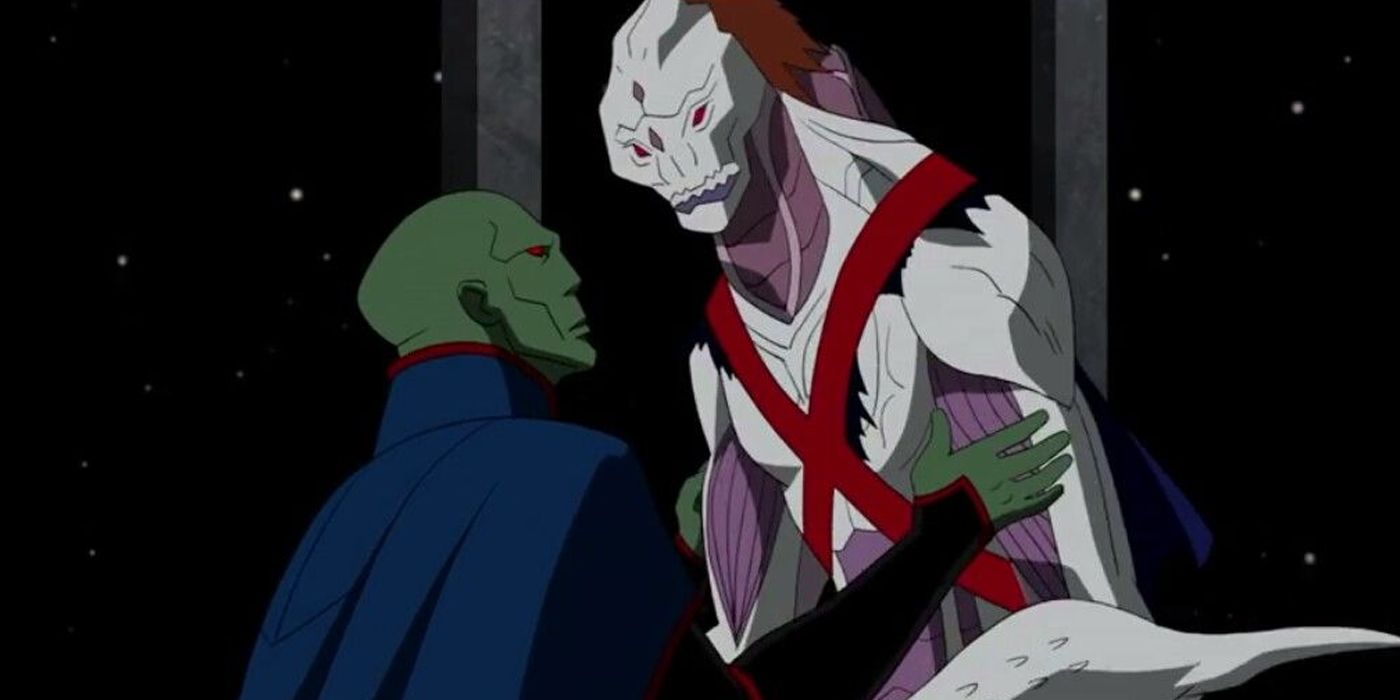
He’s usually just standing there. In the background of the Watchtower, arms crossed over a red X on his chest, staring into a holographic screen with a look of stoic detachment. If you only watch Young Justice for the high-octane fight scenes or the teen romance drama, you might think the Young Justice Martian Manhunter is just the Justice League's resident telepathic operator. A glorified switchboard. Honestly, that's a mistake.
J'onn J'onzz is the emotional anchor of the entire series, even when he isn't throwing a punch. If you found value in this article, you might want to look at: this related article.
Most people don't realize how much the show fundamentally changed him compared to the Justice League Unlimited era or the original comics. In this universe (Earth-16), J'onn isn't the "Last Martian." That’s a massive distinction. On Young Justice, Mars is a bustling, thriving, and deeply prejudiced society. By making him an immigrant rather than a refugee, the writers turned his stoicism into something way more complex: a quiet, desperate attempt to fit into a world that will never truly understand his biology or his culture.
The Secret Mentor Most People Ignore
While Batman was busy being the "scary dad" to the Team and Black Canary was acting as the therapist, J'onn was doing something way more subtle. He provided the DNA. Literally. For another angle on this development, check out the recent update from Deadline.
When we meet M'gann M'orze—Miss Martian—she claims to be J'onn's niece. We eventually find out she's a White Martian, a member of the oppressed minority on Mars. J'onn knew this the whole time. Think about that for a second. He brought her to Earth, gave her a cover story, and let her live out a fantasy based on a 1950s sitcom because he knew exactly how painful it was to be "othered."
It’s easy to miss, but J'onn’s mentorship of M’gann is basically a masterclass in "hands-off" parenting that almost goes horribly wrong. He loves her, but he’s also terrified of her power. In the episode "Failsafe," where the Team undergoes a mental simulation that goes south, we see the raw potential of Martian telepathy. It’s terrifying. J'onn has to balance his role as a loving uncle with the reality that M'gann is potentially the most dangerous being on the planet. He doesn't lecture her. He just watches.
Why the "Last Martian" Trope Was Tossed Out
Usually, J'onn is the lonely guy. He’s the alien who lost everything in a fire. In Young Justice, the Young Justice Martian Manhunter has a family back home. He has a sister, M'gann's mother. He has a whole civilization that he just... left.
This changes his vibe.
He’s not mourning a dead world; he’s navigating a living one. In Season 4 (Phantoms), we finally get to see M'arzz. It’s not a wasteland. It’s a place with a caste system where Green Martians rule, Red Martians are the elite, and White Martians are treated like dirt. J'onn’s choice to stay on Earth becomes a political statement. He chose a world where he could be a hero over a world where he was just part of the status quo.
The show does this brilliant thing where it uses Martian biology—the "Great Soup" of shared consciousness—to explain why J'onn is so calm. He’s used to everyone knowing everyone’s business. Earth is loud, chaotic, and full of secrets. To him, humans must seem like broken radios, screaming into the void without ever really connecting.
The Powers Scale: Is J'onn Nerfed?
Let's talk about the power levels because fans argue about this constantly on Reddit and in Discord servers. Is the Martian Manhunter weaker in this show?
Kinda. But it’s intentional.
In the comics, J'onn is basically Superman with a Ph.D. in psychology and the ability to turn invisible. If he wanted to, he could end most fights in three seconds. Young Justice tones this down by emphasizing the mental toll of telepathy. We see J'onn get "psychic whiplash" more than once. He’s not a tank; he’s a strategist.
- Shape-shifting: Used mostly for infiltration, not just growing extra limbs.
- Intangibility: Highly effective but requires insane focus.
- Telepathy: His primary tool, but also his greatest vulnerability.
If he was as powerful as he is in the New 52 or Post-Crisis eras, the Team wouldn't have any stakes. The writers, led by Greg Weisman and Brandon Vietti, understood that for the kids to grow, the adults—especially the heavy hitters like J'onn—had to be sidelined or occupied with "League business."
The Tragedy of the "Hello, Megan" Era
Remember the first season? M'gann's catchphrase was "Hello, Megan!" based on a fictional TV show. J'onn encouraged this. He let her shape her entire identity around a human character.
Looking back, it’s kinda heartbreaking.
J'onn knew M'gann was hiding her White Martian form. He knew she was living a lie. He probably felt that if she could find happiness in a fictional version of Earth, it was better than the reality of Martian prejudice. But by staying silent, he allowed her to develop the mental instability that eventually led to her lobotomizing enemies in Season 2. J'onn’s "wisdom" was actually a form of avoidance. He didn't want to confront the trauma of their home world, so he let her pretend it didn't exist.
The Cultural Impact of the Martian Caste System
The way Young Justice handles Martian race relations is probably the most sophisticated the franchise has ever been. It isn't just "Green vs. White." It’s about the "A'asht" (the Red Martians) and the "G'asht" (the Green Martians) and how they collectively look down on the "B'arzz" (the White Martians).
J'onn is a Green Martian. He’s at the top of the social ladder back home.
By coming to Earth and joining the Justice League, he essentially abdicated his privilege. He chose to be an immigrant in a world that occasionally tries to deport or kill him (remember the G. Gordon Godfrey arcs?) rather than stay in a world where he was the "correct" color. This adds a layer of integrity to his character that you just don't get in other versions of the DCU. He isn't just a hero because he has powers; he's a hero because he rejects systemic injustice.
Martian Manhunter's Role in the "Phantoms" Arc
In the more recent seasons, particularly the Mars arc in Young Justice: Phantoms, J'onn takes a backseat to allow M'gann and Beast Boy to take center stage. But his influence is everywhere.
We see the Martian Prince, J'emm, who looks up to J'onn. We see the way the Martian Legion of Super-Heroes fans out. J'onn has become a symbol of what a Martian can be when they step outside the "Great Soup" and engage with the wider galaxy. He is the bridge between two worlds.
And yet, he remains profoundly alone.
Even with a fiancé or a partner on Earth (as teased in various background shots and tie-in comics), J'onn is always the observer. He’s the guy who has to listen to everyone's darkest thoughts every day. That’s a heavy burden. It’s why he likes Oreos (or "Chocos" in most DC lore, though the show focuses more on his love for human culture in general). He needs those simple, tactile human pleasures to keep from drowning in the psychic noise of eight billion people.
What Fans Get Wrong About His Relationship With the Team
There’s this misconception that J'onn is just "Uncle J'onn" to everyone.
Actually, he’s pretty distant from most of the Team members except for M'gann and maybe Connor. He views them as soldiers. Efficient, brave, but ultimately, they are part of a project he oversees. He isn't warm and fuzzy. When he speaks, it’s usually to deliver mission parameters or to warn someone about the dangers of psychic intrusion.
His relationship with M'gann is the only time we see the mask slip. When she goes too far—like when she tried to rewrite Connor's mind—J'onn's reaction isn't just disappointment. It’s fear. He sees the shadow of Martian history in her actions. He knows that Martians have the power to be the ultimate dictators, and he spends every waking moment ensuring he—and his protégé—never cross that line.
Real-World Context: Why This Version Works
If you look at the production history of Young Justice, the creators wanted to move away from the "god-like" Justice League. They wanted the League to feel like a massive, slightly bureaucratic organization.
J'onn fits this perfectly.
He’s the ultimate bureaucrat. He coordinates the zeta-tubes. He manages the telepathic links. He keeps the gears turning. Without the Young Justice Martian Manhunter, the League would collapse under its own weight. He’s the literal connective tissue.
Compare this to the 2011 New 52 comics where J'onn was a secretive, almost antagonistic figure who fought the Justice League before joining them. The Young Justice version is much more likable because his secrecy isn't based on malice—it's based on a desire for peace. He’s a pacifist forced to be a warrior.
Actionable Insights for Fans and Writers
If you’re a fan of the show or a writer looking to understand how to handle "overpowered" characters, J'onn is the blueprint.
- Limit the focus, not the power: J'onn can do everything, but he chooses to do one thing—coordinate. This keeps the narrative focused on the characters who need to grow.
- Internalize the conflict: His struggle isn't with a villain like Mongul or Despero; it’s with his own Martian heritage and the temptation to use his mind-wiping powers.
- Use the "Immigrant Experience": Instead of making him a generic alien, the show treats him like a person navigating a new culture. This makes him relatable.
If you’re rewatching the series, pay attention to J'onn's eyes in the background of the Cave or the Watchtower. He’s rarely looking at the screens. He’s looking at the kids. He’s checking their moods, their stress levels, and their "vibes" (for lack of a better word). He is the silent guardian who knows everyone’s secrets but chooses to let them make their own mistakes.
Where Does J'onn Go From Here?
The future of Young Justice is always a bit up in the air depending on which streaming service is feeling generous, but J'onn’s arc feels complete yet ongoing. He has found a balance between his Martian roots and his Earthly responsibilities.
He isn't the "Last Martian" anymore. He’s just a man—well, a Martian—trying to do the right thing in a galaxy that’s constantly on fire.
If you want to dive deeper into his lore, check out the Young Justice tie-in comic issues #0-25. They flesh out his early days on Earth and his first meetings with the League. It’s canon, and it fills in a lot of the gaps about why he decided to bring M'gann to Earth in the first place.
Basically, J'onn J'onzz is the heartbeat of the show. We just had to listen closely to hear it.
Next Steps for Enthusiasts:
- Watch Season 4, "Phantoms": Specifically the first four episodes, to see the definitive take on Martian culture and J'onn's standing within it.
- Read the Tie-in Comics: Focus on the issues detailing J'onn's arrival to understand his "Earth-16" backstory compared to the main DC timeline.
- Analyze the "Failsafe" Episode: Re-watch Season 1, Episode 16, to see the exact moment J'onn realizes the danger M'gann poses.