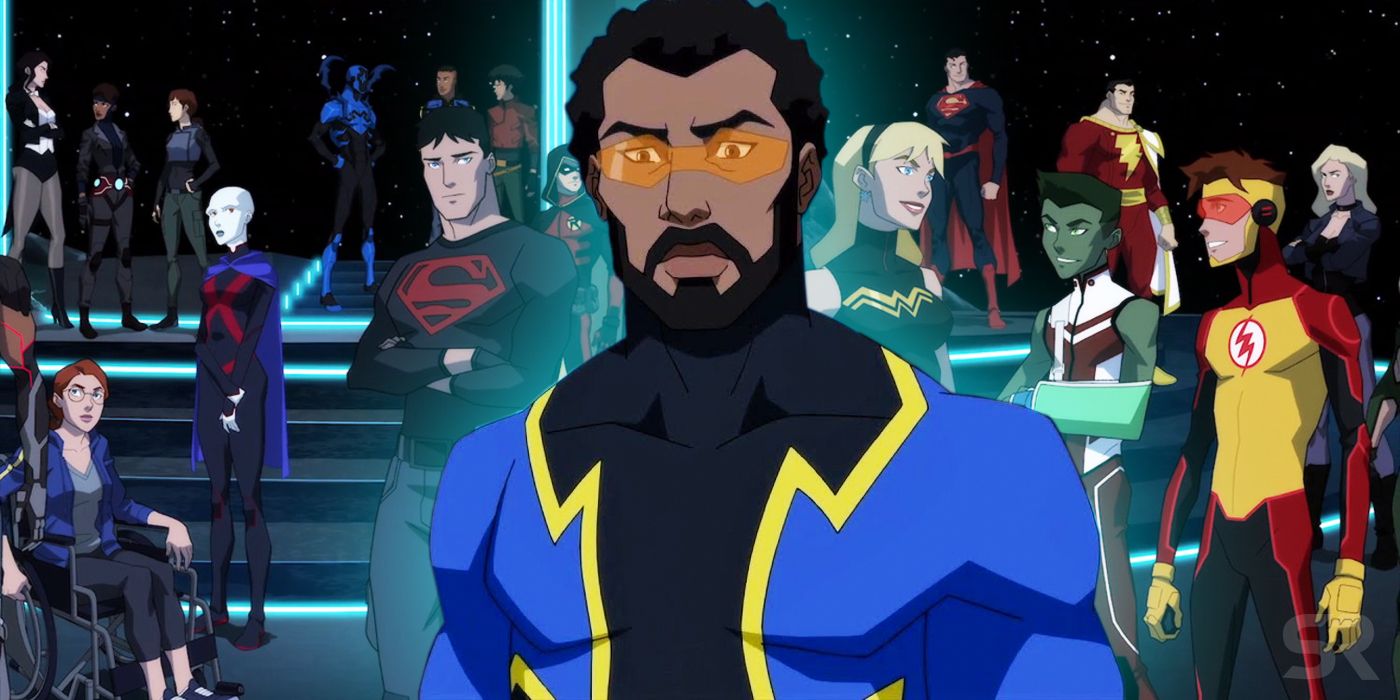
When Young Justice: Outsiders dropped after years of fans screaming into the void for a revival, everyone expected the focus to stay on the "Core Six." You know the ones—Nightwing, Superboy, Artemis, and the rest. But instead, the writers handed the keys of the emotional arc to Jefferson Pierce.
Young Justice Black Lightning wasn't just another cameo or a background Justice League member this time around. He became the moral compass for a show that was rapidly diving into some pretty dark, messy territory involving meta-human trafficking and intergalactic child abuse.
If you grew up watching the original two seasons on Cartoon Network, seeing Jefferson as a central protagonist was a bit of a curveball. Honestly, it was a genius move. While the younger heroes were busy playing 4D chess with the Light, Black Lightning was the only one asking the hard questions about the human cost of their "covert" lifestyle.
The Incident That Changed Everything
Most superhero shows start with a big win. Young Justice Season 3 started with a tragedy that basically broke Jefferson Pierce. During a mission on Rann to stop a meta-human trafficking ring, Black Lightning accidentally killed a meta-human teenager.
It wasn't a "villainous" act. It was a mistake born of chaos. The girl was a victim of horrific experiments, her body mutated into something unrecognizable, and Jefferson's lightning reacted with the tech she was fused to.
He didn't just "feel bad" about it. He quit.
He walked away from the Justice League because he couldn't trust his own judgment or his powers anymore. This is what makes the Young Justice Black Lightning portrayal so grounded. He’s a father and an educator (at Garfield High) before he’s a superhero. When he looks at a dead meta-teen, he doesn’t see "collateral damage." He sees a student. He sees his daughters, Anissa and Jennifer.
Why Batman Was Actually the Villain of His Arc
There's a lot of debate in the fandom about whether Black Lightning overreacted to "The Anti-Light." For context, Batman, Wonder Woman, and Aquaman (Kaldur'ahm) cooked up a secret plan where they "resigned" from the League to operate without UN oversight.
They lied to everyone. Including Jefferson.
They used him as the face of the "legit" Justice League while they ran black ops in the shadows. When he finally found out, he didn't just get mad; he felt violated. You've got to understand his perspective: Jefferson spent his whole life fighting for transparency and helping kids stay out of the shadows. Seeing his friends—people he trusted with his life—acting like the very villains they were fighting was a bridge too far.
The Breakdown of Trust:
- The Lie: Batman and Nightwing orchestrated a fake "split" in the League to manipulate public perception.
- The Pawn: Jefferson was kept in the dark so his "righteous indignation" would look authentic to the public and the UN.
- The Fallout: When the truth came out in the episode "Antisocial Pathologies," it nearly destroyed the team's cohesion.
It’s kind of ironic. Batman is usually the one everyone looks up to, but in this specific story, Black Lightning was the only adult in the room. He called out the "ends justify the means" mentality that usually goes unchecked in superhero media.
Voice Acting and the "Khary Payton" Factor
If Jefferson’s voice sounded familiar, that’s because Khary Payton was working overtime. Payton voices Kaldur'ahm (Aqualad/Aquaman), but he also stepped in to voice Young Justice Black Lightning.
It’s a testament to his range. Kaldur is measured, stoic, and carries the weight of Atlantis. Jefferson is more raw. You can hear the exhaustion in his voice, especially when he’s arguing with Helga Jace or trying to mentor Brion (Geo-Force).
Speaking of Helga Jace, that whole "romance" was one of the weirdest and most unsettling parts of Season 3. Jefferson thought he found a kindred spirit—another adult trying to save these kids. Instead, he was sleeping with a literal mad scientist who was grooming the Markovian royals. The look on his face when he realized her true nature? Pure heartbreak.
Leading the Justice League into Season 4
By the end of the Outsiders arc, something shifted. The League realized they couldn't keep operating in the shadows. They needed a leader who wasn't a "shadowy operative." They needed a guy who cared about the "light" in the literal sense.
Nightwing nominated Jefferson to be the Chairman of the Justice League.
It was a massive moment. He didn't just take the job; he demanded that all the "Batman Inc." splinter groups come back into the fold and play by the rules. No more secrets. No more lies.
In Young Justice: Phantoms (Season 4), we see a much more confident Black Lightning. He isn't just a guy with electricity coming out of his hands anymore. He’s a statesman. He’s the one coordinating with the UN and trying to turn the Justice League into an organization that actually helps people rather than just punching aliens in the face.
Actionable Insights for Fans
If you're looking to revisit the best Young Justice Black Lightning moments, or if you're writing your own analysis of the character, here are a few things to keep in mind:
- Watch "Princes All" and "Evelution": These episodes perfectly bookend his struggle with his powers and his eventual return to the suit.
- Analyze the "Anti-Light" reveal: Pay attention to the dialogue in the episode "Antisocial Pathologies." It’s one of the best-written arguments about hero ethics in any DC property.
- Note the Fatherhood Theme: Jefferson’s daughters, Thunder and Lightning, are seen briefly. His role as a father is the "why" behind every decision he makes. Unlike Batman, who collects orphans to fight crime, Jefferson wants to make the world safe enough so his kids don't have to fight.
The show hasn't been officially renewed for a Season 5 yet (the "save the show" hashtags are still going strong in 2026), but if it does return, expect Jefferson Pierce to remain the moral anchor. He proved that you don't need a Batmobile or a Kryptonian cape to be the most important person in the room. You just need a conscience.
Next time you rewatch the series, look at how the color palette changes when Jefferson is on screen. The animators often use his lightning to literally "illuminate" the dark corners where the other heroes are hiding. It’s not just a power; it’s a metaphor for who he is.
Keep an eye on the official DC social channels for any news regarding a revival. Until then, the best way to support the character is to keep streaming the show on Max. The numbers are the only thing that will get us more of Jefferson's story.



