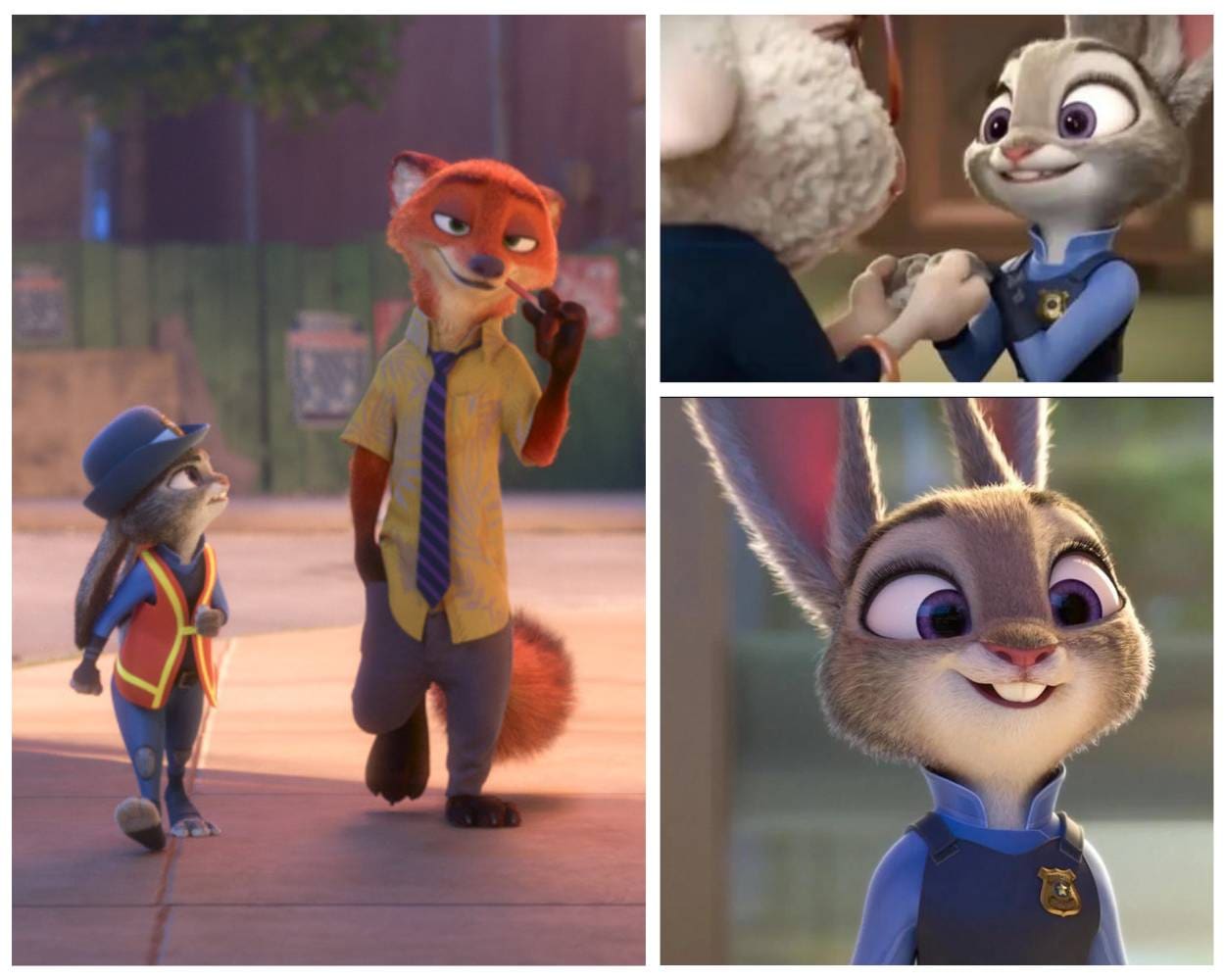
You remember that opening scene. A tiny, nine-year-old rabbit on a stage, theatrical "blood" (aka ketchup) squirting everywhere as she dramatically reenacts the primitive days of predator and prey. Most people watch young Judy Hopps and see a cute, determined kid with big dreams. But honestly? That prologue is doing a lot of heavy lifting for the rest of the movie. It’s not just a "follow your dreams" montage. It’s a masterclass in how childhood trauma and local culture shape someone's entire worldview.
Basically, the kid version of Judy isn't just a mini-Ginnifer Goodwin. She's a European rabbit living in a world that has very specific expectations for what her kind should be doing. And spoiler alert: it isn’t law enforcement.
The Talent Show and the Nine-Year-Old Visionary
When we meet young Judy Hopps, she’s nine. That's a specific age choice by the filmmakers. At nine, you’re old enough to understand that the world has rules, but you’re still young enough to think you can break them. The Carrot Days Talent Show in Bunnyburrow is where everything starts.
Judy is performing for a crowd of 225 siblings (and two very nervous parents, Stu and Bonnie). While her peers are dreaming of "realistic" jobs—Sharla the sheep wants to be an astronaut, and the jaguar kid wants to be an actuary—Judy wants to be a cop.
Here is the thing: her parents aren't being "mean" when they tell her to settle. They’re scared. Stu Hopps literally says, "If you don't try anything new, you'll never fail." That is a brutal line for a kid's movie. It’s the philosophy of a prey animal that has survived by being invisible. Judy’s refusal to accept that complacency is what makes her the protagonist, but it also makes her a bit of an outlier in her own community.
The Gideon Grey Incident: More Than Just Bullying
Most fans focus on the claw marks. Yes, Gideon Grey, the local bully fox, slashes Judy’s cheek during the festival. It’s a heavy moment. But if you look closer, the dialogue tells the real story.
Gideon isn't just picking on her; he’s trying to enforce a social hierarchy. He calls her a "stupid, carrot-farming dumb bunny." He’s using the same labels that Judy eventually fights against in the big city. What’s wild is that Judy actually gets the tickets back. She "loses" the fight—she gets knocked down and scarred—but she wins the objective.
That interaction defines her character's "try everything" spirit. It also, kida subtly, plants the seeds of her own internal bias. She spends her life proving she isn't afraid of foxes, yet she carries that "fox repellent" her dad gave her all the way to Zootopia. That's a nuanced bit of writing. It shows that even a hero can be shaped by a bad afternoon at a carrot festival.
Fact-Checking Judy’s Childhood Timeline
Let's clear up some of the math because the internet loves to argue about how old Judy actually is.
- Prologue Age: 9 years old.
- The Time Jump: 15 years pass between the Carrot Days festival and Judy leaving for the Academy.
- Current Age: This makes her 24 years old when she arrives in Zootopia.
- Training Duration: She spends about 9 months to a year in the academy, according to various production notes and the seasonal changes shown during the training montage.
People often get confused because she looks so small compared to the rhinos and hippos at the ZPD. She is small. But she's a fully grown adult by the time she hits the streets. The contrast between her 9-year-old self and her 24-year-old self is mainly in her posture and the way she carries that badge.
Behind the Scenes: Who Voiced Young Judy?
While Ginnifer Goodwin is the voice we all know, she didn't do the childhood scenes. Della Saba provided the voice for young Judy.
Director Byron Howard and Rich Moore have talked about how they needed the kid version of Judy to sound hopeful but not "cartoony." They wanted her to feel like a real kid who actually believes she can change a 1,000-year-old social system.
The animators also put a ridiculous amount of detail into her design. If you rewatch the scene where she’s hiding behind the tree watching Gideon, look at her nose. It twitches faster when she’s scared. That’s a real biological rabbit trait. The filmmakers used it to show her vulnerability even when she was trying to be brave.
Why the Bunnyburrow Opening Matters
If you skip the first ten minutes of Zootopia, the rest of the movie doesn't work. You need to see the "settling" culture of Bunnyburrow to understand why Judy is so obsessed with overachieving.
She isn't just trying to be a cop; she’s trying to prove her parents wrong. She's trying to prove Gideon wrong. She's trying to prove the entire biology of her species wrong.
When she finally makes it to the ZPD and Chief Bogo hands her a parking ticket duty assignment, that’s not just a "bad first day." It’s a callback to her childhood. It’s the world telling her, once again, to go back to the carrot farm.
Actionable Insights for Zootopia Fans
If you're looking to dive deeper into the lore of Judy's early years, here are a few things you can actually do:
- Watch for the Easter Eggs: In the opening scene, look at the "ketchup" blood. The animators intentionally made it look like the kind of stage prop a 9-year-old would use.
- Compare the Accents: Notice how Judy’s parents have a slight "country" lilt compared to the more "neutral" Zootopia city accents. This highlights the rural-urban divide that Judy crosses.
- Check out the "Zootopia+" Shorts: There are segments on Disney+ that flesh out the Hopps family further, giving more context to the environment Judy grew up in.
- Observe the Scars: In the final scenes of the movie, look at Judy's cheek. The animation team kept those faint claw marks from Gideon as a permanent part of her character model. It’s a sign of her history.
The story of young Judy Hopps is basically the foundation of the entire franchise's message. It’s about the difference between where you come from and who you choose to be. Whether you're a bunny in a carrot patch or a fox in the city, the movie argues that your "DNA"—or your childhood—doesn't have to be your destiny.



