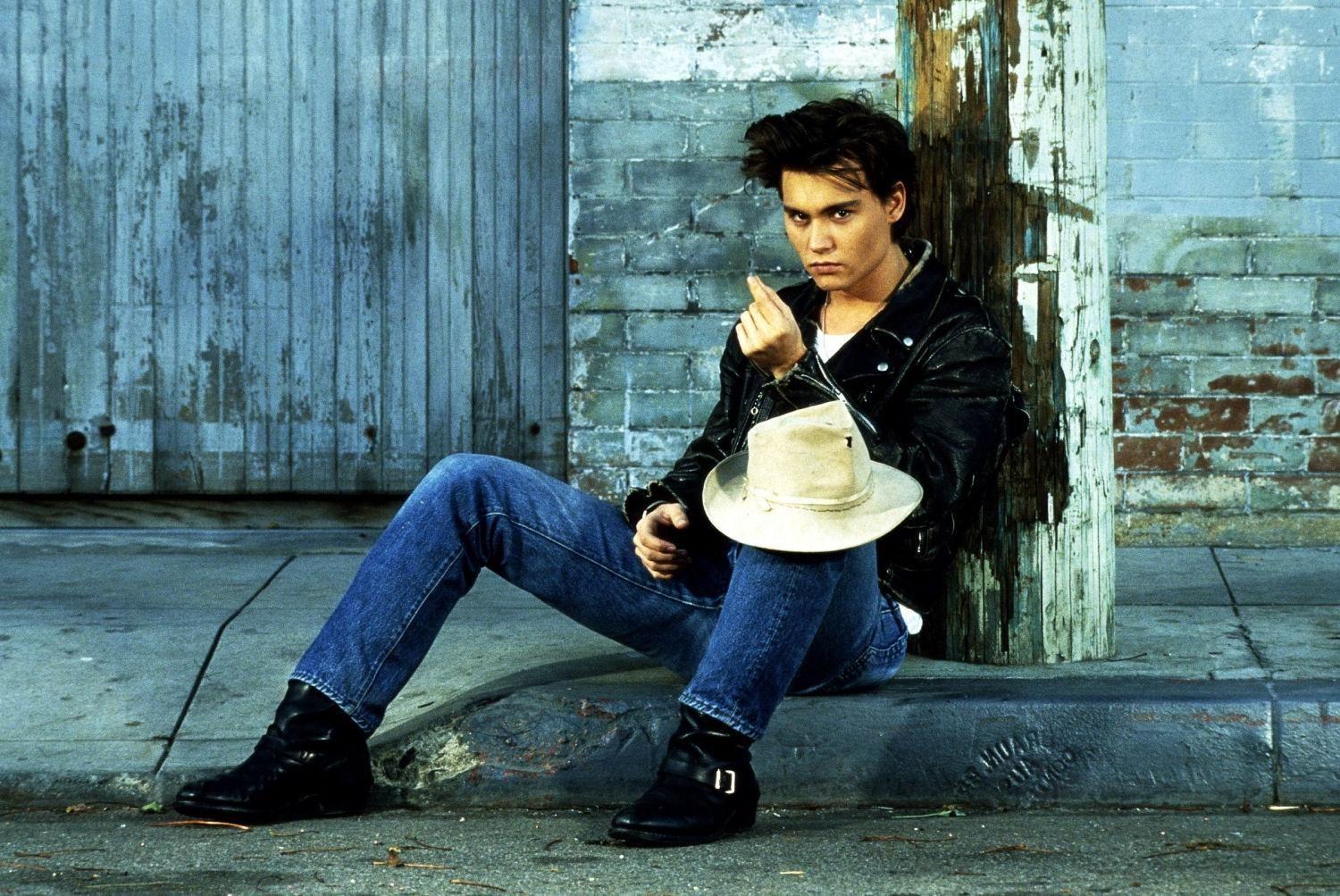
If you spend more than five minutes on Pinterest or Instagram's explore page, you’re going to see him. Usually, he’s leaning against a brick wall or staring intensely into a lens with high-waisted jeans and a leather jacket. People are still obsessed with young Johnny Depp pictures, and it isn’t just about nostalgia for the 1980s.
It’s about a specific kind of "cool" that feels almost impossible to replicate today.
Back in 1984, nobody knew who he was. He was just a kid from Florida who wanted to be a rock star. Then he got eaten by a bed in A Nightmare on Elm Street. Suddenly, photographers like Deborah Feingold and Derek Ridgers were capturing this face that seemed to change every time the shutter clicked.
The Face That Launched a Thousand Posters
Honestly, the transition from "band guy" to "global heartthrob" happened way faster than Depp probably wanted. You can actually see the hesitation in his early 1987 portrait sessions.
He looks gorgeous, sure. But there’s this palpable "get me out of here" energy in his eyes. He famously hated being a teen idol. While the studio was busy trying to sell him as the ultimate clean-cut boy next door for 21 Jump Street, the actual photos coming out of that era told a different story.
- 1984–1985: The "Fresh Face" era. Very little jewelry, short hair, and a lot of denim.
- 1987: The 21 Jump Street peak. This is where we get the iconic leather jackets and the "Tom Hanson" stare.
- 1990: The John Waters pivot. Greaser hair, leather, and a single tear for Cry-Baby.
Why the 1987 Deborah Feingold Session is Everything
If you’ve seen a black-and-white photo of a young Depp playing a piano or looking over his shoulder in a messy New York loft, it was likely from the July 1987 session with Deborah Feingold.
She caught him right as the 21 Jump Street mania was exploding. Feingold has mentioned in interviews that Depp was shy. That shyness translated to a "moody" look that basically defined the aesthetic of the late 80s.
It wasn't just about his bone structure. It was the way he wore accessories. He was one of the few guys who could pile on silver rings, bandanas, and waistcoats without looking like he was wearing a costume. Well, at least until he started working with Tim Burton.
Escaping the Teen Idol Box
By 1990, Depp was desperate to destroy his "pretty boy" image. He didn't just change his acting roles; he changed how he allowed himself to be photographed.
The young Johnny Depp pictures from the early 90s are much darker. He started leaning into the grunge movement. You see him with unwashed hair, oversized flannel shirts, and a cigarette almost permanently attached to his hand.
He was hanging out at The Viper Room. He was dating Kate Moss. The photography from this era, often candid and grainy, shifted from polished studio shots to raw, "heroin chic" snapshots.
The Tim Burton Effect
When Edward Scissorhands hit in 1990, the public's perception of "Young Johnny" shattered.
He went from the most handsome guy on TV to a pale, scarred outcast with hedge-clippers for hands. Interestingly, the promotional stills for this movie are some of the most collected images of him today. They represent the exact moment he became an "artist" instead of just a "star."
- Collaboration over Commercialism: He chose roles based on the director, not the paycheck.
- Visual Storytelling: He used his own body as a canvas—tattoos started appearing, each one documented in paparazzi shots.
- Gender Fluidity: Long before it was a mainstream trend, Depp was experimenting with "feminine" accessories and soft silhouettes in his photo shoots.
What Most People Get Wrong About His Early Style
There’s a common misconception that Depp was always a "boho" icon.
Not really. In the mid-80s, he was basically a punk. He wore thrift store finds because he was broke and living in LA, trying to make it with his band, The Kids. The "bohemian" look—the hats, the scarves, the vintage vests—didn't really solidify until the mid-90s during his Don Juan DeMarco phase.
If you look at the young Johnny Depp pictures from 1985's Private Resort, he’s just a guy in a t-shirt. There’s no mystery yet. The mystery was a defense mechanism he built later to deal with the fame.
How to Source Authentic 80s and 90s Prints
If you're looking to collect or use these images, you have to be careful with "AI-enhanced" versions.
The internet is currently flooded with upscaled, smoothed-out versions of these classic photos. They look weird. They lose the film grain that makes 80s photography special.
- Getty Images/Editorial Archives: This is where the high-res, watermarked originals live.
- Vintage Magazines: Scans from Rolling Stone or The Face (especially the April 1985 issue) offer the most "authentic" color grading.
- Photographer Portfolios: Checking the official sites of Mark Seliger or Annie Leibovitz often reveals outtakes that never made it into the magazines.
Actionable Steps for Fans and Collectors
If you're trying to track down a specific era of his look, don't just search "young Johnny Depp." You'll get a mess of results.
Instead, search by the specific photographer or the year. For the peak "rebel" look, search for "Johnny Depp 1993 US Magazine session." For the "clean" look, try "Johnny Depp 1987 21 Jump Street promo." Always look for the film grain. If the skin looks like plastic, it’s an AI "remaster" that’s stripped away the history of the shot. Real 35mm film has texture. That texture is exactly why these pictures still resonate decades after they were taken.
The reality is that we won't see another "young Johnny Depp" because the Hollywood machine is too controlled now. These photos represent a time when a kid could show up to a photoshoot in his own dirty t-shirt and become the biggest star in the world just by looking at the camera the right way.