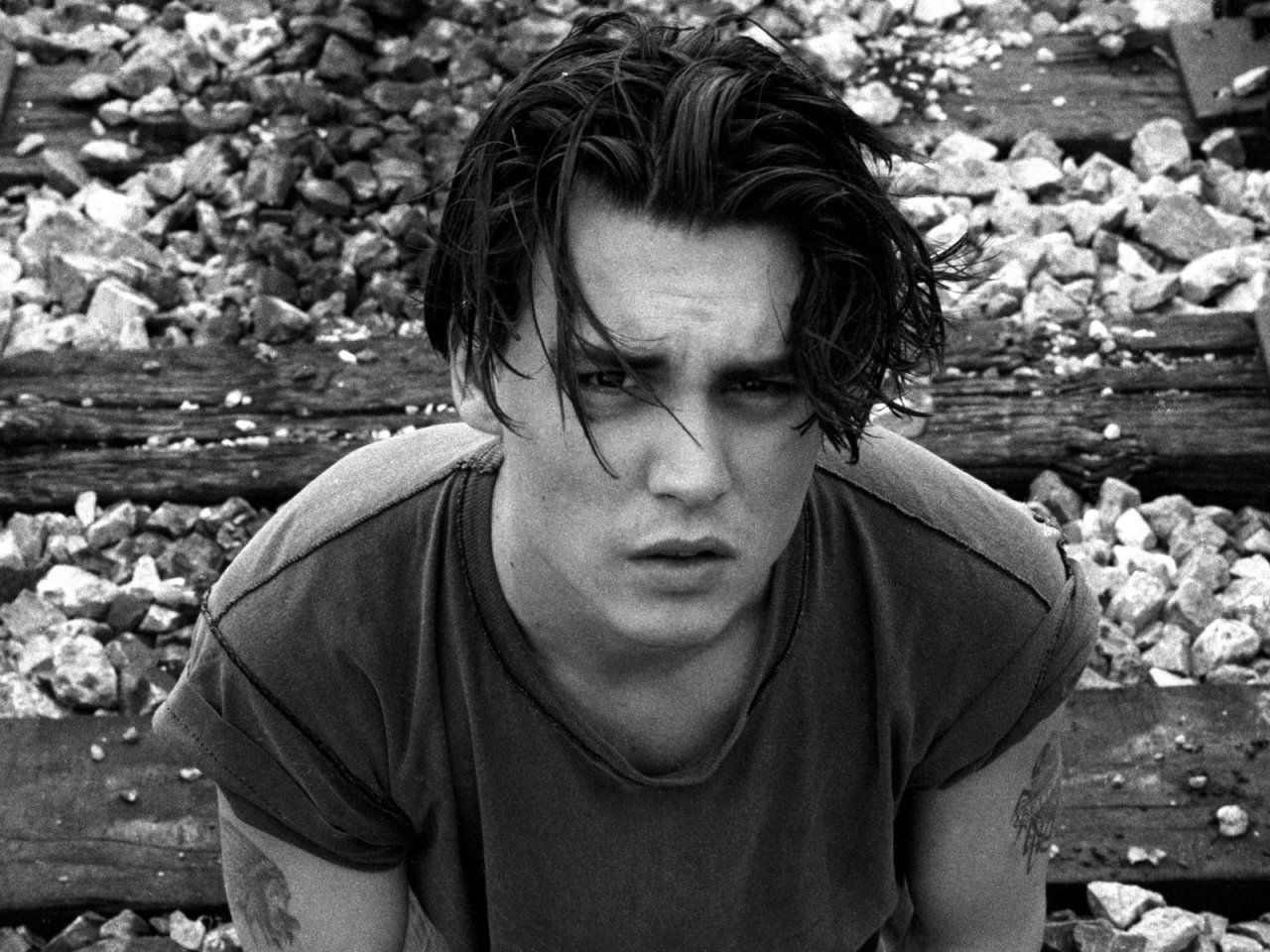
You’ve seen the photos. Maybe it’s a grainier-than-usual shot from the set of 21 Jump Street or that specific 1990 black-and-white portrait where his cheekbones could cut glass. Young Johnny Depp hair isn't just a style; it’s basically its own subculture. People are still trying to figure out how a guy could look that effortlessly disheveled without actually looking like a mess.
Honestly, it’s not just about the DNA. Sure, having some of the best hair genes in Hollywood helps. But the evolution of his look from the mid-80s to the late 90s tells a story of someone who was constantly fighting against the "teen heartthrob" mold. He used his hair to say what he couldn't always say in interviews.
The 21 Jump Street Era: The Taper That Defined a Decade
Most people think of the "bro flow" when they think of 80s Depp, but it was actually a very specific, slightly grown-out taper. It was the "Officer Tom Hanson" look. It’s a classic 80s cut, but without the stiff, hairspray-heavy vibe of his contemporaries.
While everyone else was rocking perms or flat-tops, Depp had this textured, ear-length flow. It was neat enough for a TV cop but messy enough to remind you he was a musician at heart. The sides were kept relatively clean, but the top was left long enough to fall over his forehead in these thick, dark curtains.
If you look closely at early episodes, his hair has this natural, heavy wave. It wasn't pin-straight. That’s a common misconception. People try to get this look with a flat iron and it fails because you need that "bend" in the hair. Barbers today often use a "condensed cutting technique" to recreate this—basically cutting the middle section to allow the hair to collapse into that signature shape when it dries.
Why the "21 Jump Street" look worked:
- The Nape: It used a square line on the back, which was huge in the late 80s.
- The Sideburns: They were cleaned up but kept long enough to blend into the top.
- The Volume: He didn't use much product, relying on the hair's natural weight.
Cry-Baby and the Greaser Rebirth
Then came 1990. Cry-Baby. This was the moment the young Johnny Depp hair conversation shifted from "cute guy on TV" to "iconic rebel."
Playing Wade "Cry-Baby" Walker, Depp donned a hyper-stylized version of a 1950s pompadour. This wasn't your grandpa’s pomp, though. It was aggressive. It was high-shine. It featured those two legendary "rebel strands" that hung down perfectly over his eyes.
Director John Waters wanted a look that was "dripping with juvenile delinquency." To get that, the stylists used heavy pomades—think the kind of stuff that doesn't wash out in one go. It’s a difficult look to maintain in real life because, as any greaser will tell you, those two front strands will hit you in the eye all day.
The Grunge Transition: From What's Eating Gilbert Grape to Donnie Brasco
By the mid-90s, Depp was over the "pretty boy" thing. He started growing it out. This is the era of the "Bro Flow" and the center part.
In What's Eating Gilbert Grape (1993), his hair is long, reddish-tinged, and seemingly unstyled. It looks like he just rolled out of bed. But here’s the secret: that "bedhead" look is actually the hardest to pull off. It requires a lot of "point cutting" or razoring to remove weight so the hair doesn't just hang there like a heavy curtain.
Later, in 1997's Donnie Brasco, we saw a different side. The hair was shorter, slicked back with a lot of shine, reflecting the gritty, undercover mob vibe. It proved he could do "polished" just as well as "grunge."
How to Actually Get the Look (Without Looking Like a Cosplayer)
If you're trying to replicate young Johnny Depp hair today, you have to start with the right foundation. You can't just show a picture to a barber and hope for the best.
First, you need texture. If your hair is naturally thin and straight, you’re going to need a sea salt spray. This is non-negotiable. Sea salt adds that "gritty" feel that makes the hair look lived-in.
Second, the cut matters more than the product. Ask for a "grown-out taper" with plenty of texture on top. You want the back and sides to be scissor-cut, not clipped. Clippers make it look too modern and "sharp." You want softness around the ears and the neck.
The Product Breakdown:
- Sea Salt Spray: Apply to damp hair and blow-dry while scrunching with your hands. This creates the wave.
- Matte Clay: Use a tiny amount (pea-sized) to define the ends. Don't put it near the roots or it'll look greasy.
- Lightweight Oil: If you're going for the Gilbert Grape or Cannes 1998 look, a tiny bit of argan oil adds that healthy sheen without the weight of a wax.
The "Curtain" Misconception
Everyone calls his early 90s look "curtain bangs." While technically true, Depp’s curtains weren't like the ones you see on TikTok today.
Modern curtains are often very symmetrical and blow-dried to perfection. Depp’s version was always asymmetrical. One side would be tucked behind an ear, the other would be falling into his face. It was intentional imperfection.
He also frequently switched up his parting. He wasn't a "middle part only" guy. Sometimes it was a deep side part, sometimes it was a messy zig-zag. This variety is what kept the look from becoming a caricature.
Why We’re Still Talking About It in 2026
It’s about the attitude. Johnny Depp used his hair as a shield. In his early years, he was notoriously shy and uncomfortable with the "idol" status. Messy hair was a way to hide, ironically making him even more of a style icon.
We see this today with the "grunge" resurgence. People are tired of the ultra-faded, perfect-lineup haircuts. There’s a craving for something that looks human. Young Johnny Depp hair is the blueprint for that. It’s the original "low-maintenance, high-effort" aesthetic.
Whether it’s the bleached blonde waves from the late 90s or the dark, brooding fringe of the 80s, the common thread is movement. His hair never looked "stuck."
Practical Next Steps for Your Hair Journey:
- Grow it out: You need at least 5-6 inches on top to even start playing with these styles.
- Find a "Long Hair" Specialist: Not every barber is good with scissors. Look for someone who specializes in "shags" or "flow" cuts.
- Stop Washing Daily: Natural oils are your friend here. Over-washed hair is too "fluffy" to hold these shapes. Aim for 2-3 times a week.
- Embrace the Cowlick: If your hair wants to flip a certain way, let it. That’s how you get the "effortless" vibe.
The goal isn't to look exactly like Johnny Depp. That’s impossible unless you have his facial structure. The goal is to capture that sense of rebellion and ease. Use the texture, ignore the "rules" of modern grooming, and let it grow. High-quality grooming isn't always about being neat; sometimes, it's about knowing exactly how to be messy.