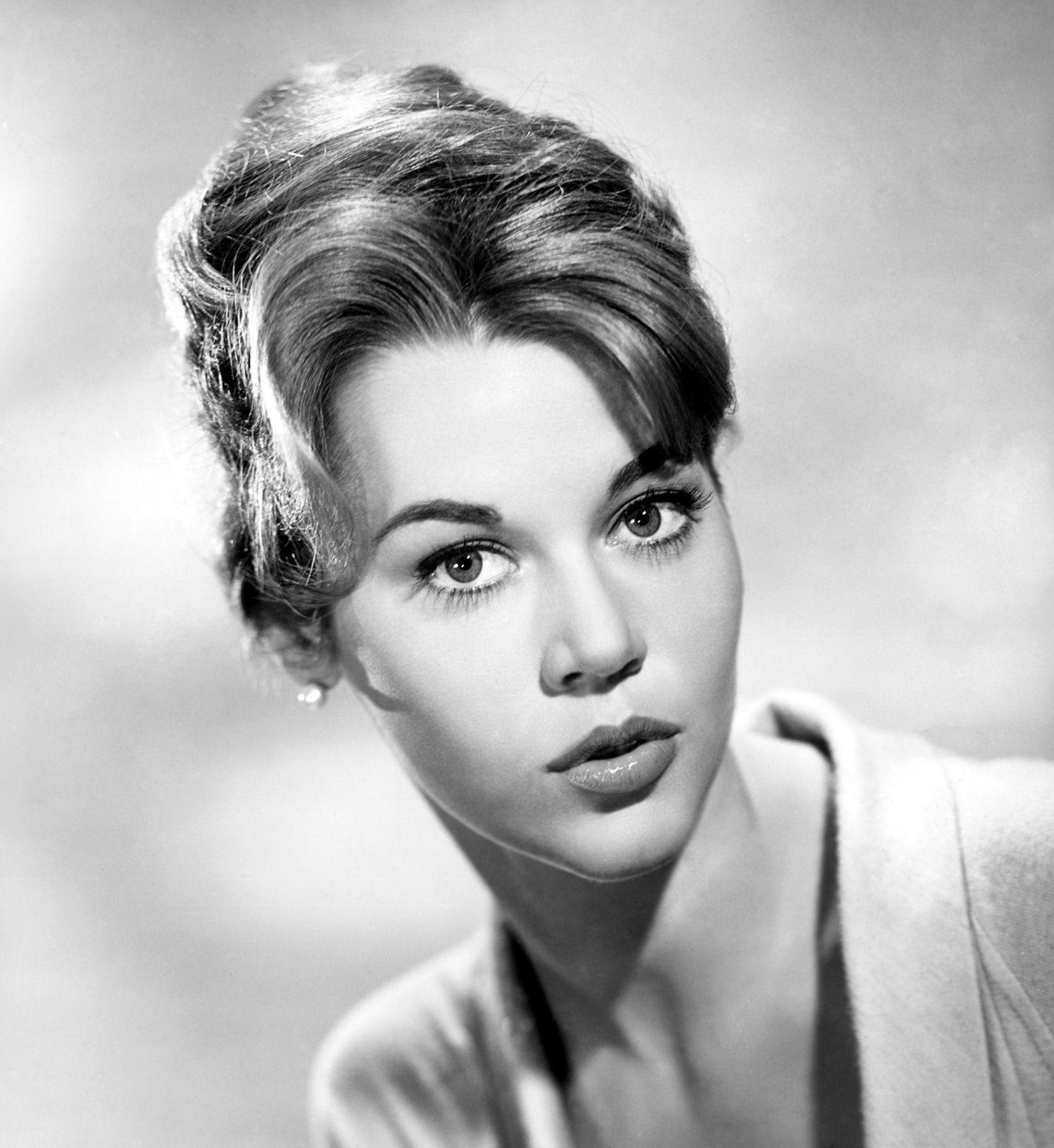
You’ve seen them on Pinterest, or maybe floating around some retro-aesthetic Instagram page: those grainy, high-contrast young Jane Fonda images that feel more like a mood board than a history lesson. There is something about her early visual output that just hits different. It isn’t just that she was "Hollywood royalty" or the daughter of the legendary Henry Fonda. It’s the sheer, whiplash-inducing speed at which she transformed from a Vassar girl in pearls to a space-age siren, then finally to a radical activist with a haircut that quite literally changed the world.
Honestly, looking at her 1960s photography is like watching someone try on identities until they find the one that fits. She wasn't born "Hanoi Jane," and she certainly wasn't born the "Workout Queen." She started as a model, appearing on the cover of Vogue twice before she even really made it as an actress.
The Modeling Days and the "Vogue" Aesthetic
Back in the late 1950s and very early 1960s, Jane Fonda was the quintessential "All-American" girl. But even then, there was a stiffness she was trying to shake. Photographers like Horst P. Horst captured her in 1959 wearing David Crystal plaid dresses, looking like a literal doll in a dollhouse. She’s often seen with that signature 50s bouffant—hair that didn't move, sprayed into submission.
In these early young Jane Fonda images, you can see the pressure of the era. She later admitted in her memoir, My Life So Far, that she was "horrified" by the studio makeovers. They tried to give her "eagle wing" eyebrows and even suggested she have her jaw broken and reset to create a more "chiseled" look. Luckily, she didn't do it.
Instead, she moved to Paris.
The French Transformation: Barbarella and Roger Vadim
When Jane met director Roger Vadim, her visual identity took a hard left turn. This is the era that gave us the most iconic young Jane Fonda images—the Barbarella years.
If you look at the 1967 set photos taken by British photographer David Hurn, you see a woman who has completely leaned into the "intergalactic sexpot" vibe. Paco Rabanne-inspired chainmail, go-go boots, and that massive, windswept blonde hair. It was a spectacle. These images didn't just sell movie tickets; they defined the "Swinging Sixties" aesthetic.
Why the Barbarella Images Still Trend:
- The Contrast: One minute she's in a white chiffon gown at the Venice Film Festival, and the next she’s in a "space-age" costume made of plastic and metal.
- The Rawness: Behind-the-scenes shots from the Dino Di Laurentis Studios in Rome show a vulnerability. She was playing a character she later described as "innocent," despite the film's "condemned" rating from the National Catholic Office for Motion Pictures.
- The Photography: David Hurn lived next to Fonda and Vadim for nine months. His images aren't just PR stills; they are intimate glimpses into a marriage and a career on the verge of a total meltdown.
The 1970 Mugshot: The Image That Defined a Movement
If Barbarella was the peak of her "sex symbol" era, 1970 was the year she burned it all down. Basically, she got tired of the blonde bouffant. She walked into a salon, met hairstylist Paul McGregor, and told him to "do something."
The result? The Klute shag.
This wasn't just a haircut; it was a political statement. When you look at her 1970 mugshot—arrested in Cleveland on suspicion of drug trafficking (which was later revealed to be just vitamins)—you see a woman who looks nothing like the girl in the 1959 Vogue ads. She has dark, choppy hair and a defiant fist raised in the air.
That specific image is arguably the most famous young Jane Fonda photo in existence. It marks the moment she transitioned from a starlet into a full-blown activist. She began supporting the Black Panthers, the Civil Rights Movement, and the American Indian Movement. The photography from this era is gritty. It’s black and white. It’s captured on the move at rallies or at the University of New Mexico.
What Most People Get Wrong About "Hanoi Jane"
You can't talk about young Jane Fonda images without mentioning the 1972 photo of her sitting on a North Vietnamese anti-aircraft gun in Hanoi. It’s the image that earned her the nickname "Hanoi Jane" and led to her being blacklisted in Hollywood for years.
Context matters. While she has apologized repeatedly for the optics of that specific photo—calling it a "betrayal" of American soldiers—the image itself was a turning point. It shows the power of a single photograph to define a legacy. For many, that one image eclipsed her Academy Award-winning performance in Klute (1971) or her work in Coming Home (1978).
The Legacy of the "Workout" Images
By the time the late 70s rolled around, Fonda was evolving again. The young Jane Fonda images of this era transition from the gritty activist to the pioneer of the home fitness revolution.
In 1981, photographer Steve Schapiro captured the images for the Jane Fonda's Workout Book. These weren't the polished, airbrushed fitness photos we see today. They were shot in a studio with one camera and no professional hairdressers. "We did it in three days," she recalled. These images—striped leotards, leg warmers, and a lot of sweat—created a multi-million dollar industry and redefined what it meant to "look like Jane."
Actionable Insights for Fans and Historians
If you’re looking to source or study young Jane Fonda images for a project or your own collection, keep these things in mind:
- Check the Photographer: For the most authentic 1960s vibes, look for works by David Hurn (Magnum Photos) or Carlo Bavagnoli. They captured the transition better than any studio headshots.
- Verify the Era by the Hair: If she has the bouffant, it’s early 60s/Starlet era. If it’s the shag, it’s the 1970-1972 Activist era. If it’s the perm/big hair, you’ve hit the 1980s Workout years.
- Look for the Mugshot T-Shirt: The 1970 mugshot is now so iconic that it’s printed on t-shirts sold at her own "Fire Drill Fridays" protests. It’s a rare case of a celebrity reclaiming a "negative" image and turning it into a symbol of resistance.
- Use Archival Sources: Instead of low-res Pinterest rips, check the Silver Screen Collection or the Bettmann Archive. These contain the high-fidelity versions of her most famous movie stills, from Cat Ballou to They Shoot Horses, Don’t They?
The evolution of Jane Fonda's public image isn't just about fashion; it's a visual record of a woman refusing to stay in the box society built for her. Whether she was in a space-age bikini or a police station, she was always, quite clearly, in control of the frame.
To dig deeper into her visual history, you should start by comparing the 1968 LIFE Magazine cover (Barbarella) with the 1970 Cleveland mugshot. The shift in those two years tells you everything you need to know about how Hollywood—and Jane herself—changed forever.



