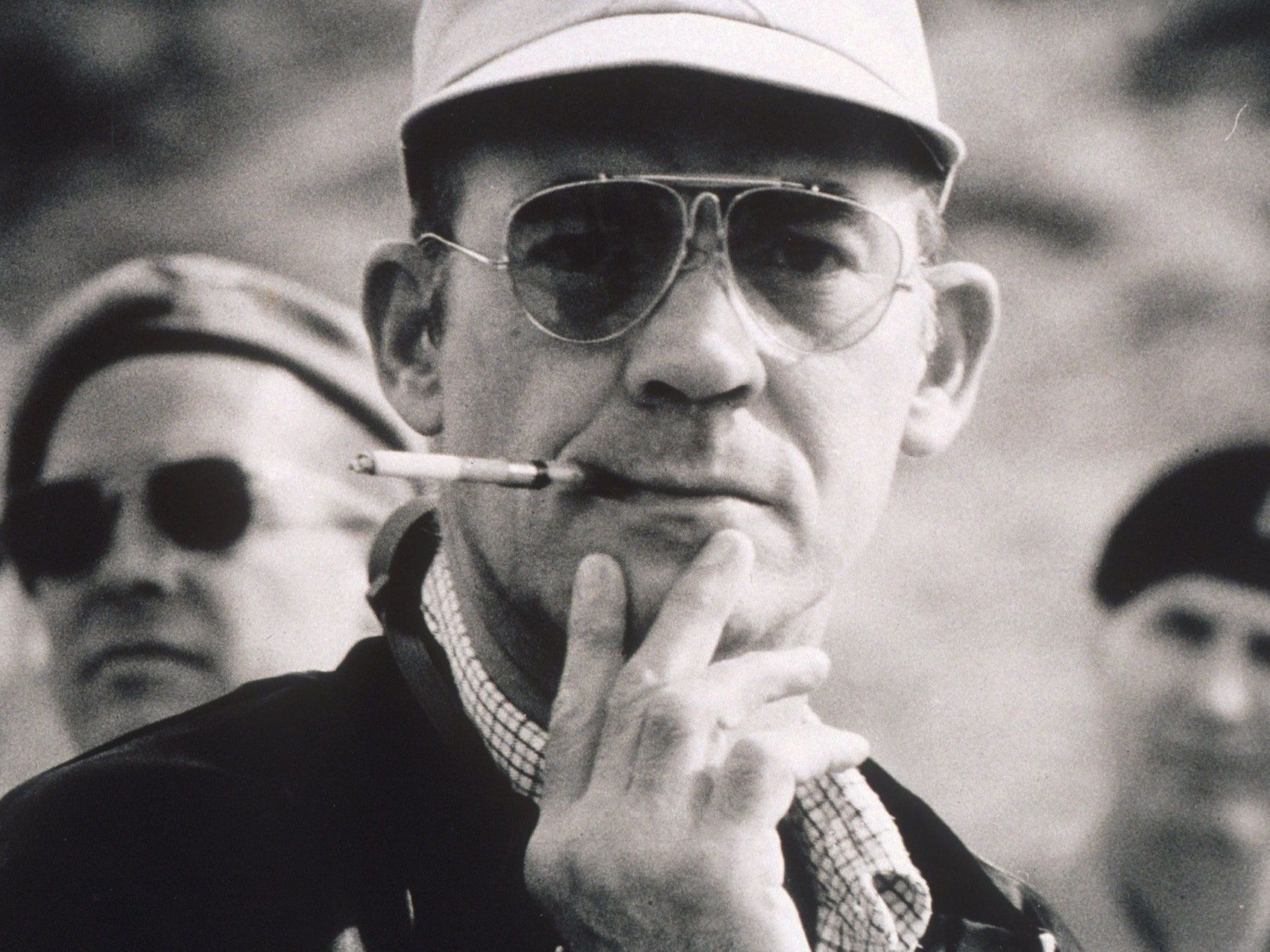
Before the aviator shades, the cigarette holder, and the wild caricature of a man who ran for sheriff on a "Freak Power" ticket, Hunter S. Thompson was just a kid from Louisville trying not to go to jail. Most people picture him as a fully-formed agent of chaos dropping acid in Las Vegas, but the origin story is way more desperate. It’s a story of a middle-class kid who lost his father young and decided that if the world was going to be rigged, he might as well be the one holding the deck.
The myth starts in 1956. Hunter was a high school senior at Louisville Male High School, but he didn't get to walk at graduation. Instead, he was sitting in a jail cell. He’d been the passenger in a car involved in a mugging, and the judge gave him a classic 1950s ultimatum: prison or the military. Hunter took the Air Force.
The Air Force Hustle and the Birth of a Liar
He wasn't exactly a model airman. Stationed at Eglin Air Force Base in Florida, Thompson realized pretty quickly that the best way to avoid scrubbing floors was to become a writer. There was just one problem: he wasn't a journalist.
So, he lied.
He managed to snag the job of sports editor for the base newspaper, The Command Courier, by essentially inventing a resume. It’s funny, honestly. Here was a teenager who had never written a professional word in his life, suddenly in charge of covering the base football team, the Eglin Eagles. He’d travel with the team, filing reports that were already showing signs of that "Gonzo" flair—heavy on the drama, light on the dry stats.
But the Air Force didn't really appreciate his vibe. His superiors noted that he had "little consideration for military bearing" and basically just wanted out. He was eventually given an honorable discharge in 1958, mostly because the military realized he was more trouble than he was worth. They described him as "talented but uncontrollable."
Copying the Greats (Literally)
After the military, Hunter drifted to New York City. He was broke, living in a tiny room in Morningside Heights, and trying to figure out how to be the next F. Scott Fitzgerald. He didn't just read books; he obsessed over them.
You’ve probably heard the legend: Hunter S. Thompson used to sit at his typewriter and re-type the entirety of The Great Gatsby and Hemingway’s A Farewell to Arms. He wasn't trying to plagiarize. He wanted to feel what it felt like to write those sentences. He wanted the rhythm of the words to get into his fingers. He was a copy boy at Time magazine for a hot minute, making about $51 a week, until he got fired for—surprise—insubordination.
He apparently kicked a vending machine or insulted an editor; the details vary, but the result was the same. He was persona non grata in the "respectable" New York publishing world.
The Caribbean and the "Rum Diary" Days
By 1960, he’d had enough of New York. He headed to San Juan, Puerto Rico, to work for a bowling magazine that folded almost immediately. He ended up as a stringer, living a life that sounds exactly like his novel The Rum Diary.
- Poverty: He was constantly on the edge of being evicted.
- Alcohol: Plenty of cheap rum and late-night arguments.
- Ambition: He was writing thousands of letters to friends and editors, trying to sell stories that nobody wanted.
This is the Hunter people forget. He wasn't a celebrity; he was a struggling freelancer who couldn't pay his rent. He even tried out for a job at the San Juan Star, but the editor—William J. Kennedy, who later won a Pulitzer—turned him down.
Big Sur and the Security Guard Phase
Eventually, he made his way back to the States and ended up in Big Sur, California. This was before it was a billionaire's playground. Back then, it was a rugged outpost for Bohemians and writers like Henry Miller.
Hunter took a job as a security guard and caretaker at Slates Hot Springs (which later became the Esalen Institute). It was a weird gig. He patrolled the grounds with a billy club and a pistol, occasionally getting into fights with "homosexual bathers" and locals. He was still trying to finish a novel, still sending out angry letters, and still perfecting that sharp, biting prose that would eventually change journalism forever.
He finally got a break when Rogue magazine paid him $350 for an article about the Big Sur scene. It was his first real "feature," and you can see the seeds of the later Hunter in it—the way he described the "Tropic of Henry Miller" was more about the feeling of the place than the facts.
The Road to the Hell’s Angels
The turning point that everyone knows is the Hell's Angels book, but even that was a bit of a fluke. He was living in San Francisco in the mid-60s, watching the Haight-Ashbury scene explode, when he wrote an article for The Nation about the motorcycle gang.
It was a sensation. Publishers started throwing money at him to write a book. He spent a year riding with the Angels, getting stomped on by them toward the end, and finally becoming a "somebody."
But the "Young Hunter" was the one who did the heavy lifting. He was the one who learned to type by copying Fitzgerald. He was the one who got fired from every "real" job he ever had because he couldn't stand being told what to do.
What We Can Learn From the Young Thompson
If you’re looking for a takeaway from the early years of Hunter S. Thompson, it’s not that you should go out and get arrested or buy a magnum of rum. It’s about relentless output. Even when he was starving, Thompson was writing. His letters from that era show a guy who was absolutely committed to his craft, even when the world was telling him to shut up. He didn't wait for permission to be a writer. He just wrote until people couldn't ignore him anymore.
Actionable Insights for Aspiring Writers:
- Find Your Rhythm: Don't just read your favorite authors. Type out their work. See how they transition between thoughts. It sounds crazy, but it works.
- Lean Into the Friction: If you keep getting fired or "rejected" by the mainstream, it might be because you have a voice that doesn't fit a box. Instead of smoothing your edges, sharpen them.
- The "Letter" Strategy: Thompson’s best writing often appeared in his personal letters before it made it into print. Treat every email or post like it's a draft for your masterpiece.
- Embrace the "Liar's Resume": Sometimes you have to claim the title before you have the credentials. Just make sure you can deliver the work once you get the gig.
The young Hunter S. Thompson wasn't a legend; he was a survivor. He turned a jail sentence into a career and a rejection letter into a lifestyle. That’s the real Gonzo spirit.
Pick up a copy of The Proud Highway to read his actual letters from this era. It's the best way to see the man before the myth. For a deeper look at his San Francisco years, track down his original 1965 article for The Nation on the motorcycle outlaws.



