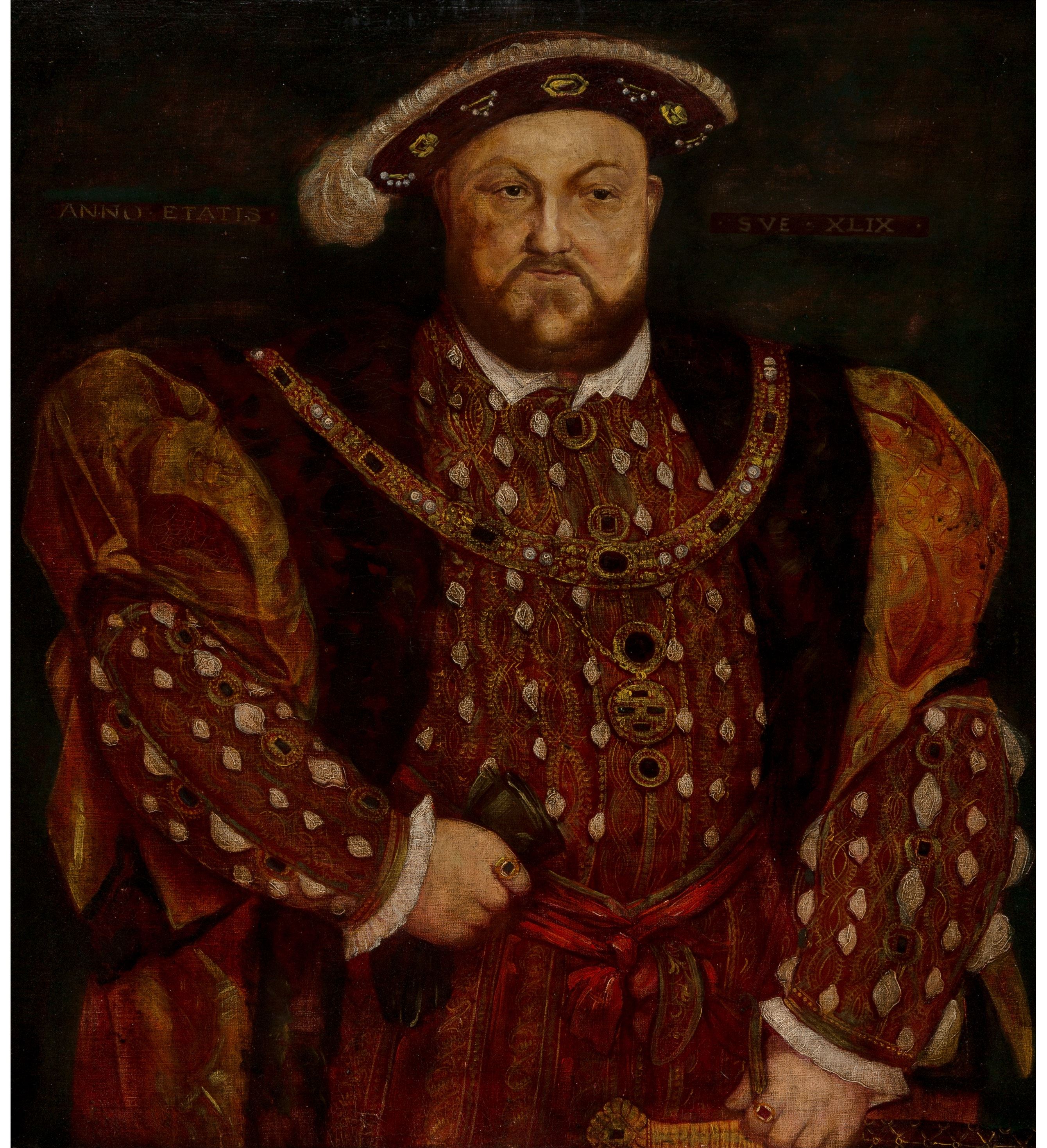
When you picture Henry VIII, you probably see a massive, bearded man glaring from a Holbein portrait. He's usually clutching a giant turkey leg or screaming for someone’s head. He's the guy who broke the church because he was obsessed with a specific woman, right? Honestly, that version of him is basically a caricature. It’s the "Old Henry"—the sick, paranoid, and morbidly obese version of a man who actually started his life as the golden boy of Europe.
Young Henry VIII was different. Like, fundamentally different.
He was the spare, not the heir. Born in 1491, he wasn't even supposed to be king. His older brother Arthur was the one being groomed for the throne while Henry was likely being steered toward a career in the church. Because of that, he was ridiculously well-educated. We’re talking about a kid who spoke multiple languages and wrote music that people still listen to today. When Arthur died unexpectedly in 1502, the entire trajectory of English history shifted. Henry went from being the forgotten second son to the most important teenager in the world.
The Athlete and the Idol
Forget the turkey leg. Seriously.
In his twenties, Henry was a physical specimen. He was 6'2", which was massive for the 1500s. He had a 32-inch waist. Imagine a modern elite athlete—maybe a mix between a star quarterback and a heavyweight boxer—and you’re getting close to how his contemporaries described him. He didn’t just watch sports; he dominated them. He spent his days wrestling, hunting for hours on end, and playing "real tennis" with such intensity that he’d change his shirt six times a day because he was sweating through them.
The Venetian ambassador, Sebastian Giustinian, wrote back home in 1519 that Henry was "the handsomest potentate I ever set eyes on." He had a complexion that was "fair and as bright as a woman’s." That sounds a bit weird to us now, but back then, it was the ultimate compliment for a royal. It meant he didn't have to work in the fields. He was the "Rose without a Thorn."
He loved jousting. It was his obsession. It was dangerous, loud, and incredibly expensive. It was the Formula 1 of the 16th century. Henry didn't just host the tournaments; he rode in them, often anonymously at first, just to prove he could win on merit rather than his title. He was a thrill-seeker. This wasn't a man who wanted to sit behind a desk and sign papers. He wanted to be in the thick of the action, hearing the wood of a lance shatter against his chest.
A Renaissance Mind in a Suit of Armor
It wasn't just about the physical stuff, though. That’s a common misconception.
Henry was a massive nerd. He was genuinely interested in theology, math, and astronomy. He invited Erasmus, the most famous scholar in Europe, to his court. He composed songs like "Pastime with Good Company," which wasn't just a hobby; it was a way to show he was a sophisticated Renaissance prince. He played the lute and the organ. He sang. He danced until the sun came up.
- He owned a massive collection of clocks and scientific instruments.
- His library was one of the best in England.
- He wrote a book defending the Pope—the Assertio Septem Sacramentorum—which earned him the title "Defender of the Faith."
The irony there is almost too much to handle, considering what he did later. But in his youth, he was the Pope's golden boy. He was deeply, almost performatively, religious. He’d hear three or four masses a day when he wasn't out hunting. People thought he was going to usher in a new age of enlightenment. He was the "Humanist King."
The Marriage to Catherine of Aragon
We have to talk about Catherine. Pop culture usually portrays her as this dowdy, boring older woman who Henry ditched for a younger model.
That’s just wrong.
When they married in 1509, she was a total catch. She was the daughter of Isabella and Ferdinand of Spain—the most powerful people in the world. She was beautiful, smart, and just as educated as Henry. For the first decade of their marriage, they were actually happy. Like, genuinely in love. They rode together, they hunted together, and she even acted as his regent while he was away at war in France. In 1513, while Henry was playing soldier in Europe, Catherine was the one who oversaw the defense of England against the Scots at the Battle of Flodden. She sent Henry a piece of the Scottish King’s bloodied coat as a victory gift.
They were a power couple.
The tragedy of young Henry VIII isn't that he hated Catherine from the start. It’s that he became obsessed with the lack of a male heir. He saw it as a literal curse from God. He started looking at a verse in Leviticus that said if a man takes his brother’s wife, they shall be childless. Even though they had a daughter, Mary, Henry’s ego couldn't handle the idea that the Tudor dynasty might end with him.
The Turning Point: 1536
If you're looking for the moment the "Golden Prince" died and the "Tyrant" was born, 1536 is the year.
A lot happened. Anne Boleyn was executed. Catherine of Aragon died. But the big one was a jousting accident. Henry was thrown from his horse while wearing full armor, and the horse—also armored—fell on top of him. He was unconscious for two hours. Some historians, like Dr. Lucy Worsley, argue that this caused a traumatic brain injury (TBI).
Before the accident: Generous, athletic, charismatic. After the accident: Paranoiac, explosive, and unable to exercise.
His leg never healed properly. He developed chronic ulcerations that smelled so bad you could hear (and smell) him coming from several rooms away. Because he couldn't move but kept eating like an athlete—consuming upwards of 5,000 calories a day of meat, bread, and ale—he ballooned. The "spare" who became a "star" became a prisoner of his own body.
Why Young Henry Still Matters
Most people study Henry VIII as a political figure or a religious reformer. But if you want to understand why England looks the way it does, you have to look at the psychology of the young man.
He was a man of huge appetites and even bigger insecurities. He spent his youth trying to outshine his father, Henry VII, who was famously stingy and boring. Young Henry wanted glory. He wanted to be remembered as a conqueror like Henry V. He spent the entire English treasury on useless wars in France just to see his name in the history books.
He was a "breach of contract" personified. He broke the rules because he felt he was divinely appointed to do so. That sense of exceptionalism started when he was a teenager. When he realized the Pope wouldn't give him what he wanted, he didn't just complain; he declared himself the head of the church. That’s the kind of confidence you only get if you spent your twenties being told you’re the most perfect human being alive.
- The Navy: Henry is often called the "Father of the Royal Navy." He went from owning five ships to over fifty. He built the Mary Rose. He saw England as an island nation that needed to dominate the seas.
- The Architecture: He built Hampton Court Palace (well, he took it from Cardinal Wolsey) and Nonsuch Palace. He wanted everything to be grander than what the French kings had.
- The Bureaucracy: Even though he hated paperwork, he empowered people like Thomas Wolsey and Thomas Cromwell to modernize how England was run.
Exploring the Reality
If you're looking to dive deeper into who this guy actually was, don't just watch the movies. Most films get the costumes right but the vibe totally wrong. They make him look like a villain from page one. In reality, the people of England loved him for a long time. He was charming. He was approachable in a way his father never was.
To get a real sense of his world, you should check out the primary sources. Read the letters he wrote to Anne Boleyn when he was "in his youth" (though he was in his late 30s then, he was still clinging to that younger persona). They are surprisingly mushy and desperate. It shows a man who was ruled by his emotions rather than just cold, hard strategy.
Also, look at the armor. If you ever visit the Tower of London, look at the progression of his armor sets. You can literally see him growing. Not just in height, but in girth. You can see the point where the athlete disappears and the heavy, sedentary king takes over. It’s one of the most visceral ways to track a human life through metal.
What You Should Do Next
History isn't just about dates; it's about the "why" behind the "what." To truly grasp the impact of Henry's early years, here are a few specific steps to take:
- Listen to his music. Search for "Pastime with Good Company" on Spotify or YouTube. It gives you a direct link to his creative mind. It’s catchy, even 500 years later.
- Visit Hampton Court Palace virtually. Many museums offer high-resolution tours. Look at the Great Hall. Imagine it filled with hundreds of people, dogs, and the smell of roasting meat. That was his world.
- Read "The Autobiography of Henry VIII" by Margaret George. It’s historical fiction, but it’s impeccably researched. It gets inside his head better than almost any dry biography.
- Analyze the Holbein Portraits. Look at the "Thrasher" portrait. Notice the stance. It’s a stance of defiance. Henry was the first king to really use art as a weapon of propaganda.
The story of the young king is a reminder that people aren't born as monsters or icons. They are shaped by their accidents, their insecurities, and their environment. Henry wasn't born a tyrant; he was born a prince who had everything, and that's exactly why he couldn't handle it when he finally found something he couldn't have.