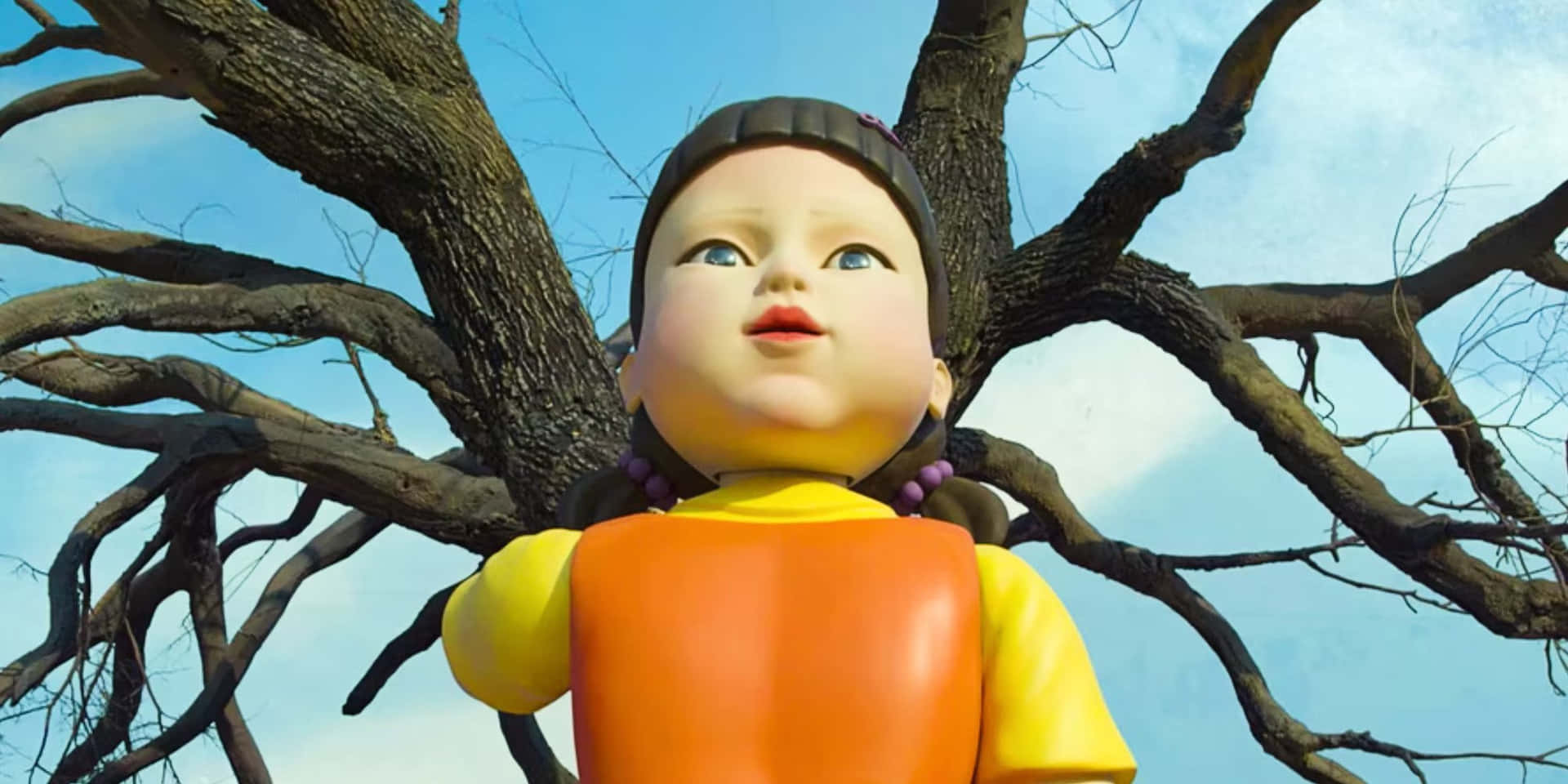
Everyone remembers that first episode. You're sitting there, maybe a little skeptical of the hype, and then you see her. A massive, pigtail-wearing robot standing in an open field. She looks innocent, almost like something out of a dusty 1970s textbook. Then the head spins 180 degrees with a mechanical whir, the eyes scan the crowd with terrifying precision, and suddenly, "Red Light, Green Light" isn't a playground game anymore. It’s a massacre.
The Squid Game doll, known formally as Young-hee, became an overnight cultural icon. But she wasn't just some random prop dreamed up in a writers' room to look creepy. She has deep roots in South Korean culture that most Western viewers completely missed. Honestly, the fact that she’s based on a character from children’s books makes her role in the show way more disturbing than if she were just a generic monster.
Where Young-hee Actually Came From
The design of the Squid Game doll isn't an original creation of director Hwang Dong-hyuk in the sense that he built her from scratch. She is a direct reference to a character from Korean textbooks used in the 1970s and 80s. In those books, there was a duo—a boy named Cheol-su and a girl named Young-hee. They were the "Dick and Jane" of South Korea. They represented childhood innocence, the standard for a "good" student, and the nostalgia of a generation that grew up during a period of intense economic transition.
Hwang Dong-hyuk has mentioned in several interviews that he wanted to take the most familiar, safe imagery from his own childhood and twist it. By putting Young-hee in charge of a lethal game, he wasn't just creating a jump scare. He was signaling the death of innocence. It's a heavy-handed metaphor, sure, but it works because of the visual contrast. You have this bright, orange-and-yellow-clad figure standing against a bleak, gray landscape and the green tracksuits of the players. It’s jarring. It’s supposed to be.
The actual physical prop used in the filming wasn't a CGI creation. It was a real, massive statue. After filming wrapped on the first season, she didn't head to a museum or a landfill. For a long time, the doll was actually stored at a horse carriage museum called Macha Land in Jincheon County, about three hours north of Seoul.
People actually flocked there to see her. It became a bizarre tourist attraction. However, there was a bit of a mishap; the museum accidentally put her on display when she was supposed to be kept in storage. One of her hands even went missing during the shuffle. It adds to the eerie vibe—this giant, broken, murderous schoolgirl just chilling in a rural Korean museum.
The Engineering of a Nightmare
When we talk about why the Squid Game doll works so well as a horror element, we have to look at the "Uncanny Valley." This is that psychological sweet spot where something looks almost human, but not quite, which triggers a biological revulsion in our brains. Young-hee hits every note. Her movements are jerky. Her eyes move like high-tech security cameras. She doesn't have a mouth that moves, which somehow makes her more menacing.
The "Mugunghwa kkochi pieotseumnida" chant she sings is the Korean version of "Red Light, Green Light." Literally translated, it means "The hibiscus flower has bloomed." The hibiscus is the national flower of South Korea. So, you have this patriotic, innocent, nostalgic song being sung by a giant robot that is literally scanning for heartbeats to stop.
The tech behind the doll in the show—the motion sensors and the sniper-linked optics—is obviously sci-fi. But in the real world, the production team spent ages getting the scale right. She had to be tall enough to overlook the entire field, making the players feel like ants. If she were human-sized, it wouldn't have the same "all-seeing god" energy. She’s the referee, the judge, and the executioner all rolled into one plastic shell.
Why the Squid Game Doll Ruled Social Media
You couldn't escape her in 2021. From TikTok filters to Halloween costumes, Young-hee was everywhere. Why? Because she’s a perfect visual shorthand for the show's themes. You don't need to explain the plot of Squid Game to someone if you show them the doll. They get it. It's "childhood game plus death."
Interestingly, the doll appeared in promotional pop-ups all over the globe. There was a version in a mall in the Philippines that would turn its head and glow red if someone tried to cross the street against the walk signal. Netflix's marketing team knew exactly what they were doing. They turned a symbol of state-mandated education into a viral marketing tool.
Some critics argued that the over-commercialization of the doll diluted the show's anti-capitalist message. There is a weird irony in selling plastic toys of a character that represents the cold, mechanical nature of a system that kills the poor for sport. But hey, that's the world we live in. The doll moved from a critique of society to a product of society in record time.
Misconceptions and Urban Legends
There's a persistent rumor that the doll is "haunted" or based on a real-life ghost story from a Korean school. That’s basically nonsense. While South Korea has plenty of urban legends about statues coming to life at night in schools—usually statues of famous historical figures like Admiral Yi Sun-sin—Young-hee herself doesn't have a supernatural backstory. She’s a product of the educational system, which, in its own way, is a different kind of scary to a lot of people who went through the grueling Korean school system.
Another misconception is that the doll was built specifically for the show and destroyed afterward. As I mentioned, the "real" Young-hee lived at Macha Land for a while. However, as Season 2 approached, rumors swirled about her return. Netflix teaser trailers confirmed that we haven't seen the last of this aesthetic. But it might not be the same doll. In the world of the show, there’s actually a "boyfriend" character in the original textbooks named Cheol-su. Director Hwang hinted that we might meet him in the sequel. Imagine a male version of that doll. It's a terrifying thought.
Impact on the Horror Genre
Before Squid Game, giant dolls were a bit of a cliché. You had Chucky, Annabelle, and those creepy porcelain things in various B-movies. But the Squid Game doll changed the scale. She brought a sense of industrial, mechanical dread that we usually associate with Terminator or Robocop and fused it with the aesthetic of a kindergarten classroom.
She also solidified the "Deadly Game" subgenre in a way that Battle Royale or The Hunger Games didn't quite manage for a mainstream Western audience. There’s something specifically "Gen Z" and "Millennial" about the doll's aesthetic—it’s high-definition, brightly colored, and deeply cynical.
How to Experience the Young-hee Phenomenon Today
If you're looking to dive deeper into the world of Young-hee, you don't have to wait for the next season. There are several ways to engage with this piece of pop culture history:
- Visit South Korea: While the original prop's status is sometimes kept under wraps for maintenance or filming, various replicas exist in Seoul, particularly around Itaewon and major Netflix promotional zones during release windows.
- The Original Textbooks: If you're a hardcore collector, look for vintage "Cheol-su and Young-hee" textbooks from the 70s and 80s on Korean auction sites. It’s fascinating to see the "innocent" version of the character.
- Study the Language: Learning the "Mugunghwa" song gives you a lot of insight into the rhythm and pace of the game. It’s not just a random tune; the speed at which the sentence is finished is what dictates the difficulty of the game.
- Fan Theory Communities: Sites like Reddit have massive threads dedicated to the mechanical specs of the doll. Some people have even tried to calculate her "field of vision" based on the camera angles in the show.
The Squid Game doll is more than a prop. She’s a cultural bridge. She connects the nostalgic past of a developing nation to the cynical, globalized present. Whether you see her as a cool piece of production design or a haunting symbol of systemic cruelty, one thing is for sure: you’ll never look at a game of "Red Light, Green Light" the same way again.
Honestly, just stay still when the music stops. It's better for everyone.



