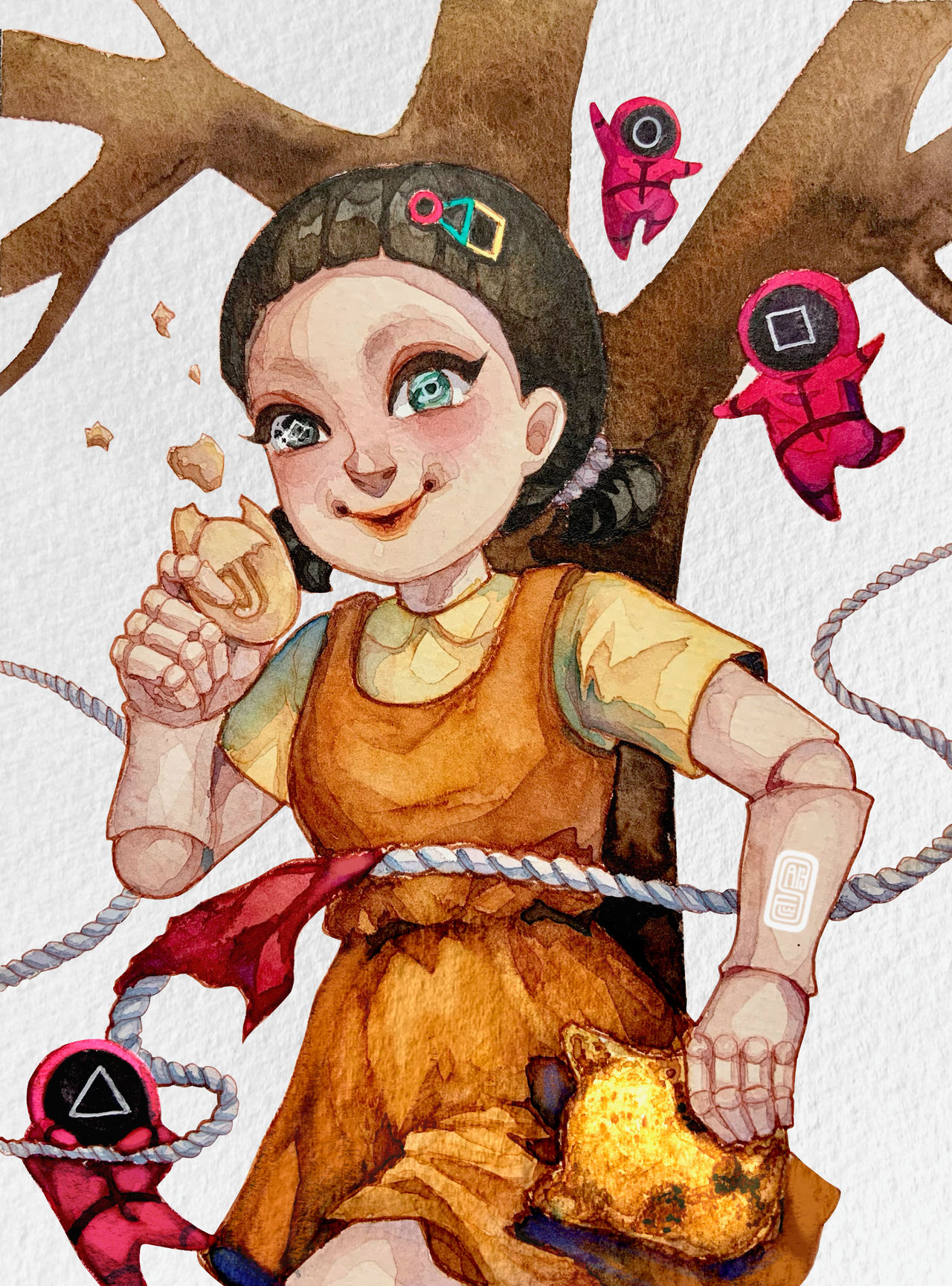
That giant, robotic girl standing in an open field remains the most haunting image from Netflix's biggest hit. You know her. The cold, mechanical swivel of the head. Those unblinking eyes. The sing-song chant of "Mugunghwa kkochi pieotseumnida." Honestly, Young-hee—the official name of the Squid Game doll—became an overnight cultural titan for a reason. She wasn't just a prop; she was the face of a global phenomenon that turned playground nostalgia into a literal bloodbath.
It's creepy.
But where did she actually come from? Most people think she was just dreamed up in a writer's room to be scary. That's only half the story. Director Hwang Dong-hyuk didn't pull her out of thin air. He reached deep into Korean childhood memories from the 70s and 80s. Young-hee and her male counterpart, Cheol-su, were the "Jane and Dick" of South Korean school textbooks back in the day. They were the gold standard for wholesome, innocent childhood.
Seeing her transformed into a motion-sensing sniper machine was a massive gut punch for Korean audiences. It took something safe and made it a nightmare.
The Machine Behind the Motion: How Young-hee Works
The Squid Game doll isn't just a statue. For the production, the crew built a massive, functioning animatronic. She’s huge. If you were standing next to her on set, you'd be looking up at a ten-foot-tall figure that weighs enough to require a serious foundation.
Production designer Chae Kyoung-sun has talked about the specific color palette used for Young-hee. Those bright oranges and yellows? They’re meant to mimic the actual illustrations from old textbooks. The contrast is the point. You have this vibrant, childlike figure looming over a dusty, grey field filled with people in teal tracksuits. It’s visual whiplash.
The eyes are the most technical part. In the show, they use high-speed cameras to detect movement. In reality, the prop used on set was a mix of practical effects and post-production CGI to give it that "unnatural" robotic fluidity. When her head snaps 180 degrees, it’s not just a jump scare. It’s a violation of how we expect a "little girl" to move.
Where is the doll now?
After filming wrapped, the Squid Game doll actually went back home. Sorta.
She was moved to a horse carriage museum called Macha Land in Jincheon County, a rural area about three hours north of Seoul. For a while, fans could actually go visit her. She stood guard at the entrance, though she was missing a hand (it apparently got damaged during transport or storage). However, once the show blew up and the museum started getting swamped with more visitors than they could handle, she was reportedly moved into storage to protect the IP and the physical structure itself.
It’s weird to think of a global icon just sitting in a dark warehouse under a tarp, but that’s the reality of TV props.
Red Light, Green Light: The Cultural Translation
The game she presides over is called Mugunghwa kkochi pieotseumnida. In English, we call it Red Light, Green Light. In the UK, it’s Statues. In Japan, it’s Daruma-san ga koronda.
The literal translation of the Korean chant is: "The Hibiscus syriacus has blossomed."
The Hibiscus is the national flower of South Korea. The chant has a specific rhythm. It’s five syllables, but the person who is "it"—in this case, our Squid Game doll—can speed up or slow down the phrase to catch people off guard. If you’re still moving when the sentence ends and she spins around, you’re out. In the show, "out" means a high-caliber round to the chest.
This game was chosen specifically because it’s a game of "forced stillness." It represents the paralyzing fear of the debt-ridden players. They have to move forward to survive, but moving at the wrong time is fatal.
Impact on Fashion and Pop Culture
The influence of this doll went way beyond Netflix. Within weeks of the premiere:
- Halloween was basically a sea of orange jumpers and yellow shirts.
- Replica dolls appeared in malls from Manila to Sydney.
- High-end fashion brands started referencing the color blocking of the 70s Korean school uniform.
Vans saw a 7,800% spike in sales for white slip-on shoes because of the show. While the players wore them, the doll’s aesthetic—that specific, neat, schoolgirl look—became a bizarrely popular costume for influencers.
It's a strange irony. A character designed to critique the way capitalism treats humans as disposable became one of the most successfully marketed toys and costumes of the decade.
Season 2 and the Return of the Nightmare
We know Squid Game is returning. And we know Young-hee isn't alone anymore.
Director Hwang Dong-hyuk has teased the introduction of Cheol-su. Remember him? The "boyfriend" or male counterpart from those same textbooks. If Young-hee was terrifying, the prospect of a duo of giant, murderous animatronics is even worse.
Netflix has already used the doll in its marketing for the upcoming season, confirming that her "family" will play a role. We might see more advanced tech, perhaps more complex games that involve team-based detection. The dread isn't going away.
Why We Can't Look Away
Psychologically, the Squid Game doll taps into something called the "Uncanny Valley." This is the point where something looks almost human, but not quite, and it triggers a deep sense of revulsion or fear in our brains.
Young-hee hits that sweet spot perfectly. Her proportions are slightly off. Her skin is too smooth. Her voice is too sweet for what she’s doing.
It’s also about the loss of innocence. We like to think of childhood as a protected time. By putting a massive schoolgirl doll in charge of a massacre, the show forces us to confront the idea that no space is truly safe. It’s a cynical, brilliant piece of character design that has earned its place in the horror hall of fame alongside Chucky or Annabelle, but with a much more "clean" and "ordered" aesthetic.
Actionable Insights for Fans and Creators
If you're looking to dive deeper into the world of Young-hee or even use her as inspiration for your own creative projects, keep these points in mind:
- Study the Source Material: Look up the "Cheol-su and Young-hee" textbook illustrations from the 70s. Understanding the wholesome origin makes the horror version much more effective.
- Visit Jincheon (With Caution): While the doll is currently in storage, the Jincheon area is where the museum is located. Check local travel forums for updates on whether she’s been put back on public display, as temporary exhibitions happen frequently in Seoul.
- Costume Accuracy: If you’re doing a cosplay, the key is the specific shade of mustard yellow and burnt orange. It’s not a standard primary yellow. The socks are also critical—white, calf-high, perfectly neat.
- Cinematography Lessons: For filmmakers, study how the camera uses "low-angle" shots on the doll to make her feel mountain-sized. The perspective is what gives her the power over the players.
- Keep an eye on Netflix’s "Tudum" site: This is where they drop the official behind-the-scenes assets. Don't rely on fan theories for the new season; the production notes often contain details about the new animatronics being built for Season 2.
The Squid Game doll changed how we look at playground games forever. She’s a reminder that sometimes the scariest things aren’t monsters or ghosts—they’re the memories of our own childhood twisted into something unrecognizable. Keep your eyes open, stay perfectly still when the music stops, and maybe don't wear teal in a dusty field anytime soon.



