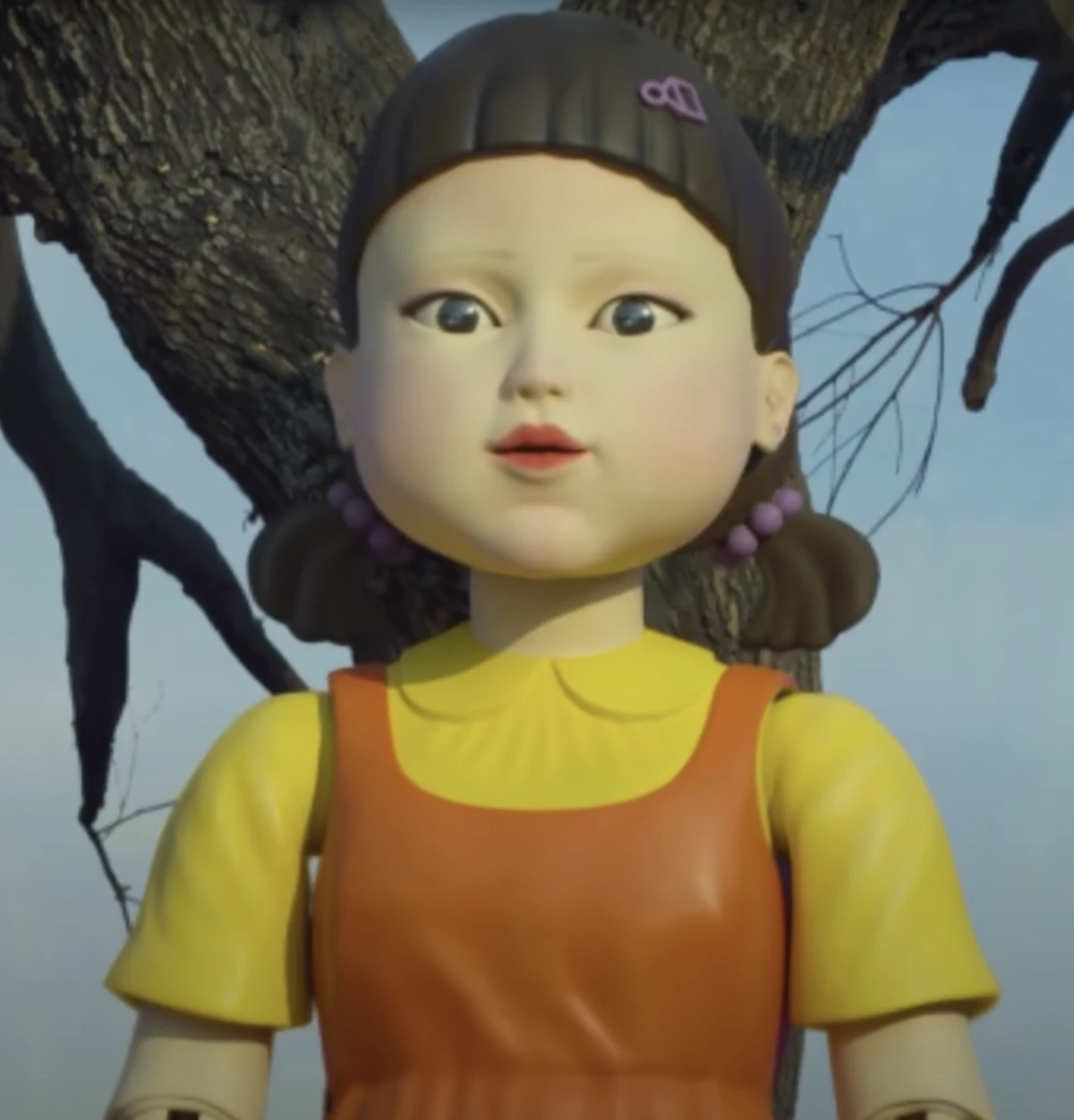
You know the feeling. That high-pitched, sing-song voice starts chanting. Mugunghwa kkochi pieot seumnida. It’s catchy, right? Until the head snaps around with a mechanical whir and those motion-sensor eyes lock onto you. If you flinch, you’re dead. This is Young Hee Squid Game, the towering mascot of Netflix’s most massive hit, and she’s basically become the international face of childhood-turned-lethal.
She isn't just some random creepy prop. She’s a cultural icon. Don't miss our earlier post on this related article.
When Squid Game dropped in 2021, the world lost its collective mind over the "Red Light, Green Light" doll. We saw her everywhere—from Halloween costumes to giant replicas in shopping malls from Sydney to Seoul. But honestly, most people don't realize that Young Hee has a history that goes way back before Hwang Dong-hyuk ever wrote a script. She’s deeply rooted in South Korean nostalgia, which is exactly why she’s so terrifying. It’s the subversion of innocence. Taking something you loved as a kid and turning it into a literal killing machine is a classic horror trope, but the Young Hee Squid Game doll does it with a specific kind of cold, mechanical efficiency that feels different.
The Real Story Behind the Design
So, where did she actually come from? To read more about the history of this, Variety offers an in-depth summary.
She wasn't invented in a writer's room. Young Hee is actually a character from Korean textbooks used in the 1970s and 80s. Think of her as the Korean version of "Jane" from the Dick and Jane books. She usually appeared alongside a boy named Cheol-su. They were the "every-kids." They represented safety, education, and the simple days of growing up in a developing nation. By choosing Young Hee, the showrunners tapped into a very specific, visceral childhood memory for millions of Koreans.
The physical doll used in the show wasn't a CGI creation either. That was a real, physical prop. Interestingly, after filming wrapped, the production team actually stored the doll at a horse carriage museum called Macha Land in Jincheon County, about three hours outside of Seoul. For a while, fans could actually visit her, though reports later surfaced that she was missing a hand and eventually got moved into storage or covered up because the attention was just too much for the quiet museum.
Why the Design Works
There’s a concept in robotics and horror called the "Uncanny Valley." It’s that point where something looks almost human, but not quite, and it triggers a "flight or fight" response in our brains.
The Young Hee Squid Game doll nails this. Her pigtails are perfectly neat. Her yellow shirt and orange jumper are bright and cheerful. Her face is round and friendly. But those eyes? They don’t blink. They rotate. They scan for the slightest tremor in a human muscle. The contrast between her schoolgirl aesthetic and the high-tech sniper rifles hidden behind the walls is the core of the show’s visual identity. It’s the "death of childhood" represented in a single frame.
The Viral Impact of the Red Light, Green Light Doll
Let’s be real: the first episode, "Red Light, Green Light," is what hooked everyone. Without the Young Hee Squid Game doll, the series might have been just another survival thriller. Instead, it became a meme-able, TikTok-dominating juggernaut.
- The Global Replicas: Netflix knew they had a hit. They put a three-meter-tall replica in a mall in the Philippines to catch jaywalkers. People loved it. They put another one in Sydney.
- The "Chant" Explained: The phrase she says isn't actually "Red Light, Green Light." The Korean phrase Mugunghwa kkochi pieot seumnida translates to "The Hibiscus flower has bloomed." The Hibiscus is the national flower of South Korea. The game is played the same way, but the cultural weight of that specific flower adds a layer of national identity that was lost on most Western viewers.
- The Sound Design: That mechanical "click-clack" as her head rotates 180 degrees? It’s arguably more iconic than the chant itself.
It's weirdly fascinating how a character with about ten minutes of total screen time can define an entire franchise. But that’s the power of great character design. You don't need a backstory for the doll because the doll is the backstory. She represents the rules of a society that doesn't care if you're a person; it only cares if you're following the instructions.
The Psychology of Fear: Why Young Hee Still Scares Us
Why do we keep talking about her?
Part of it is the total lack of emotion. In later games, like the glass bridge or the marbles, there is human cruelty involved. But in the first game, the Young Hee Squid Game doll is just an algorithm. She doesn't hate the players. She doesn't want them to lose. She just detects motion. If $x$ moves, then $y$ happens.
That kind of cold, automated judgment is a very modern fear. We live in an age of algorithms and AI—much like the ones I'm a part of—and the idea of a giant, unfeeling machine deciding our fate based on a technicality hits close to home.
Misconceptions About the Doll
A lot of people think the doll was a haunted-house style jump scare. Honestly, it's the opposite. She stands in broad daylight. The sun is shining. The field is bright. There are no shadows to hide in. This is "Daylight Horror," a subgenre made famous by films like Midsommar. It’s much scarier because there is nowhere to run. You are exposed. The Young Hee Squid Game doll sees everything.
Another common mistake? People think she’s a villain. She’s not. She’s a tool. The real villains are the ones wearing the masks and sipping scotch while they watch the feed. Young Hee is just the interface.
How to Experience Young Hee Today
If you’re a fan, you’ve probably noticed that the doll has popped up in everything from Gears of War mods to Roblox levels. But if you want the "authentic" experience, you have to look at how the creators are evolving her for Season 2.
Director Hwang Dong-hyuk has already teased the arrival of "Cheol-su," Young Hee’s boyfriend from those old textbooks. If one giant, motion-sensing doll was bad, imagine two of them working in tandem. It’s going to be a nightmare.
Collecting the Icon
For the collectors out there, there’s no shortage of Young Hee Squid Game merch. But be careful. Most of the stuff you see online is unofficial knock-off material. If you want the real deal, look for the Funko Pops or the high-end vinyl figures released by Netflix’s official partners. Some of the early, limited-edition statues now go for hundreds of dollars on the secondary market.
Actionable Steps for Fans and Creators
If you're looking to dive deeper into the world of Squid Game or even use the Young Hee aesthetic for your own creative projects, here’s what you should actually do:
1. Study the Source Material Don't just watch the show. Look up the 1970s "Chul-soo and Young-hee" illustrations. Understanding the original art style helps you see how the showrunners distorted those features (the wide-set eyes, the specific shade of pink on the cheeks) to create discomfort. This is a masterclass in subverting expectations.
2. Explore the "Mugunghwa" Cultural Context If you’re a creator, notice how the show uses a national symbol (the Hibiscus) as a timer for death. It’s a powerful way to critique national identity. Try applying that to your own work—take a "safe" cultural symbol and place it in a high-stakes environment.
3. Visit the Real Locations (Safely) While the original doll from the set is mostly tucked away, Jincheon (where Macha Land is located) is still a fascinating spot for fans of the show's production history. Just check local travel forums first, as the "exhibits" for Squid Game props change constantly due to licensing and maintenance.
4. Prepare for Season 2 The best way to "rank" your own knowledge is to re-watch the first episode and pay attention to the doll's "rules." Every time she stops chanting, there’s a specific pattern. Learning the rhythm of the game makes the tension of the upcoming season even better because you'll be playing along in your head.
Young Hee changed the way we look at playground games. She’s more than a prop; she’s a reminder that sometimes, the things we remember most fondly from our past can be the most dangerous things in our future. Keep your eyes peeled for Cheol-su. He’s coming. And he probably won't be any nicer than she was.



