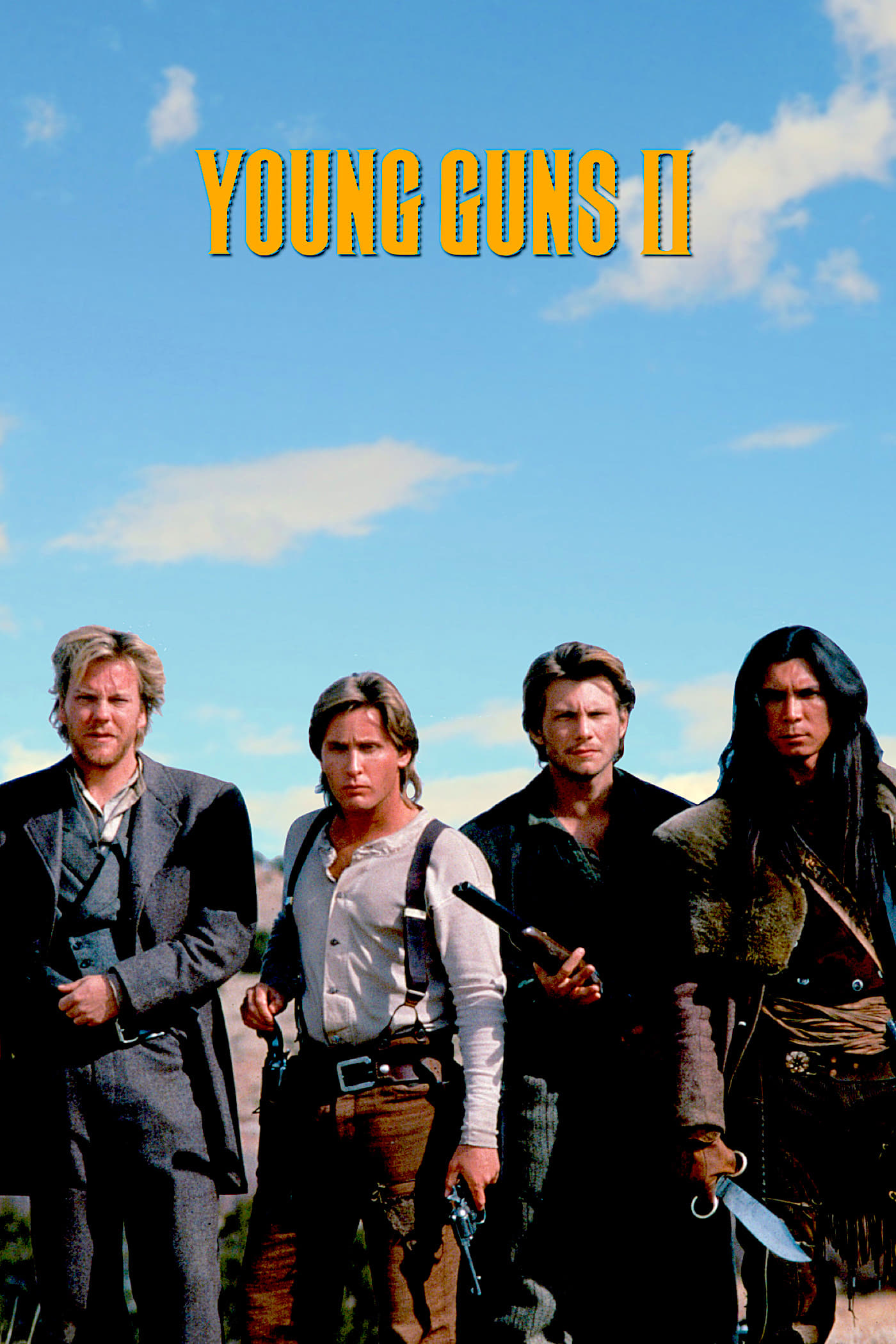
Honestly, the 1990s started with a bang, and I’m not just talking about the box office. If you grew up then, or if you've recently tumbled down a rabbit hole of Western cinema, you know that Young Guns II occupies this weird, electric space in movie history. It isn’t just a sequel. It’s a mood.
Most sequels feel like a tired victory lap, but this one? It felt like a sprint toward a cliff. While the first film gave us the origin story of Billy the Kid and his "Regulators," the second film—released in the summer of 1990—decided to get poetic, gritty, and surprisingly philosophical about what happens when the party's over and the law finally catches up.
The Brushy Bill Roberts Gamble
Let’s talk about the framing device because that’s where the movie really sticks its neck out.
Instead of a standard linear narrative, writer John Fusco leaned into the real-world legend of Brushy Bill Roberts. In 1950, an old man in Hico, Texas, claimed he was actually William H. Bonney. He claimed he hadn't been killed by Pat Garrett in 1881. This wasn't just some screenwriter’s fever dream; it was based on an actual historical controversy that persists in some corners of the Southwest to this day.
Emilio Estevez returns as Billy, but he also plays the aged "Brushy Bill" under layers of heavy prosthetic makeup. It’s a bold choice. It changes the movie from a standard "shoot 'em up" into a story about legacy, memory, and the lies we tell to stay alive. The film opens in the desert in 1950, with a lawyer meeting this mysterious old man who begins to recount the "true" story of how the gang broke apart.
Why Young Guns II Still Matters Today
People usually remember two things about this movie: the cast and the music.
You had the "Brat Pack" energy carrying over, but it was maturing. You’ve got Estevez, obviously, but then there's Kiefer Sutherland returning as Doc Scurlock and Lou Diamond Phillips as Chavez y Chavez. Then they added Christian Slater as "Arkansas" Dave Rudabaugh, who brings this twitchy, chaotic energy that perfectly balances Sutherland’s more soulful performance.
But we have to talk about Jon Bon Jovi.
The story goes that Emilio Estevez originally wanted to use "Wanted Dead or Alive" for the soundtrack. Bon Jovi didn't think the lyrics quite fit, so he wrote "Blaze of Glory" on a napkin in a diner. It became a global monster hit. It’s one of those rare moments where a song and a film are so inextricably linked that you can’t hear that acoustic guitar intro without seeing Billy the Kid laughing while jumping out of a window.
A Grittier Version of History
While the first movie was about the Lincoln County War, Young Guns II focuses on the aftermath. The gang is hunted. They are tired. The New Mexico Territory is changing from a wild frontier into a structured society, and guys like Billy are dinosaurs who don't know they're extinct yet.
The casting of William Petersen as Pat Garrett was a stroke of genius. Garrett wasn't just some faceless lawman; he was Billy’s former friend. That betrayal is the heartbeat of the movie. It’s a psychological chase. Garrett knows how Billy thinks because they used to drink and ride together. When you watch their final "confrontation" at Fort Sumner, it’s played with a heavy sense of inevitability.
Breaking Down the Cast Dynamics
The chemistry here is actually better than the first film.
- Emilio Estevez (Billy): He plays Billy with a manic, almost terrifying joy. He's a sociopath, sure, but he’s a charming one.
- Kiefer Sutherland (Doc): He provides the heart. His character just wants a quiet life, a family, and a schoolhouse. Watching that dream get dismantled is the movie's greatest tragedy.
- Christian Slater (Arkansas Dave): He’s the wildcard. His constant vying for leadership creates a friction that makes the group's eventual dissolution feel real.
- Viggo Mortensen (John W. Poe): Yes, before he was Aragorn, he was a silent, lethal deputy hunting the Kid. It’s a small but chilling role.
It’s easy to dismiss these films as "MTV Westerns," a term critics loved to throw around back then. But that’s reductive. Director Geoff Murphy brought a sweeping, cinematic scale to the New Mexico landscapes. The cinematography by Dean Semler—who won an Oscar for Dances with Wolves—is genuinely stunning. He uses natural light and deep shadows to make the West look beautiful but lethal.
The Historical Accuracy (Or Lack Thereof)
Look, if you’re looking for a 1:1 historical documentary, you’re in the wrong place.
Historians will tell you that the real Dave Rudabaugh wasn't exactly like Christian Slater’s portrayal. They’ll tell you that Doc Scurlock actually moved to Texas and lived a long life, rather than dying in a blaze of glory in a canyon. And, of course, the big one: most historians are 99% certain Pat Garrett really did kill Billy the Kid in 1881.
But that’s not really the point of Young Guns II.
The film captures the mythos of the West. It captures the feeling of being young, invincible, and then suddenly realizing you’re surrounded. It leans into the folklore. In many ways, the film is a tribute to the way legends are built—through tall tales told by old men in the desert.
Action Sequences That Hold Up
In an era of CGI blood and green screens, the practical stunts in this movie are refreshing. The "pit" escape sequence? Incredible. The final shootout? It’s loud, messy, and desperate. There’s a weight to the violence that feels earned because we’ve spent two movies with these characters.
When Billy rides out into the night, hooting and hollering while the law closes in, it’s a pure cinematic high. It’s the definition of "going out on your own terms."
The Legacy of the Soundtrack
Aside from "Blaze of Glory," the score by Alan Silvestri is underrated. It’s heroic but tinged with sadness. It’s the sound of a closing era. Bon Jovi’s involvement brought a younger audience to the Western genre, which was largely considered "dead" at the time. Without the success of these films, you might not have seen the Western revival of the early 90s that led to Unforgiven or Tombstone.
What Most People Get Wrong
People often group this movie with "teen heartthrob" flicks. That’s a mistake. If you actually sit down and watch it, it’s a pretty bleak film. It’s about the death of friendship. It’s about how the world eventually breaks everyone.
The ending—whether you believe Brushy Bill or not—is haunting. If he was Billy, he spent 70 years running from a ghost. If he wasn't, he was a man so obsessed with a legend that he gave up his own identity. Either way, it’s a heavy ending for a "popcorn" movie.
Actionable Next Steps for Fans
If you’ve recently re-watched the film or are diving in for the first time, here is how to get the full experience:
- Watch the "making of" documentaries: Specifically, look for interviews with John Fusco regarding his research into Brushy Bill Roberts. It adds a whole new layer to the viewing experience.
- Listen to the full Bon Jovi "Blaze of Glory" album: It’s actually a concept album inspired by the film's script, not just a collection of random songs. Tracks like "Billy Get Your Guns" and "Blood on the Bricks" provide a lyrical deep dive into the characters.
- Visit the Billy the Kid Museum: If you're ever in Fort Sumner, New Mexico, or Hico, Texas, check out the local history. Comparing the movie's locations to the actual sites of the Lincoln County War is a trip for any history buff.
- Pair it with "Tombstone": To see how the Western evolved in the early 90s, watch these two back-to-back. One represents the "outlaw as a rockstar" vibe, while the other represents the "lawman as a titan" aesthetic.
Young Guns II isn't just a relic of the 90s. It’s a fast-paced, emotionally resonant, and visually striking piece of Americana that reminds us why we’re still obsessed with the Kid over a century later. It’s about the moment the music stops and you have to decide who you’re going to be when the lights come up.



