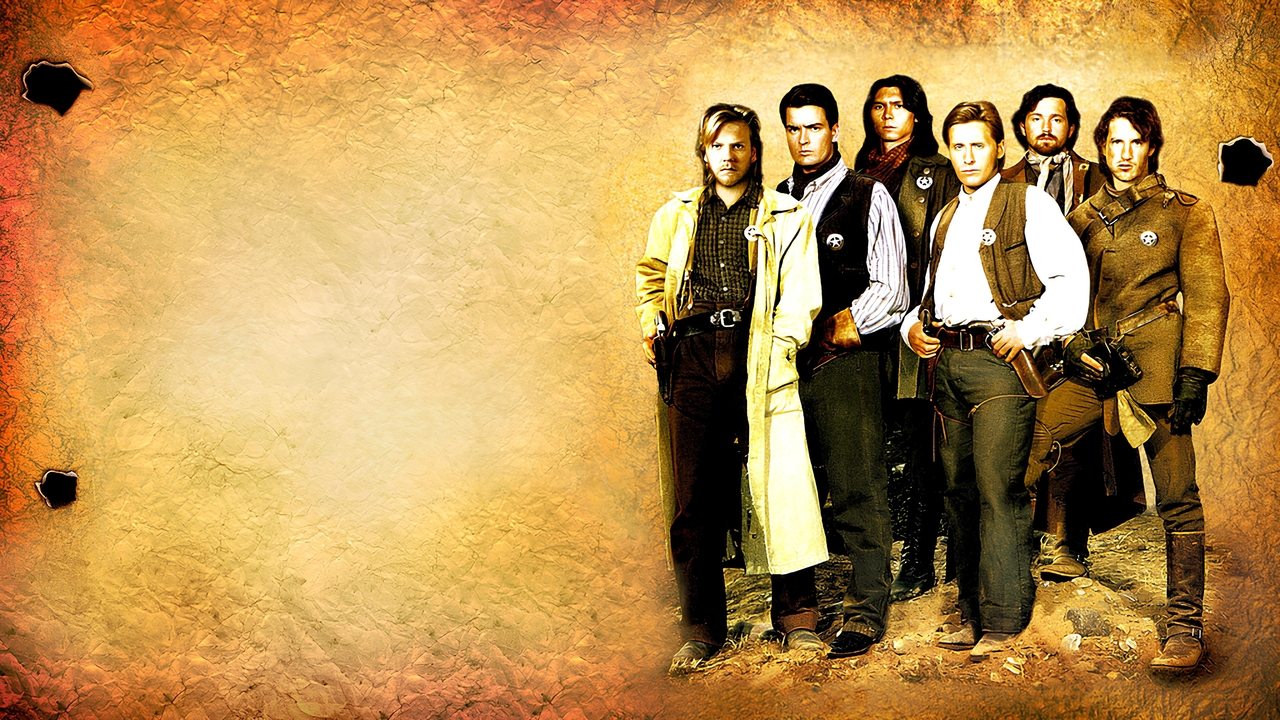
Let's be real for a second. In 1988, the idea of putting a bunch of "Brat Pack" heartthrobs in a gritty Western sounded like a total disaster waiting to happen. Critics were ready to pounce. They figured it would be nothing more than The Breakfast Club with spurs and revolvers. But then the movie dropped, and the Young Guns cast proved everyone wrong by leaning into the chaotic, sweaty, and violent reality of the Lincoln County War. It wasn't just a vehicle for posters on teenage bedroom walls; it was a surprisingly faithful—though obviously stylized—look at Billy the Kid’s "Regulators."
The movie works because the chemistry wasn't manufactured. You had Emilio Estevez, the undisputed leader of the pack at the time, playing William H. Bonney not as a misunderstood hero, but as a borderline sociopath with a high-pitched giggle. He was joined by his real-life brother Charlie Sheen, plus Kiefer Sutherland, Lou Diamond Phillips, Dermot Mulroney, and Casey Siemaszko. They weren't just acting like a gang; they basically became one during the grueling shoot in New Mexico.
The Young Guns Cast and the Reality of Billy the Kid
When people talk about the Young Guns cast, they usually start with Emilio Estevez. Honestly, it’s his best work. He captured the erratic nature of Billy the Kid in a way that previous Hollywood legends like Paul Newman or John Wayne never quite touched. Billy wasn't a stoic lawman. He was a kid. A dangerous, impulsive kid.
Estevez reportedly obsessed over the historical Billy. He wanted that frantic energy.
Then you have Kiefer Sutherland as Doc Scurlock. Doc was the "poet" of the group, providing the emotional soul that balanced out Billy’s madness. Sutherland brought this quiet intensity that he’d later perfect in 24, but here, it was wrapped in 19th-century dust.
- Charlie Sheen as Dick Brewer: The nominal leader who tries (and fails) to keep the Regulators on a leash.
- Lou Diamond Phillips as Jose Chavez y Chavez: A Mexican-Navajo scout who added a layer of spiritual grit and some of the coolest knife-throwing scenes in 80s cinema.
- Dermot Mulroney as "Dirty Steve" Stephens: Basically the comic relief, but a filthy, dangerous version of it.
- Casey Siemaszko as Charlie Bowdre: The loyal friend who just wanted to get married and live a quiet life, making his eventual fate even more of a gut-punch.
Why the Chemistry Felt So Authentic
The studio didn't just throw these guys onto a set. They sent them to a "cowboy boot camp." For weeks, the Young Guns cast had to live together, ride horses until they were sore, and learn how to handle period-accurate firearms. You can see it in the way they sit in the saddle. They don't look like actors playing dress-up; they look like they’ve been riding for days.
John Fusco, the screenwriter, was adamant about historical accuracy where it mattered. While the film takes massive liberties with the timeline, the core of the Lincoln County War—the rivalry between John Tunstall and the Lawrence Murphy faction—is grounded in fact. Tunstall, played by the legendary Terence Stamp, really was a father figure to these "stray dogs." When he was murdered, the Regulators weren't just looking for justice; they were looking for revenge. That raw emotion is what anchors the performances.
Jack Palance and the Villains Who Made the Heroes Shine
You can’t talk about the Young Guns cast without mentioning the heavyweights on the other side. Jack Palance played Lawrence Murphy with a cold, reptilian sneer that made your skin crawl. He represented the "Santa Fe Ring," a corrupt group of politicians and businessmen who basically owned New Mexico.
Palance didn't have to do much to be intimidating. He just existed.
Watching these young, fast-talking actors go up against a titan of the Golden Age of Hollywood like Palance created a meta-narrative. It was the new school vs. the old school. The kids vs. the establishment. That tension bleeds through the screen, especially in the final shootout at Alex McSween’s house.
Terry O'Quinn also puts in a stellar performance as Alex McSween. Before he was John Locke on Lost, he was the man of God caught in the middle of a bloodbath. His transformation from a man of peace to someone holding a rifle in a burning house is one of the film's most underrated character arcs.
The "Sixth Man" of the Cast: New Mexico
The landscape itself acts as a character. The production filmed in places like Cerrillos, New Mexico, which actually looks like the 1870s. The dust is real. The sweat is real. The Young Guns cast spent months in the sun, and by the end of the shoot, they looked as haggard as the real outlaws.
There’s a specific scene where the gang takes "peyote" (though it’s depicted in a very Hollywood, hallucinogenic way). Whether or not the real Regulators were trippin' in the desert is up for historical debate, but that scene allowed the actors to improvise. It broke the tension of a standard Western and made them feel like actual teenagers blowing off steam. It’s those moments of levity that make the violence of the finale hit so much harder.
Behind the Scenes: Ego, Brotherhood, and Gunfights
Working with that many rising stars in one place is usually a recipe for an ego-driven nightmare. Surprisingly, that wasn't the case here. Mostly.
The Young Guns cast famously got along. Charlie Sheen was at the height of his "cool" phase, freshly coming off Platoon and Wall Street. Kiefer was the burgeoning character actor. Lou Diamond Phillips was the breakout star from La Bamba. They were the kings of Hollywood in 1988.
But according to various interviews over the years, there was a genuine sense of protection among them. They knew the "Brat Pack" label was a double-edged sword. If the movie failed, they were all going down together. If it succeeded, they would redefine the Western for a new generation.
- They performed many of their own stunts, including some of the high-speed chases.
- Emilio Estevez reportedly kept a "kill count" on set to stay in character as Billy.
- The famous "he ain't my spiritual brother" line was a bit of on-set improvisation that made it to the final cut.
The Legacy of the 1988 Ensemble
When you look back at the Young Guns cast today, it’s a time capsule of talent. Most of these guys went on to have massive careers. It spawned a sequel, Young Guns II, which added Christian Slater and a banger of a theme song by Jon Bon Jovi (who actually has a cameo in the first film—look for the guy getting shot in the back during the final shootout).
The film succeeded because it didn't try to be The Searchers. It was a rock-and-roll Western. It understood that Billy the Kid was a celebrity in his own time, a folk hero to some and a devil to others. By casting the biggest celebrities of the 1980s, the producers mimicked the actual notoriety of the Regulators.
Surprising Facts About the Casting Process
Did you know Patrick Swayze was almost in the movie? He was considered for several roles but eventually passed. Tom Cruise also famously visited the set because he was buddies with the cast, leading to his blink-and-you'll-miss-it cameo as a crooked deputy in the final battle. He’s wearing a fake mustache and gets gunned down by the Regulators.
It’s these little details that keep fans coming back. The Young Guns cast wasn't just a list of names; it was a moment in pop culture history where the Western was cool again, if only for a few years.
- The Age Factor: In real life, Billy the Kid died at 21. Emilio Estevez was 25 during filming, which is actually closer to the real age than many other actors who have played the role (some were in their 30s or 40s!).
- The Weapons: The cast used authentic Peacemakers and Winchesters. The sound design of the gunshots was intentionally boosted to make them sound more like modern action movie explosions.
How to Experience Young Guns Like an Expert
If you're revisiting the film or watching it for the first time because you saw a clip on social media, don't just watch it as a popcorn flick. Look at the dynamics.
Notice how Billy (Estevez) slowly alienates his friends as his bloodlust grows. Look at the way Doc (Sutherland) tries to maintain his humanity while covered in gore. That’s where the real "acting" happens. The Young Guns cast managed to balance the "cool" factor with the psychological toll of being a hunted man.
Actionable Next Steps for Fans
To truly appreciate the work of the Young Guns cast, you should dive into the actual history of the Lincoln County War. It makes the performances even more impressive when you realize how much of the "crazy" stuff actually happened.
- Visit Lincoln, New Mexico: Much of the town is preserved exactly as it was in 1878. You can stand where the house burned down.
- Read "The Authentic Life of Billy, the Kid" by Pat Garrett: It’s heavily biased (since Garrett killed him), but it gives you the mythos that the movie draws from.
- Watch the 4K Restoration: The film was recently color-graded to bring out the natural dirt and grit of the New Mexico landscape, making the cinematography finally match the intensity of the acting.
- Compare with "The Left Handed Gun": Watch Paul Newman’s 1958 version of Billy the Kid to see just how much more "punk rock" Estevez’s portrayal really was.
The Young Guns cast redefined a genre that was supposedly dead. They proved that if you have enough charisma, a bit of historical truth, and a lot of gunpowder, you can make something that lasts for decades. It remains the definitive "youth Western," a film that captures the terrifying, exhilarating feeling of being young, armed, and completely out of your depth.



