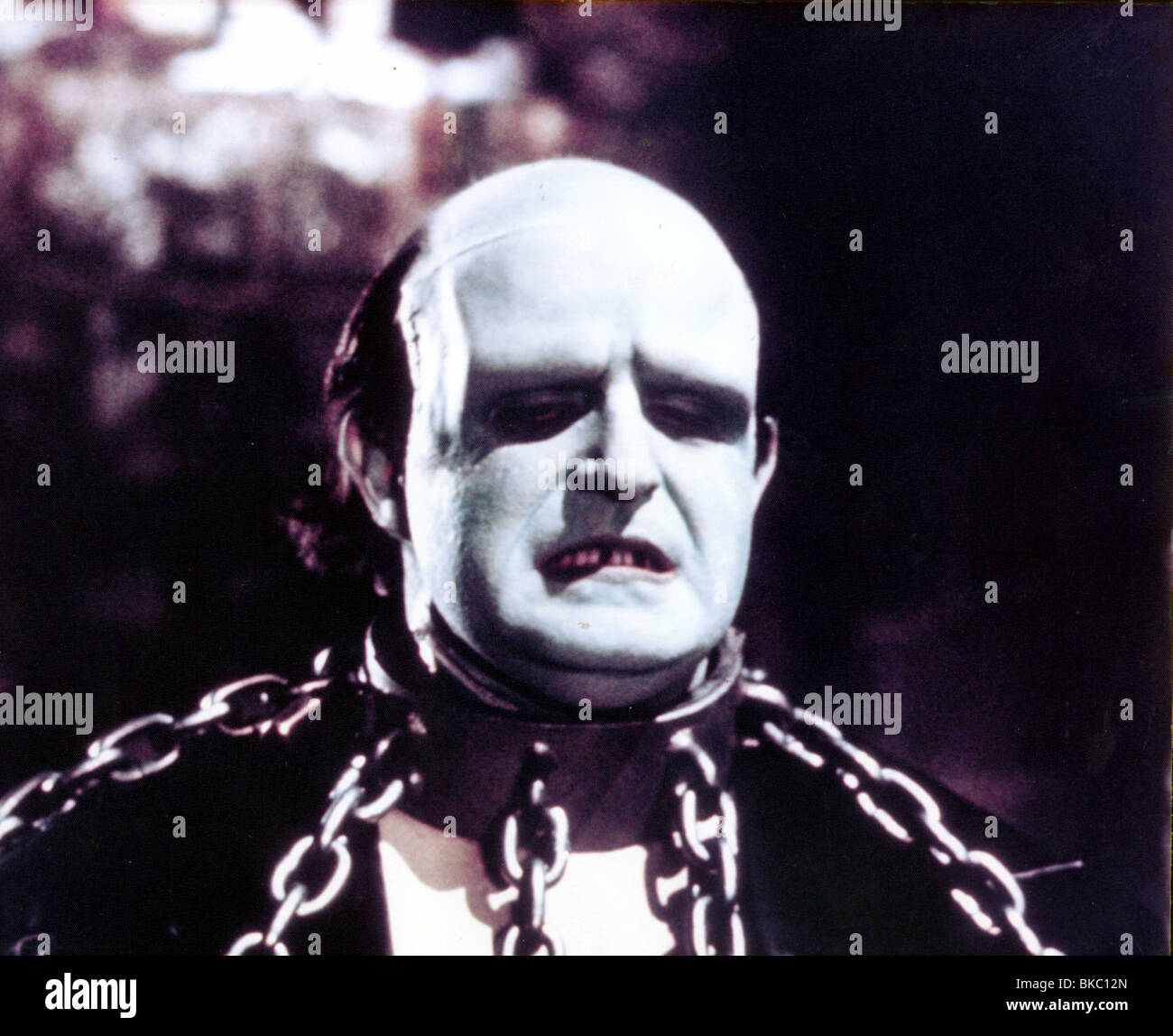
When people talk about the greatest comedic performances of the 20th century, they usually point to the loud guys. The ones doing the pratfalls or the high-energy stand-up routines. But if you really look at what was happening on the set of Young Frankenstein back in 1974, you’ll find that the heaviest lifting—emotionally and physically—was being done by a man who barely said a word for most of the movie.
Peter Boyle.
Most modern audiences know him as the cranky, recliner-bound Frank Barone from Everybody Loves Raymond. To others, he was the terrifying bigot in Joe or the philosopher-cab-driver in Taxi Driver. But for those of us who grew up on Mel Brooks movies, Peter Boyle will always be the "Monster." Not just a creature made of spare parts, but a misunderstood, zipper-necked baby who just wanted to dance.
Why Peter Boyle Almost Didn't Get the Part
It’s wild to think about now, but Peter Boyle wasn’t necessarily the "obvious" choice for a slapstick horror parody. At the time, he was a serious dramatic actor. He had a reputation for being intense, maybe even a little scary.
Honestly, the only reason he ended up in the room was a bit of Hollywood networking. Boyle shared an agent with Gene Wilder and Marty Feldman. This agent, a guy with an eye for chemistry, basically told Mel Brooks, "I’ve got these three guys. Put them in a movie together." Gene Wilder already had the seed of the idea—a story about Baron Frankenstein’s grandson who is actually embarrassed by his family legacy.
When Boyle walked in, he didn't play it for laughs. Not at first. He understood something that many comedic actors miss: the funniest thing you can do is be completely sincere in an absurd situation. He played the Monster as a literal infant in a giant’s body. To him, the world wasn't a place to be haunted—it was a terrifying, alien environment.
The Secret Behind the Green Skin and 35-Foot Walls
If you look closely at the cinematography of Young Frankenstein, it looks... well, it looks expensive. That’s because Mel Brooks was obsessed with making it a "love letter" to the 1931 original. He tracked down Kenneth Strickfaden, the guy who did the electrical props for the original Boris Karloff film, and found out the equipment was just sitting in his garage. They used the actual 1930s gear.
Because they were shooting in high-contrast black and white, the makeup was a nightmare.
Peter Boyle had to wear green makeup. Why green for a black-and-white movie? Because on that specific film stock, green gave the skin a "dead," translucent look that regular flesh tones couldn't replicate. It took two hours every morning to glue on the forehead piece and the zippers.
The lighting was another story. Director of photography Gerald Hirschfeld had to keep the key lights high to emphasize Boyle’s prosthetic brow, often hanging lights from the ceiling to create those deep, mysterious shadows in his eyes. It was a technical slog that Boyle endured with a surprising amount of grace, considering he was basically a walking science experiment for 10 hours a day.
The Fight Over "Puttin' on the Ritz"
You know the scene. The top hat. The tails. The "Puuu-in' un da Reeez!"
It’s arguably the most iconic moment in the film, but it almost never happened. Mel Brooks hated the idea. He thought it was too silly. He thought it would "break the fourth wall" and ruin the atmosphere of the film.
Gene Wilder, who co-wrote the script, went to bat for the scene. He and Brooks had their only major screaming match over it. Wilder was almost in tears, insisting that the audience needed to see the Monster trying—and failing—to be "civilized." Brooks finally caved, but with a condition: they would shoot it, and if a single person in the test screening thought it was too stupid, it was getting cut.
The audience didn't just like it; they went feral.
The genius of Boyle's performance in that dance number is the sheer effort. He isn't "playing" a bad singer. He is playing a creature whose vocal cords are barely functional, trying to satisfy his "father" (Wilder). That strained, guttural yell was something Boyle improvised on the spot during filming. It wasn't in the script. He just felt it.
The Gene Hackman Soup Incident
One of the best stories from the set involves a "tiny" role that wasn't supposed to be a big deal. Gene Hackman, fresh off The French Connection, really wanted to try comedy. He asked Gene Wilder for a part, and since the "Blind Man" role was open, he took it for free.
The scene where the Blind Man accidentally pours hot soup on the Monster’s lap is legendary. What most people don't realize is that Peter Boyle was genuinely in the zone here. The "scalded" reaction he gives isn't just a gag; it's the peak of his "loving sweetheart" character being pushed to the limit.
Fun fact: in some of the close-up shots where the soup is spilled, that’s actually Mel Brooks’ hand, not Gene Hackman’s. They had some continuity issues and had to reshoot the "spill" later.
What Most People Get Wrong About Peter Boyle’s Career
There's this weird misconception that Boyle was a "typecast" actor. People see the Monster and they see Frank Barone and think, "Oh, he plays the grumpy big guy."
That’s a disservice to the guy’s range. He was a student of Uta Hagen. He was part of Second City in Chicago. He was an improvisational master. On the set of Young Frankenstein, he was the one suggesting bits like chasing imaginary butterflies. He brought a "vaudevillian" energy to the role because his father had been a local TV host in Philadelphia who worked with old-school performers.
He wasn't just a guy in a suit. He was a classically trained actor using every tool in his kit to make a mute creature feel like the most human person in the room.
How to Appreciate the Performance Today
If you're going back to rewatch the film, don't just look for the jokes. Look at Boyle's eyes.
- The Curiosity: Watch the scene where he first hears the violin. It’s not a comedy beat; it’s a discovery beat.
- The Physicality: Notice how he walks. He doesn't do the "stiff-arm" Frankenstein walk. He moves like someone who doesn't quite know how long his legs are yet.
- The Romance: His scenes with Madeline Kahn (Elizabeth) are surprisingly "natural." Boyle later joked that he had to turn into a monster before he could find a role where he was attractive to the opposite sex.
The Actionable Legacy
If you're a filmmaker, a writer, or just a fan of the craft, there’s a massive lesson in Peter Boyle’s work here. Sincerity is the engine of comedy. If Boyle had played the Monster as a "funny guy," the movie would have been a forgettable spoof. Because he played it with the weight of a Shakespearean tragedy, it became a masterpiece.
To truly honor his work, look for the "heart" in the absurd. Whether you're creating content or just navigating a weird situation at work, remember that the most "human" thing you can do is be honest about how strange everything is.
Next Steps for the Super-Fan:
- Watch the 1931 Frankenstein first. It makes the visual jokes in Young Frankenstein hit ten times harder once you see what they were parodying.
- Listen to the "Puttin' on the Ritz" track closely. You can hear the layers of Boyle’s "grunt-singing" that were mixed to sound like a struggling vocal apparatus.
- Check out Boyle in The X-Files. He won an Emmy for the episode "Clyde Bruckman’s Final Repose," which uses that same "sad-sack-yet-hilarious" energy he perfected in 1974.



