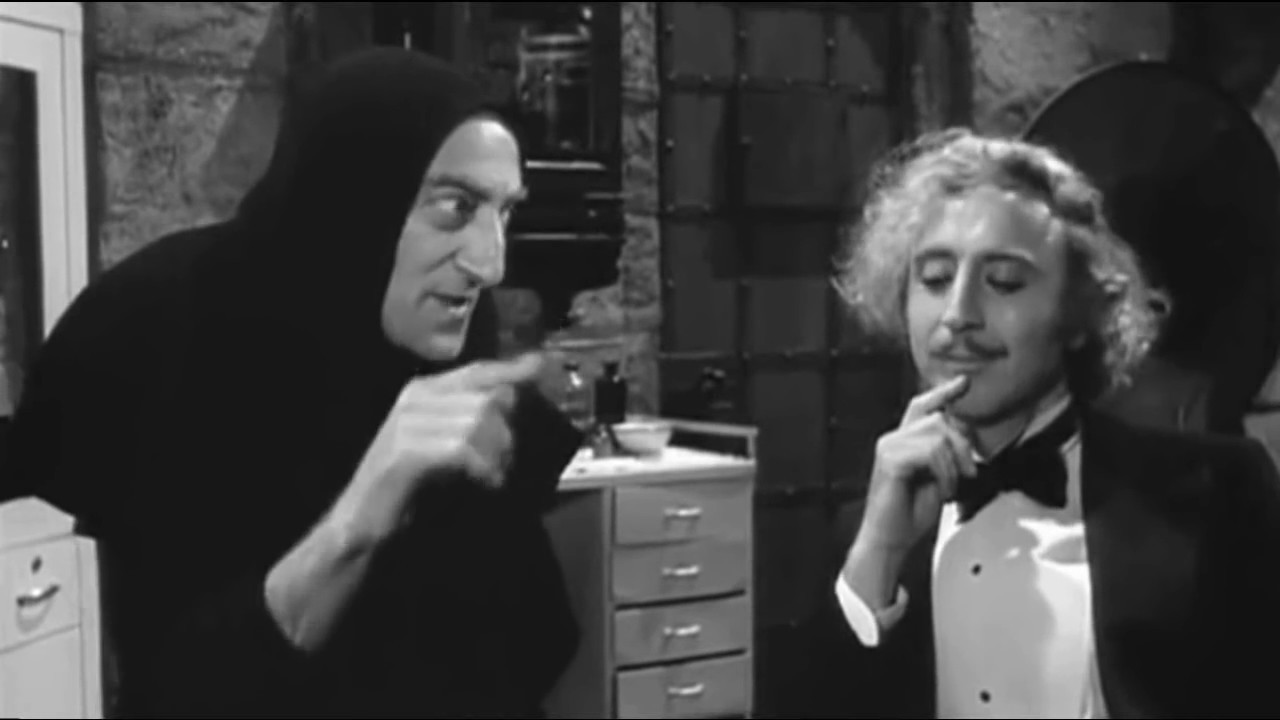
It shouldn't have worked. Really. A black-and-white comedy released in 1974, right when the world was pivoting toward gritty realism and neon lights, seemed like a massive gamble. But Mel Brooks and Gene Wilder had a secret weapon that went beyond the stunning cinematography or the "Puttin' on the Ritz" tap dance number. They had the brain. Specifically, the Young Frankenstein Abby Normal brain.
You know the scene. Igor is sent to the local "Brain Depository" to retrieve the mind of Hans Delbrück, a scientist and saint. He slips, the jar shatters, and in a moment of sheer panic, he grabs the backup. What follows is one of the most quoted exchanges in cinematic history. It’s the moment the movie stops being just a parody and becomes a masterclass in comedic timing.
Marty Feldman’s performance as Igor is legendary. It’s his wide-eyed, nonchalant delivery that makes the "Abby Normal" reveal so visceral. When Dr. Frederick Frankenstein—pardon me, Fronkonsteen—realizes his creation is a homicidal maniac, the interrogation begins.
The Anatomy of the Abby Normal Joke
Mel Brooks didn't just write jokes; he built environments where accidents could happen. The term "Abby Normal" is a simple play on "abnormal," but the way it’s layered into the film’s mythology is what gives it staying power.
Gene Wilder, who co-wrote the script, was obsessed with the idea of a "controlled" scientist losing his mind. The Abby Normal bit is the breaking point. Think about the pacing. Most comedies today rush the punchline. Brooks lets it breathe. There is a long, agonizing silence before Igor finally admits the name on the jar.
"Abby... someone." "Abby who?" "Abby Normal."
It’s stupid. It’s brilliant. It’s exactly why the film holds a 94% on Rotten Tomatoes decades later. The joke works because it’s grounded in the physical reality of the set. They actually used laboratory equipment from the original 1931 Frankenstein film, which Brooks tracked down and rented from Kenneth Strickfaden. This wasn't just a spoof; it was a resurrection.
Why We Still Quote the Abnormal Brain in 2026
Culture moves fast. Memes die in a week. Yet, the Young Frankenstein Abby Normal reference hasn't budged. Why?
Honestly, it’s because it’s the universal excuse for when things go sideways. Did you mess up a project at work? Must be an Abby Normal brain. Did the car breakdown? Abby Normal. It’s a linguistic shorthand for "I tried, but I’m working with faulty equipment."
The chemistry between Wilder and Feldman cannot be overstated. Feldman, with his distinctive features caused by Graves' ophthalmopathy, had a face made for silent-era comedy. He used his eyes to communicate a level of "innocent mischief" that made Igor lovable despite the fact that he essentially doomed a seven-foot monster to a life of social alienation and fire-related trauma.
The Science of Hans Delbrück vs. The Fiction of Abby
In the film, the "intended" brain belonged to Hans Delbrück. Most people assume this was a name Brooks just made up because it sounded sufficiently German and prestigious. It wasn't. Hans Delbrück was a real person—a German historian and politician who lived in the 19th and early 20th centuries. His son, Max Delbrück, was a Nobel Prize-winning biophysicist.
Brooks was playing a high-level game of intellectual "gotcha." By using a real name associated with actual brilliance, the contrast with "Abby Normal" becomes even sharper. It’s the gap between the monumental expectations of the Enlightenment and the messy, ridiculous reality of human error.
Interestingly, the "Brain Depository" scene was one of the few that didn't undergo massive changes during the editing process. Brooks famously had a first cut that was almost three hours long. Most of it was garbage, by his own admission. He spent months cutting it down to the lean, mean 106 minutes we see today. But the Abby Normal sequence was untouchable. It was the heart—or rather, the prefrontal cortex—of the movie’s logic.
Breaking Down the "Abby Normal" Psychology
What is it about the "wrong brain" trope that fascinates us? From a narrative perspective, it’s the ultimate "out." It removes the moral agency of the Monster. In Mary Shelley’s original 1818 novel, the creature is eloquent, philosophical, and driven to evil by societal rejection. In the 1931 James Whale film, the "criminal brain" plot point was added to simplify the conflict for audiences.
Brooks takes that 1931 trope and mocks it. By naming the brain "Abby Normal," he’s telling the audience: "Yeah, we know this is a lazy plot device, so let’s make it as ridiculous as possible."
The Monster, played by Peter Boyle, doesn't start out as a killer. He starts out as a confused child in a giant’s body. When the Abby Normal brain is "activated" by the Doctor’s frustration, we see the comedy of errors reach its peak. The Monster isn't bad; he’s just... misconfigured.
The Legacy of Marty Feldman’s Igor
It’s impossible to talk about the Young Frankenstein Abby Normal moment without discussing Marty Feldman’s physical comedy. Did you know he moved his "hump" from side to side throughout the movie?
Wilder noticed it during filming and asked, "I thought that was on the other side?" Feldman simply replied, "What hump?"
That line was ad-libbed. It’s that same spirit of improvisation that led to the delivery of the Abby Normal reveal. Feldman played Igor as someone who was always five minutes ahead of everyone else while simultaneously being completely lost.
Production Secrets: Shooting the Brain Room
The scene was shot at 20th Century Fox, and the lighting was crucial. To get that authentic Universal Monsters look, cinematographer Gerald Hirschfeld used a specific type of high-contrast lighting that modern digital cameras struggle to replicate.
They didn't use "fake" jars. The props were heavy. When Igor drops the Hans Delbrück brain, the "brain" inside was actually a molded piece of rubber soaked in water to give it a glistening, organic look. The sound of it splashing on the floor was enhanced in post-production to sound as disgusting as possible, heightening the tragedy of Igor’s mistake.
Cultural Impact and Modern References
We see the DNA of the Abby Normal joke everywhere today. From The Simpsons to Family Guy, the "incompetent assistant with a misunderstood instruction" has become a staple. But none quite capture the deadpan sincerity of the original.
Even in modern medicine, you’ll occasionally hear a surgeon or a lab tech crack an "Abby Normal" joke to lighten the mood. It has become a permanent part of the English lexicon, even for people who haven't seen the full movie. That is the mark of true cultural saturation.
How to Watch Young Frankenstein Like an Expert
If you're revisiting the film to catch the Young Frankenstein Abby Normal scene again, pay attention to the background.
- The Labels: Look at the other jars in the Brain Depository. The level of detail in the hand-written labels is incredible for a 1974 production.
- Gene Wilder’s Eyes: Watch Wilder’s face during the interrogation. You can see him vibrating with a mix of murderous rage and scientific curiosity.
- The Music: John Morris’s score shifts slightly when the brain is mentioned. It goes from a Gothic horror vibe to something slightly more "circus," signaling the shift in the Monster's nature.
Actionable Takeaways for Movie Lovers
If you want to dive deeper into the world of Mel Brooks and the creation of this specific comedic era, here is what you should actually do. Don't just watch the clips on YouTube.
- Watch the 1931 Original First: To truly appreciate the Abby Normal joke, you have to see the scene it’s parodying in the original Frankenstein. It makes the payoff ten times better.
- Track Down the "Making Of" Documentaries: There is a great documentary called It’s Alive! Resurrecting 20th Century-Fox’s Young Frankenstein. It features interviews with Brooks and Wilder about the writing process.
- Look for the Strickfaden Equipment: Next time you watch the "creation" scene, look for the humming electrical orbs. Those are the actual props used in the 1930s. Knowing they are real adds a layer of "tangible" history to the comedy.
- Analyze the Script Structure: If you’re a writer, look at how the Abby Normal reveal is delayed. It’s a lesson in "The Rule of Three." Igor tries to dodge the question twice before finally giving the ridiculous answer.
The brilliance of Young Frankenstein Abby Normal isn't just in the pun. It’s in the craftsmanship of a team of creators who respected the genre they were mocking. They didn't punch down at horror movies; they elevated them through laughter.
In the end, we all have a little Abby Normal in us. Whether it's a slip of the tongue or a colossal mistake at the Brain Depository, the lesson remains the same: when you mess up, do it with enough confidence that people are still laughing about it fifty years later.
Next Steps for Enthusiasts: Start by comparing the Brain Depository scene with the 1931 version side-by-side; the shot-for-shot parody is much more technical than most people realize. Then, seek out the audio commentary by Mel Brooks. He details exactly which lines were scripted and which were "Abby Normal" accidents that happened live on set.



