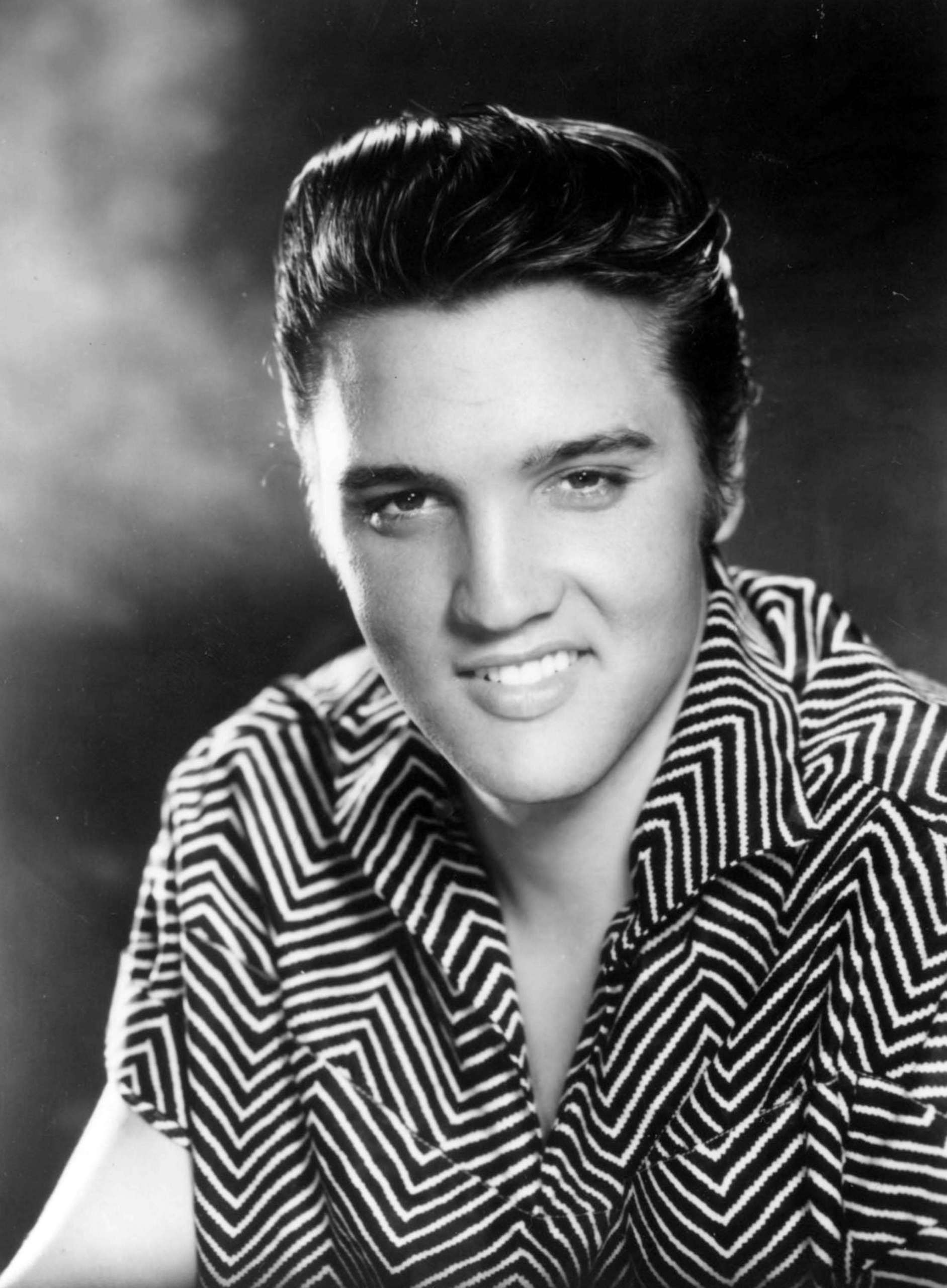
Before the gold lamé suits and the white capes of Vegas, there was just a kid with grease in his hair and a chip on his shoulder. Honestly, looking at young Elvis Presley photos today feels like peering into a different universe, one where the King of Rock 'n' Roll was still just Elvis from Tupelo. It’s the eyes. In those early shots from 1954 and 1955, there is a mix of absolute terror and total defiance that you just don't see in the later, more polished PR images.
He was raw.
If you've ever spent time scrolling through the archives of Alfred Wertheimer or William Speer, you know exactly what I’m talking about. These aren't just pictures of a singer; they are blueprints for the next seventy years of pop culture. You see a boy who didn't quite know he was about to change the world, yet he carried himself like he’d already won.
The Memphis Flash: Beyond the Pout
Most people think they know the face. The sneer, the quiff, the heavy lids. But the earliest young Elvis Presley photos tell a much more complicated story than the "teen idol" narrative we’ve been fed for decades.
In 1955, Elvis wasn't a global icon. He was a regional hillbilly cat playing flatbed trucks and high school gyms. Look at the shots taken by William Speer in his Memphis studio. These are widely considered some of the most important images in rock history. Speer used dramatic, "Rembrandt-style" lighting—lots of deep shadows and bright highlights. Elvis is shirtless in some, looking more like a brooding method actor than a country singer. It’s moody. It’s dark. It was, for the time, incredibly dangerous.
There’s this one specific shot where he’s looking off-camera, his hair a mess, and you can see the sheer physicality he brought to the table. He wasn't trying to be "pretty" in the way Perry Como or Eddie Fisher were. He was trying to be James Dean with a guitar.
Why the 1956 Wertheimer Collection Changed Everything
If we are talking about authenticity, we have to talk about Alfred Wertheimer. In 1956, RCA Victor hired this young freelance photographer to follow Elvis around for a few days. They wanted promotional material. What they got was arguably the most intimate look at stardom ever captured on film.
Wertheimer didn't use a flash. That's the secret.
Because he relied on natural light, he could blend into the background. He caught Elvis in the "in-between" moments. You’ve probably seen "The Kiss"—that grainy, close-up shot of Elvis backstage at the Mosque Theater in Richmond, Virginia, playfully touching tongues with a young woman. It’s incredibly human. No handlers, no security, no wall between the star and the fan.
You see him eating in a lonely drugstore. You see him sitting at a piano in a silk shirt, head bowed, just... tired. These young Elvis Presley photos work because they strip away the myth. We’re so used to seeing the "icon" that we forget there was a 21-year-old kid underneath it all who really liked bacon, lettuce, and tomato sandwiches and missed his mom.
The Style That Launched a Thousand Subcultures
Let's get into the clothes for a second because, man, the fashion in these early photos is wild.
He wasn't wearing what everyone else was wearing. While the average 1950s dad was in a grey flannel suit, Elvis was shopping at Lansky Brothers on Beale Street. He was buying pink and black combinations. He was wearing lace shirts and upturned collars.
- The High Collar: It wasn't just a choice; it was a shield. He felt he had a long neck, so he popped the collar to hide it.
- The Pink Cadillac Contrast: Early color photos show the vividness of his world. The pink suit against the black hair? It was a visual riot.
- The Two-Tone Shoes: Loafers with socks, often in contrasting colors that shouted for attention.
The photos from his 1956 appearance on The Milton Berle Show or The Ed Sullivan Show show a silhouette that was completely alien to the American living room. The trousers were wide through the thigh and tapered at the ankle, allowing for that legendary "rubber legs" movement. When you look at these stills, you realize he wasn't just singing the music; he was wearing it.
The Myth of the Natural Blonde
Here is something that usually catches people off guard: the "Black-Haired King" wasn't.
If you find some of the very early young Elvis Presley photos from his time at Humes High School, you’ll notice his hair is a sandy, dirty blonde. He started darkening it with black shoe polish and eventually hair dye because he wanted that sharp, cinematic look of actors like Tony Curtis.
By the time he hit the Sun Records era in '54, the hair was getting darker and the pompadour was getting higher. He used three different types of hair oil at once—a heavy wax for the top, a lighter grease for the sides, and something else for the back. It was a structural engineering project. The photos of him sweating through a performance, with a single lock of jet-black hair falling over his forehead, became the definitive image of 1950s rebellion.
Behind the Scenes at Graceland and Beyond
There is a stark difference between the professional shots and the candid ones taken by friends like Red West. The "candid" young Elvis Presley photos often show a much goofier side of the man.
He loved his motorcycles. There are great shots of him on his 1956 Harley-Davidson KH, looking like the king of the road. There are photos of him at the Memphis fairgrounds, riding the rollercoasters until the sun came up. In these images, the "brooding" mask slips. You see a kid who suddenly had all the money in the world and decided to spend it on making his friends happy.
It’s also worth looking at the photos from his time in the Army (1958-1960). While he was technically "young" here, something changed. The buzzcut photos represent a massive shift. The rebellious youth was being rebranded as the patriotic soldier. While the photos of him in uniform are iconic, many fans feel they mark the end of the truly "raw" Elvis. The edge was being sanded off by the industry.
How to Tell a Real Vintage Photo from a Reprint
If you're a collector or just a fan, you’ve gotta be careful. The market is flooded with "vintage-look" prints.
- Check the Paper: Real 1950s press photos were usually printed on fiber-based paper, which has a different weight and texture than modern resin-coated stuff.
- The Back Matters: Flip the photo over. You want to see "slugs" (typed descriptions) or date stamps from newspapers.
- The Clarity: Modern digital reprints often look too perfect or have weird pixelation in the shadows. Original 1950s silver gelatin prints have a specific depth to the blacks that is hard to fake.
Why We Still Look
Why do we care about young Elvis Presley photos seventy years later?
Maybe it’s because he represents the last moment of pure, unmanufactured cool. Today, every star has a stylist, a social media manager, and a filter. Elvis had a comb and a vision. When you look at those grainy black-and-whites, you’re seeing the birth of the teenager as a concept. Before Elvis, you were a child and then you were a small adult. He created the middle ground.
The photos remind us that greatness usually starts with a bit of awkwardness and a lot of nerve. He wasn't born a legend; he was a kid from a two-room house who dared to look into a camera lens and act like he owned it.
Action Steps for Fans and Researchers
To truly understand the visual legacy of the King, don't just stick to Google Images. Dig into the specific archives that captured him before the myth took over.
- Visit the Graceland Archives: They occasionally do digital rotations of "unseen" family photos that show Elvis at home in his early 20s.
- Study Alfred Wertheimer’s "Elvis '56": This book is the gold standard. If you want to see the real Elvis, this is the only source you need.
- Look for Sun Records Era Ephemera: Search for photos taken at the Overton Park Shell in 1954. These are some of the first professional live shots of him, and the energy is palpable.
- Analyze the "Million Dollar Quartet" Session: Look at the photos from December 4, 1956, when Elvis, Jerry Lee Lewis, Carl Perkins, and Johnny Cash all jammed at Sun Studios. It’s a masterclass in candid, historical photography.
The power of these images isn't just in the subject, but in the transition they document. You are watching a human being turn into a monument, one frame at a time. Keep looking at the early stuff—that's where the truth is.



