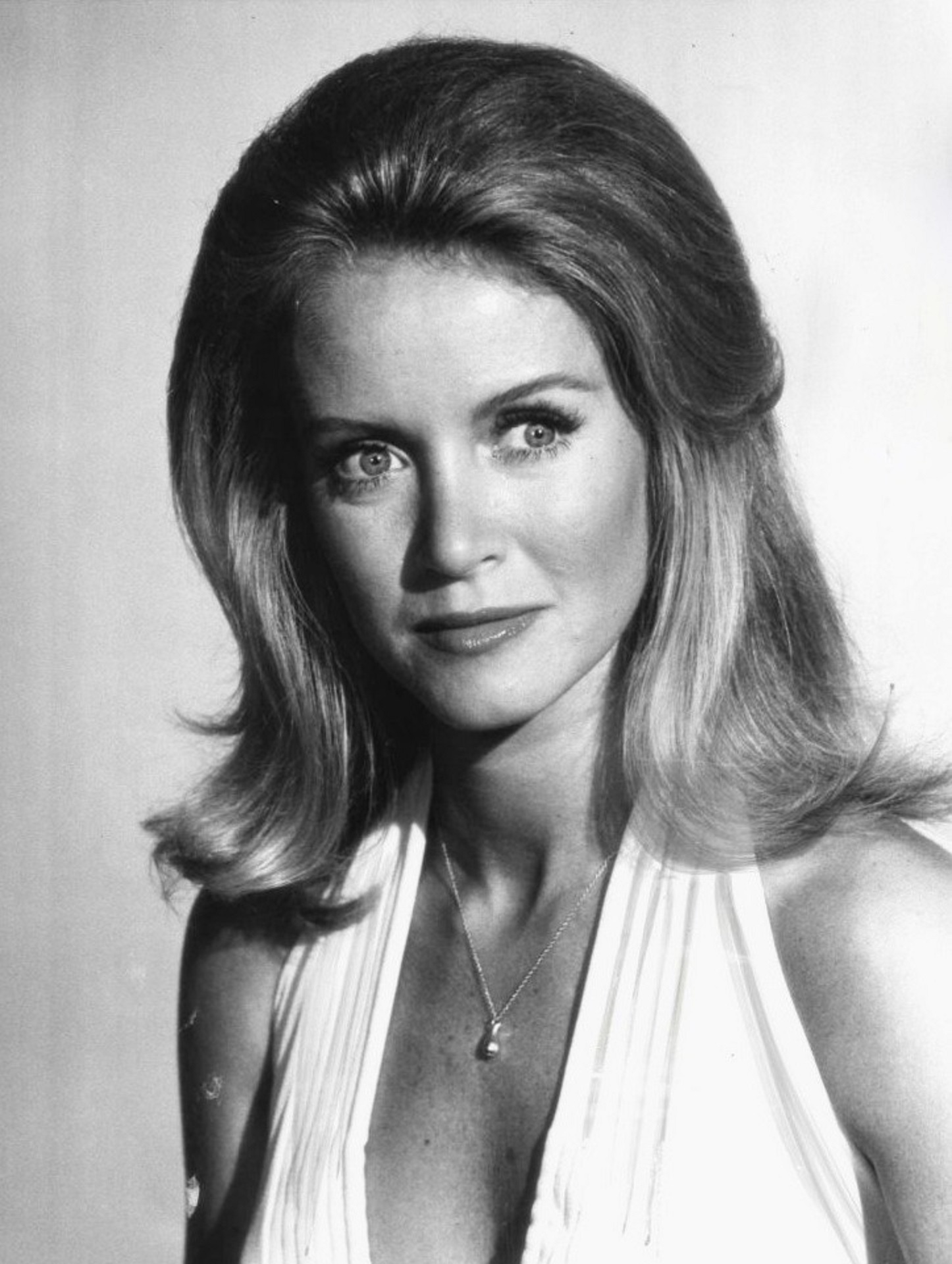
Most people remember the eyes. Those icy, piercing blue eyes framed by enough mascara to keep a cosmetic company in business for a decade. By the time 1980 rolled around, Donna Mills had become the definitive "bad girl" of primetime. As Abby Cunningham on Knots Landing, she was the vixen you loved to hate, the woman who drove a Volvo and stole your husband before the first commercial break.
But there is a version of young Donna Mills that has been almost entirely scrubbed from the collective memory.
Before she was the neighborhood’s resident manipulator, she was the industry’s go-to victim. Honestly, it’s a bit of a trip to look back at her early credits. She wasn’t the one holding the smoking gun; she was the one running through the woods in a nightgown, screaming for help. For nearly fifteen years, Mills was trapped in a "damsel in distress" loop that she eventually had to fight her way out of.
It started in Chicago. She was Donna Jean Miller back then. Her dad was a computer analyst, and her mom taught dance. You can see the dancer's discipline in every role she’s ever played—that perfect posture and the way she moves through a room like she’s hitting a mark on a stage. She actually dropped out of the University of Illinois after just one year to pursue dance. It wasn’t a whim. It was a career move.
The Secret Storm and the Nun Who Fell in Love
In 1966, she landed her first TV gig. It was a soap called The Secret Storm. Here’s a fun piece of trivia: she played a nightclub singer named "Rocket."
She can't sing.
Mills has admitted in interviews that she has no idea why they cast a dancer to play a singer, but she did it anyway. She even sang on the show. Imagine that—the future Abby Cunningham, arguably the most polished woman on television, faking her way through a lounge act in a New York studio.
Shortly after, she moved on to Love Is a Many Splendored Thing. This is where the "good girl" image really took root. She played Laura Donnelly, a nun. Well, an ex-nun. Her character was constantly tormented by her "carnal desires" for her sister’s boyfriend. It was classic daytime drama, but it cemented her as the wide-eyed, innocent blonde. She was the moral center, the person things happened to, rather than the person making things happen.
While she was doing the soap, she was also pounding the pavement in New York. She landed a role in Woody Allen’s Broadway play Don't Drink the Water. She was working constantly. But Hollywood had already decided what she was.
Clint Eastwood and the Scene That Wasn't in the Script
The big break came in 1971. Clint Eastwood was making his directorial debut with Play Misty for Me. He needed someone to play Tobie, the "nice" girlfriend who provides a contrast to Jessica Walter’s unhinged stalker character.
Burt Reynolds actually tipped Clint off about her. He’d seen her in some dailies for a show called Dan August and told Clint he needed to check out this blonde actress. Clint didn't even make her audition. He just hired her.
There is a legendary montage in that movie set to Roberta Flack’s "The First Time Ever I Saw Your Face." It’s basically a five-minute music video of Donna Mills and Clint Eastwood frolicking in the woods and by the sea. It features the only nude scene of her entire career.
Interestingly, that scene wasn't in the original script. Clint decided on the fly that the movie needed a moment of pure, lyrical romance to make the later horror feel earned. He had to personally convince her to do it. He played the song for her to show the "vibe" he was going for, promising it would be beautiful and not exploitative. She trusted him. It worked.
But even after a hit movie with Clint Eastwood, the typecasting didn't stop.
The 1970s: A Decade of Being Chased
If you turned on a TV in the mid-70s, there was a 50% chance you’d see young Donna Mills being terrorized.
She guest-starred on everything. The Six Million Dollar Man, Hawaii Five-O, Gunsmoke, Fantasy Island. In almost every single one, she was the guest star in peril. She was the kidnapped daughter, the witness to a crime, or the woman being stalked by a psycho.
"I got tired of playing the victim," she told the Toledo Blade years later. "It’s a more active role. Abby keeps things stirred up, and I like that."
It’s easy to forget how much of a risk Knots Landing was for her. When the show started, the creator, David Jacobs, wasn't even looking for someone like her. He wanted a female version of J.R. Ewing, but he envisioned a different kind of actress. He saw Donna Mills as the "Midwestern blonde" from all those TV movies.
She had to fight for the audition. She had to prove she could be mean.
When she finally got the role of Abby in the second season, she didn't just play a villain. She invented a whole aesthetic. She was the one who decided Abby should always be perfectly coiffed, even when she was doing something terrible. She even did her own eye makeup because she was too impatient to wait for the professionals. She knew exactly how those blue eyes should look on camera.
The Sandy Connection
Here is a detail that sounds like a Hollywood myth but is actually true. Jim Jacobs, the guy who co-created the musical Grease, was a classmate of Donna’s at Taft High School in Chicago.
He based the character of Sandy on her.
The "Sandra Dee" archetype—the blonde, virtuous, slightly naive girl—was literally inspired by the high school version of Donna Mills. It makes her eventual transformation into Abby Cunningham even more impressive. She didn't just change her career; she dismantled the very archetype she had helped inspire.
Why Her Early Career Still Matters
Looking back at young Donna Mills isn't just about nostalgia. It’s a masterclass in how to navigate an industry that wants to put you in a box.
She didn't wait for the industry to change; she changed herself. She produced her own projects in the 90s when the roles for women her age started to dry up. She took an eighteen-year break to raise her daughter, Chloe, and then came back and won an Emmy for General Hospital in 2015.
She’s still working. Just recently, she popped up in Nope and Origin. At 85, she’s still got that same discipline she had as a dancer in Chicago.
Takeaways from the Early Years
If you're studying her trajectory, there are a few things that stand out:
- Skill stacking: She used her dance training to inform her physical acting, which gave her a presence that other "ingenues" lacked.
- Trusting the director: The Play Misty for Me scene only happened because she was willing to take a calculated risk with a first-time director she respected.
- The Power of the Pivot: She recognized when her "brand" was becoming a cage and actively sought out a role that broke the mold.
The next time you see a clip of Abby Cunningham side-eyeing someone on a cul-de-sac, remember the girl who played a nun and ran from killers for fifteen years. She wasn't born a vixen. She worked for it.
To really understand her impact, you have to watch her early guest spots on shows like Thriller or The F.B.I. Notice how she commands the screen even when she's playing the "victim." The intensity was always there; it just took a while for the scripts to catch up to her. Keep an eye out for her 1971 sitcom The Good Life with Larry Hagman, too—it's a rare glimpse of her doing pure comedy before they both became soap opera royalty.



