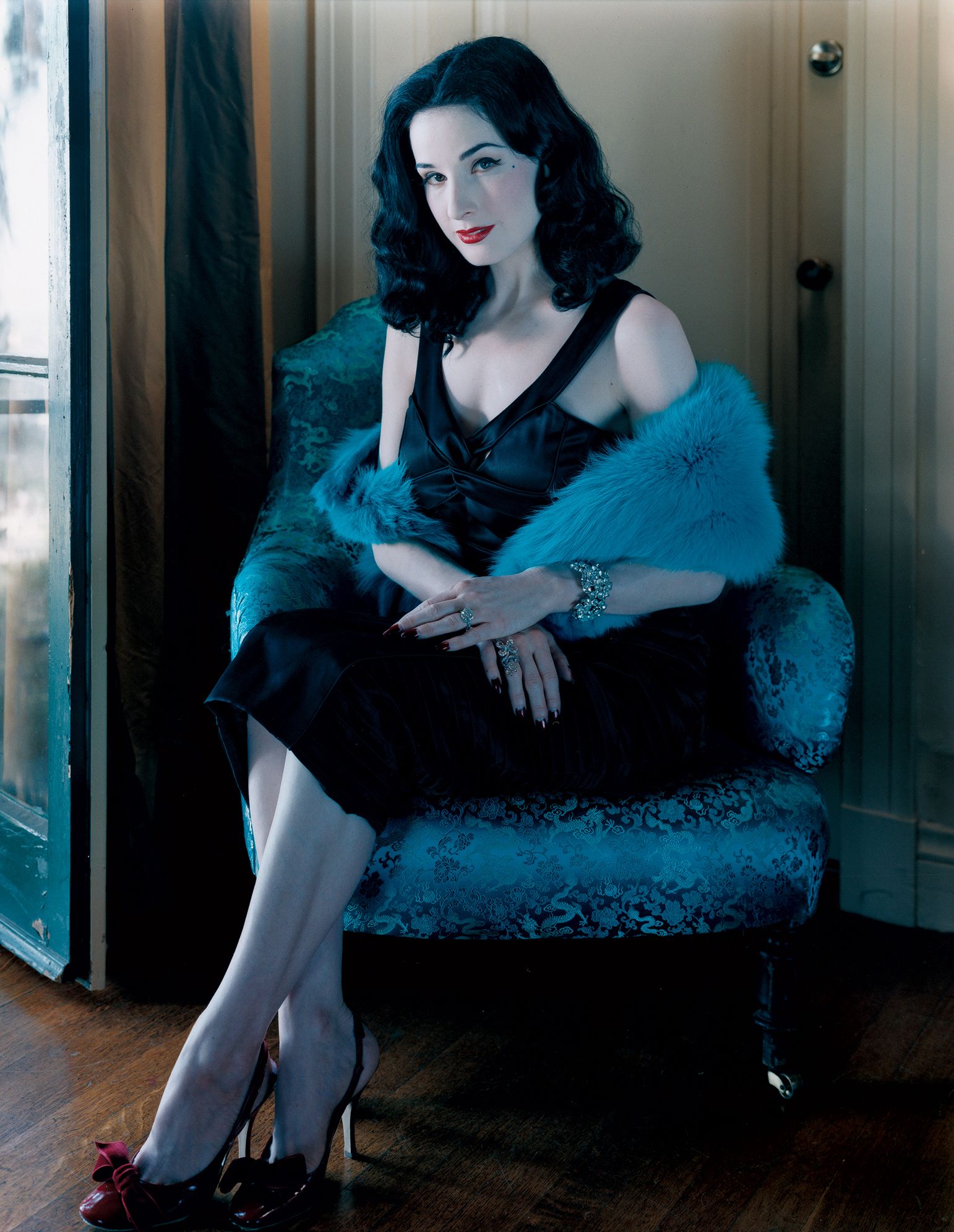
Before she was a global icon or the "Queen of Burlesque," Dita Von Teese was just a blonde girl named Heather Sweet. Honestly, when you look at early photos of her, it’s jarring. She grew up in West Branch, Michigan. It’s a small farming town, the kind of place where you’re more likely to see overalls than a crystal-encrusted corset. Her dad was a machinist. Her mom worked as a manicurist.
Life wasn't exactly draped in velvet.
People often think young Dita Von Teese was born with that raven-black hair and a penchant for 1940s glamour, but she actually describes her younger self as "mediocre-looking." She was a dishwater blonde. She was the middle child. She spent her time cleaning the local ballet studio’s bathrooms just so she could afford to take lessons. That’s the reality. It wasn’t a silver spoon upbringing; it was a "work for every inch of it" upbringing.
The Michigan Years and the Lingerie Obsession
You’ve probably heard the story about the "egg." When Dita was a teenager, she was desperate for the lacy, sophisticated lingerie she saw in the vintage movies she watched with her mother. She wanted to be Hedy Lamarr. She wanted the mystery. Instead, her mother handed her a plain white cotton training bra and a plastic egg containing a pair of lumpy, flesh-colored pantyhose.
She was devastated.
That moment—the sheer disappointment of that "L'eggs" egg—basically sparked her entire career. If the world wouldn't provide the glamour, she’d have to build it herself. By 15, she was working in a local lingerie shop. She wasn’t just folding bras; she was a student of the craft. She eventually became a buyer for the store, learning the architecture of garments before she ever stepped onto a stage.
The California Shift and Creating Heather Sweet
Moving to Orange County, California, as a teenager was a total culture shock for her. She was a pale, vintage-obsessed girl in a land of tanned, blonde beach girls. She didn’t fit. At all.
So she leaned in.
She started dyeing her hair that famous blue-black shade. She got her signature beauty mark tattooed on her cheek at age 18. She wasn’t trying to follow a trend; she was trying to distinguish herself from the "rock and roll" aesthetic that dominated the early '90s. While everyone else was wearing neon and flannel, she was hunting through thrift stores for 1940s suits because she couldn't afford new designer clothes.
It's kinda wild to think that her entire multi-million dollar brand started because she was broke and didn't want to look like everyone else at University High School in Irvine.
Young Dita Von Teese and the 1991 Strip Club Scene
When she was 19, she walked into an Orange County strip club and asked for a job.
It was 1991.
The stage was full of women dancing to hair metal. Dita showed up in a corset, opera-length gloves, and stockings. She was using a fake ID because she wasn't quite old enough to be there. Most of the other dancers thought she was crazy for wearing more clothes than necessary, but she realized something quickly: she had zero competition.
She wasn’t just a stripper. She was a "fetish model" before that term was mainstream. She started one of the first-ever fetish websites in the early days of the internet. She was posing for BDSM-inspired pin-up photos long before she ever landed a Playboy cover.
The Name That Was Actually a Typo
The name "Dita Von Teese" wasn't even the plan.
- She chose "Dita" as a tribute to silent film star Dita Parlo.
- She picked "Von Treese" out of a phone book because she needed a last name for a Playboy shoot.
- Playboy made a typo and printed it as "Von Teese."
She just went with it.
Why Her Early Years Actually Matter Today
Most people see the finished product—the martini glass, the Swarovski crystals, the flawless skin—and assume it was always this way. It wasn't. The young Dita Von Teese era is a masterclass in self-invention. She didn't have a stylist. She still does her own hair and makeup to this day because she spent those early years in Michigan and California figuring out how to do it herself with Revlon "Cherries in the Snow" lipstick.
She failed at being a professional ballerina. She admits she wasn't good enough. She couldn't remember the choreography. But she took that "failure" and used the posture, the grace, and the pointe work to revolutionize burlesque.
How to Apply the Dita Method to Your Own Life
If you’re looking to build a personal brand or just find your own style, Dita’s early life offers some pretty solid blueprints.
First, stop trying to compete where the market is crowded. She didn't try to be the prettiest blonde in Orange County; she became the only "vintage" girl in the room. Second, don't wait for permission or a big budget. She started with thrift store finds and a home hair-dye kit.
The biggest takeaway? Lean into what makes you weird. What she was teased for in high school—the "old lady" clothes and the pale skin—eventually became the very things that made her a millionaire.
If you want to start your own vintage journey, don't go out and buy a $500 corset immediately. Start by researching the history of the era that actually speaks to you. Look at the silhouettes. Find a signature color. Dita didn't become an icon overnight; she spent a decade in the "underground" before the mainstream even knew she existed.
Build your foundation in the shadows. That's where the real magic happens.



