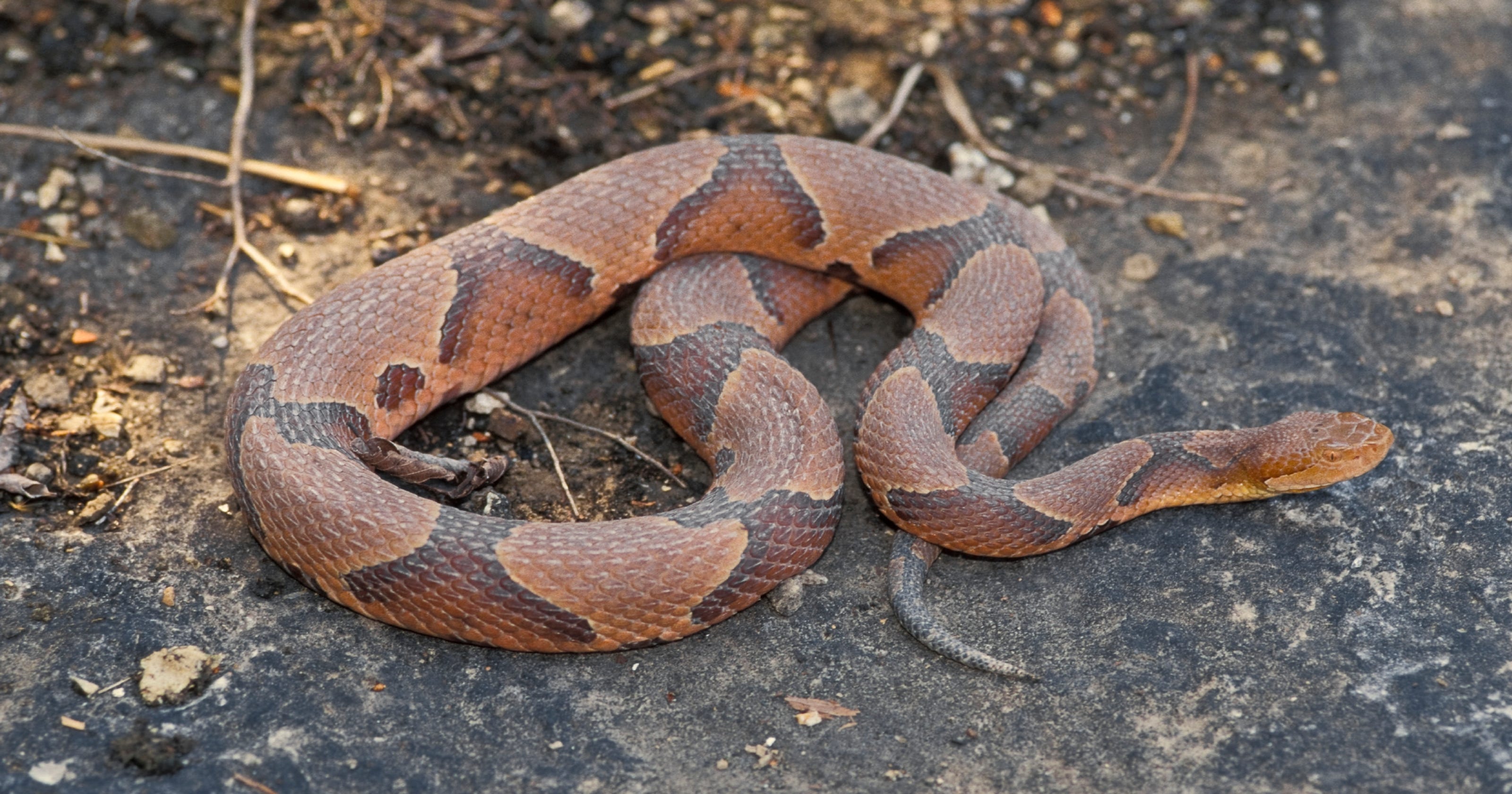
You’re scrolling through your phone after a weekend hike, looking at your camera roll, and you freeze. There it is. A tiny, patterned snake curled up near a rock where you just had your lunch. You take a closer look at those young copperhead snake pictures you snapped and suddenly, your stomach drops. Was it venomous? Was I too close?
Most people panic. It's a natural reaction to seeing a pit viper, even a small one. But honestly, identifying a juvenile Agkistrodon contortrix—the Eastern Copperhead—is a lot easier than people make it out to be once you know the "tells." It isn't just about the Hershey's Kisses on their sides. For the babies, it’s all about the tail.
The glowing neon tail trick
If you look at enough young copperhead snake pictures, one feature jumps out immediately. It looks like the snake dipped the last inch of its body into a bucket of highlighter fluid.
This bright sulfur-yellow or chartreuse tail tip is a specialized tool. Scientists call this "caudal luring." Basically, the little snake wiggles that bright tail to mimic a caterpillar or a worm. A hungry frog or lizard sees a snack, moves in for the kill, and—boom. The copperhead gets a meal instead. As the snake matures, this neon glow fades into a dark brown or black. If you see a snake with a bright yellow tail in the eastern or central U.S., you’re almost certainly looking at a juvenile copperhead or its cousin, the cottonmouth.
The color is shocking. It doesn't look natural. In the dappled sunlight of a forest floor, that yellow tip is often the first thing you'll spot, even before you notice the camouflage of the rest of the body.
Patterns that look like snacks
Let's talk about the body. Most people describe copperhead patterns as "hourglasses" or "Hershey's Kisses."
When you view the snake from the side, the dark brown markings look like triangles or Hershey's Kisses with the wide part at the belly and the point at the spine. If you’re looking down from above, those triangles meet at the spine to form an hourglass shape. It’s a classic look. But here is the thing: young copperheads have much higher contrast than the adults. Their colors are "crisper."
While an old adult might look a bit dusty or faded, a neonate (a newborn) has very distinct, grayish-tan base colors with dark, chocolate-brown bands. The "pixelation" is incredible.
Why do people get them confused?
Mistaken identity is a death sentence for a lot of harmless snakes. People see any brown snake and reach for a shovel. Don't do that.
The most common victim of mistaken identity is the Eastern Milk Snake or the Common Watersnake. If you look at young copperhead snake pictures side-by-side with a baby watersnake, the differences are huge. Watersnakes have "splotches" that are widest on the back and narrow on the sides—the exact opposite of the copperhead’s hourglass. Also, watersnakes have vertical black lines on their "lips" (labial scales). Copperheads have clean, pale faces.
No vertical lip lines? Probably a copperhead.
The "Grumpy" face and cat eyes
Copperheads are pit vipers. This means they have heat-sensing pits between their eyes and nostrils. You probably won't see those pits unless you’re way too close, but you will notice the eye shape.
In bright light, a copperhead has vertical, slit-like pupils. Think cat eyes. Most harmless "lookalikes" in the U.S. have round pupils like humans.
Wait. Don't rely on this.
Pupils can dilate in low light. If it’s getting dark and that baby copperhead is hunting, its pupils might look round. Plus, if you're close enough to check the shape of a snake's pupils, you've already violated the "stay back" rule.
The head shape is another big one. It's distinctively triangular or spade-shaped. This isn't just a style choice; it’s where the venom glands live. The "neck" is much thinner than the head, giving it a bobblehead look that is especially pronounced in juveniles.
Where you’ll find them hiding
They love "edge" habitats. This is where the forest meets a field, or where your lawn meets the woods.
Check your woodpiles. Check your flowerbeds. If you have old pine straw or leaf litter, you're basically providing a luxury resort for them. Young copperheads are born alive (they don't lay eggs) usually in late summer or early fall. This is why you see a surge of young copperhead snake pictures on social media every September.
The mothers often congregate in "rookeries" to give birth. You might find five or six of them in one small area. They aren't aggressive, but they are incredibly well-camouflaged. You could step right over one and never know it. Most bites happen when someone is weeding a garden or moving rocks without gloves and literally puts their hand on the snake.
Is the venom "more dangerous" in babies?
You’ve heard the myth. "Baby snakes are more dangerous because they can't control how much venom they inject."
Honestly? It's mostly nonsense.
While it's true that neonates might be more "reactive," they have significantly less venom than an adult. A full-grown copperhead has a much larger venom gland and can deliver a "wet" bite that is far more serious than a tiny nip from a six-inch baby. That said, a bite is still a medical emergency. Copperhead venom is hemotoxic, meaning it breaks down tissue and causes intense swelling and pain.
It’s rarely fatal for healthy humans, but it will ruin your month. And your bank account. Antivenom isn't cheap.
What to do if you encounter one
If you’re out taking young copperhead snake pictures, keep your distance. A good rule of thumb is to stay at least two snake-lengths away.
- Don't try to move it. Most bites occur when people try to kill or relocate the snake.
- Back away slowly. They aren't going to chase you. They aren't "mean." They just want to be left alone to eat their cicadas.
- Wear shoes. Flip-flops in the woods are an invitation for trouble.
- Use a flashlight. Copperheads are crepuscular (active at dawn and dusk) and nocturnal during the hot summer months.
The best thing you can do is appreciate them from a distance. They are an essential part of the ecosystem, keeping rodent populations in check. Without them, we'd be waist-deep in mice and ticks.
Actionable steps for property owners
If you want to keep young copperheads away from your porch, you need to change the landscape. Stop using heavy mulch or pine straw right against the foundation of your house; use crushed stone instead. It's too hot and offers no cover, so snakes avoid it.
Clear out the "clutter" where they hide. That pile of old bricks or the stack of firewood you haven't touched in three years is a snake magnet. Elevate your woodpiles at least 6-12 inches off the ground. If you see a juvenile, don't reach for the shovel. Spray it with a garden hose from a safe distance. The cold water and the "pressure" will encourage it to find a quieter place to live, far away from your front door.
If you are bitten, do not use a "snake bite kit" or try to suck out the venom. Keep the limb at heart level, stay calm to keep your heart rate down, and get to an emergency room immediately. Documenting the snake with a quick photo can help doctors confirm the species, but never risk a second bite just for a better picture.
The goal is co-existence, not conflict. Understanding their markings is the first step toward staying safe in their territory.



