You’re scrolling through your phone, looking at a blurry thumb-sized creature someone posted on a local Facebook group. Or maybe you're actually standing in your backyard, staring at a frozen coil of brown scales near the hydrangeas. You need to know—and fast—if that's a copperhead. Most young copperhead snake photos online are actually mislabeled water snakes or harmless milk snakes. That's a problem. Honestly, getting it wrong isn't just a blow to your ego; it’s a genuine safety risk if you decide to try "relocating" it with a shovel.
Copperheads (Agkistrodon contortrix) are famous for being masters of camouflage. When they’re babies, they’re basically ninjas. They blend into dried oak leaves so perfectly it feels like a magic trick. But here’s the kicker: they have one specific feature that most people miss in photos because they’re too busy looking at the head shape. Recently making waves lately: Why Everything You Know About the Summer Solstice Is Kinda Wrong.
Why Young Copperhead Snake Photos Are So Tricky
Most people think a baby copperhead looks exactly like a miniature version of the adults. That is mostly true, but there’s a neon-colored exception. Look at the tail. If the snake in the photo has a bright, sulfur-yellow or chartreuse-green tail tip, you are looking at a juvenile copperhead. Nature gave them this "lure" for a reason. They wiggle it to look like a caterpillar, tricking frogs and lizards into coming within striking distance. It’s called caudal luring. It’s brilliant, and frankly, it's the easiest way to ID a youngster.
Adults lose this yellow tail as they age, usually by the time they hit the one-year mark. If you see a photo of a "baby" snake without that yellow tail, it might just be a very small adult, or more likely, it’s a completely different species. Additional information regarding the matter are covered by Cosmopolitan.
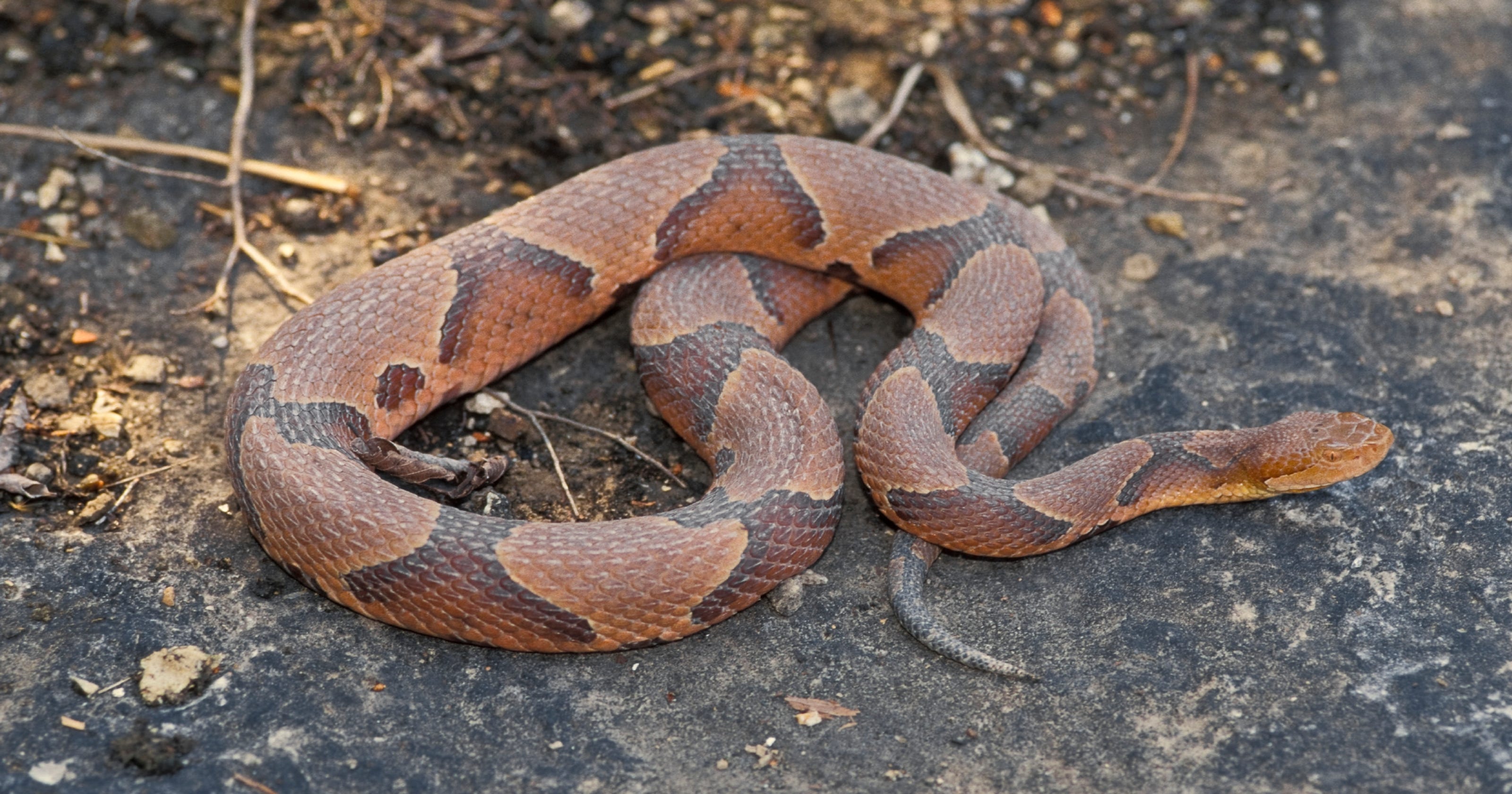
The pattern is the second big giveaway. People call it the "hourglass" or "Hershey's Kiss" pattern. From the side, the dark brown markings look like little Hershey's Kisses sitting on a lighter tan background. If you look at the snake from directly above, those "kisses" meet in the middle, forming an hourglass shape. This is a crucial distinction. Many "lookalike" snakes, like the Northern Water Snake, have patterns that are widest at the spine. In a copperhead, the dark bands are narrowest at the spine and widest on the sides.
The Most Common Misidentifications
I’ve seen thousands of photos where someone screams "COPPERHEAD!" and it’s actually a harmless Eastern Milk Snake. It happens all the time. People see a reddish-brown snake and panic.
- The Corn Snake: These guys are vibrant, often much more orange or red than a copperhead. They don't have the hourglass. They have blocky, rectangular blotches.
- The Northern Water Snake: These are the most frequent victims of mistaken identity. They get dark and cranky when cornered, which makes people think they’re venomous. But their pattern is "broken"—it doesn't form those clean kisses. Plus, their eyes are round.
- The DeKay’s Brownsnake: These stay tiny. Even as adults, they’re barely a foot long. People see a small brown snake in their garden and assume it's a baby copperhead. Look for two rows of dark spots down the back instead of the hourglasses.
The "triangular head" rule is kind of a myth. Well, it's not a myth, but it's misleading. Many non-venomous snakes can flatten their heads when they feel threatened to mimic a venomous look. It’s a bluff. If you rely solely on head shape from a photo, you’re going to misidentify a lot of harmless snakes.
Instead, look at the eyes—if the photo is clear enough. Copperheads have vertical, cat-like pupils. Harmless snakes in North America have round pupils. But seriously, don’t get your face six inches from a snake just to check its pupils. That’s what zoom lenses are for.
What to Do if You Spot One
First off, breathe. Copperheads are generally not aggressive. They are defensive. Most bites happen when someone accidentally steps on one or, more commonly, tries to kill it. According to the American Association of Poison Control Centers, a huge percentage of snakebites occur when humans interact with the snake rather than just walking away.
If you’re taking young copperhead snake photos for identification, keep your distance. A good rule of thumb is to stay at least two snake-lengths away.
Step-by-Step ID Checklist
- The Tail: Is the tip bright yellow or lime green? (Yes = Juvenile Copperhead).
- The Pattern: Are there "Hershey's Kisses" on the sides? (Yes = Copperhead).
- The Scales: Copperheads have "keeled" scales, meaning there's a little ridge down the center of each scale, making them look matte rather than shiny.
- The Location: Are they in a woodpile, under a leaf litter, or near a stone wall? This is prime real estate for them.
Copperhead venom is hemotoxic, meaning it breaks down tissue. While deaths are extremely rare—almost non-existent for healthy adults—the bite is excruciating and can cause permanent damage. If you find one in your yard, don't reach for the shovel. Sprinkling them with a garden hose from a distance is usually enough to make them move along to a quieter spot.
Realities of Habitat and Behavior
You’ll rarely find a copperhead out in the middle of a perfectly manicured lawn in the midday sun. They’re "edge" creatures. They love the boundary where the woods meet the grass. They love your mulch. They love that pile of old firewood you haven't touched since 2022.
In the heat of the summer, they actually become more nocturnal. If you're taking photos at night, you're much more likely to see them active. During the day, they're usually tucked away, relying on that camouflage. I've walked past copperheads dozens of times without seeing them until they moved. It's humbling.
The pits are another thing. As pit vipers, they have heat-sensing pits between their eye and nostril. You won't always see this in a photo unless it’s a high-res macro shot, but it’s how they find their prey in total darkness. It's basically infrared goggles built into their face.
Managing Your Yard to Avoid "Unwanted Guests"
If you’re seeing too many baby copperheads, your yard is basically a luxury resort for them. You've got food, water, and shelter. To change that, you need to think like a snake.
Stop feeding birds right against the house. Birdseed attracts mice. Mice attract snakes. It's a simple food chain. Keep your grass short. Snakes hate being exposed because hawks and owls are constantly looking for a noodle-shaped snack. If the grass is short, the snake feels vulnerable and stays in the woods.
Move your woodpile away from the foundation of your home. Elevate it if you can. Clear out the English Ivy or dense groundcover. Those thick mats of vegetation are like a heated blanket for a young copperhead.
Actionable Next Steps for Homeowners
If you have a photo and you're still not 100% sure, don't guess.
- Upload to iNaturalist: This app uses AI and a community of real biologists to verify sightings. It’s incredibly accurate.
- Join "Snake Identification" Groups: There are several high-quality Facebook groups (like National Snake Identification) staffed by experts who will give you an answer in minutes.
- Leave it alone: If you can't ID it, treat it as venomous.
- Contact a Professional: If the snake is in a high-traffic area like a doorway, search for "humane snake removal" in your area. Many enthusiasts will actually come and relocate the snake for free just to save its life.
Understanding the visual markers of a young copperhead makes you a better neighbor to the wildlife in your area. Most of the fear surrounding these animals comes from a lack of information. Once you know what to look for—that yellow tail and those Hershey's Kisses—the mystery disappears, and you can coexist without the panic.
Keep your boots on in the woods, keep your flashlight handy at night, and always check the other side of a log before you step over it.
Key Takeaway: The bright yellow tail tip is the "smoking gun" for identifying a juvenile copperhead. If that's missing, look for the hourglass pattern that pinches at the spine and widens at the belly. When in doubt, take a photo from five feet away and let an expert identify it online rather than getting close enough to find out the hard way.



