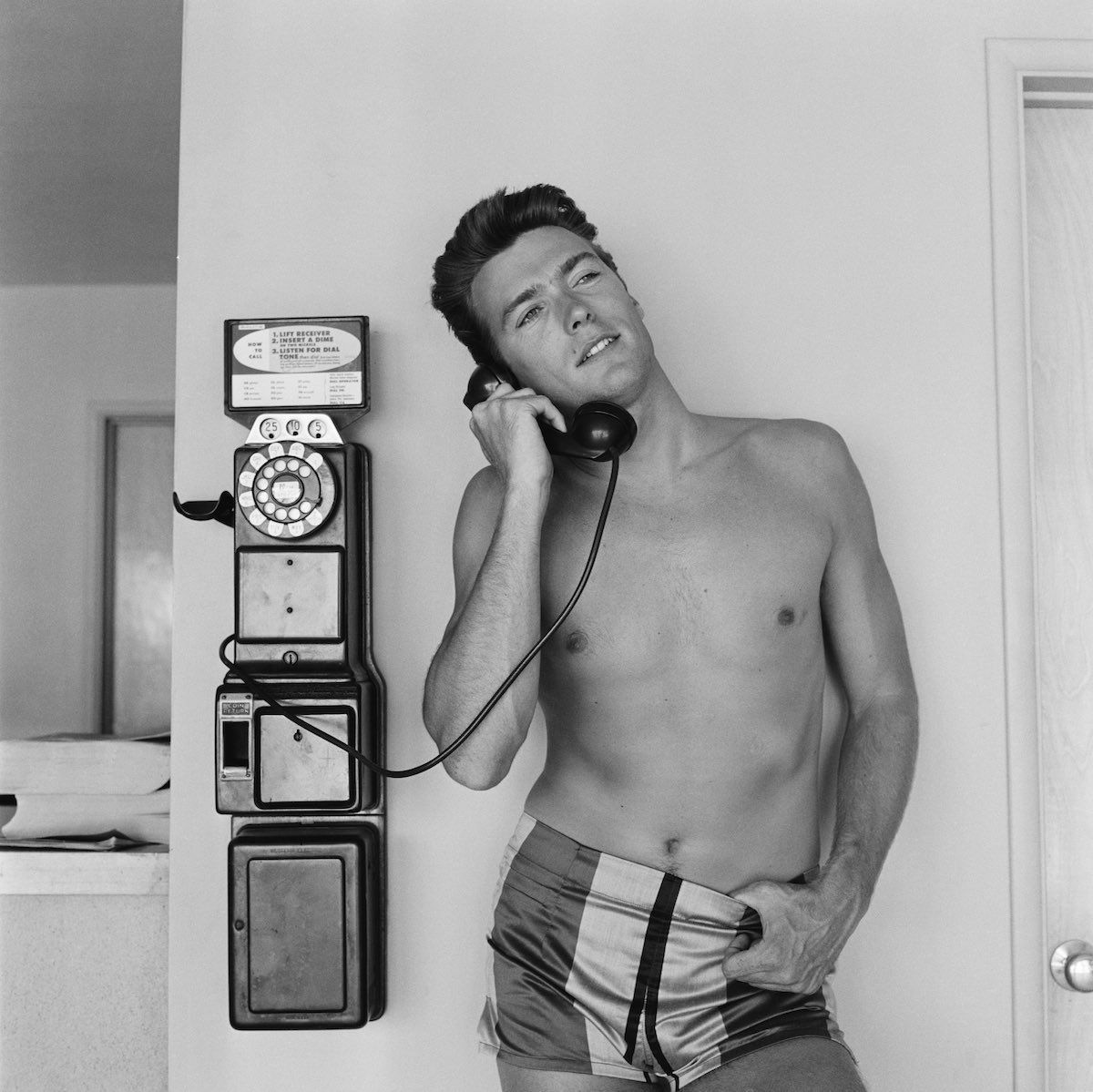
Ever seen that shot of a 26-year-old guy with a perfect jawline, leaning against a beat-up car with his shirt off? That’s not some modern-day Instagram model using a vintage filter. It’s Clint Eastwood in 1956. Before he was the most famous cowboy on the planet, he was basically just a tall, skinny kid from Oakland trying to figure out how to stand in front of a camera.
Honestly, looking at young Clint Eastwood pictures is like watching a masterclass in how a "look" is built. People think he was born with that iconic squint and the cigarillo hanging out of his mouth.
He wasn't.
Back in the mid-fifties, Universal Pictures had him under contract for $75 a week, and they didn't really know what to do with him. He was 6'4", which was actually a problem back then because he towered over his co-stars. Studio executives told him his Adam's apple stuck out too much. They said he talked through his teeth.
Joke's on them, right?
The Fort Ord Days and That Famous Swim
Most people stumble upon photos of Clint in a military uniform and assume he was some kind of war hero. The reality is a bit more... damp.
Drafted in 1950 during the Korean War, Eastwood ended up stationed at Fort Ord in California. He wasn't on the front lines. He was a swimming instructor. There's a reason he looks so comfortable in those early beach photos—he spent years as a lifeguard and a "swimming coach" for the troops.
But there’s a specific story behind the grit you see in his eyes in later 1950s shots.
In 1951, he was hitching a ride on a Navy AD-1Q torpedo bomber. The engine failed. The plane ditched into the Pacific near Point Reyes. A 21-year-old Clint and the pilot had to swim two miles through freezing, shark-infested water in the dark to reach the shore.
When you see those young Clint Eastwood pictures where he looks like he's seen some things, remember that swim. It wasn't acting. He’d actually stared down the Pacific and won.
Life as a "Contract Player"
The 1955-1958 era of Eastwood’s life is a goldmine of weird, staged publicity photos. Since he was a Universal contract player, they forced him into all sorts of awkward "heartthrob" shoots.
- The Weightlifting Shots: There are several photos from 1956 of him working out with dumbbells in his backyard. He looks lean, but nowhere near the "tough guy" bulk he’d later carry.
- The Domestic Candid: Pictures of him with his first wife, Maggie Johnson, usually show him looking like a standard 1950s suburbanite—drinking coffee, talking on a payphone, or tinkering with a car.
- The "Monster Movie" Era: His first real roles were uncredited bits in Revenge of the Creature and Tarantula. If you find a photo of a young pilot in a cockpit from 1955, that’s probably him.
It’s kinda funny to see him so polished. No stubble. No scowl. Just a handsome guy hoping he doesn't get fired.
Eventually, he did get fired. Universal dropped him in 1955.
He spent the next few years digging swimming pools and driving a garbage truck to pay the bills. The "struggling actor" photos from this time aren't staged. He was actually broke.
Rawhide and the Birth of the Cowboy
Everything changed in 1958. Clint walked into the CBS cafeteria, and a producer noticed him. He looked like a cowboy.
The resulting photos from the set of Rawhide show the first real shift toward the Clint we know. As Rowdy Yates, he started to develop that "Man with No Name" silhouette.
However, Clint actually hated the character of Rowdy. He was nearly 30 years old, and Rowdy was written as a "hotheaded kid." In many publicity stills from this era, you can see a slight stiffness. He was playing a boy, but he was already a man.
The most interesting thing about these Rawhide photos? The clothes.
When Sergio Leone eventually called him to Italy to film A Fistful of Dollars in 1964, Clint didn't go to a costume designer. He went to a Western store in Santa Monica and bought his own black jeans. He brought the sheepskin vest from the Rawhide set.
He even brought his own cigars, even though he hated smoking.
Why the Spaghetti Western Photos Look Different
If you compare young Clint Eastwood pictures from Hollywood to the ones taken in Almería, Spain, the difference is jarring.
Leone’s photographer captured something the American studios missed: the dirt.
In the 1964–1966 photos, Clint looks sweaty. He’s covered in dust. The lighting is harsh. This was the "Spaghetti Western" aesthetic. James Coburn and Charles Bronson had already turned down the role, thinking the script was garbage.
Clint took it for $15,000 and a trip to Europe.
There's a famous photo of him from The Good, the Bad and the Ugly (1966) where he’s squinting against the sun. People think that’s a "tough guy" choice. Actually, it was just really bright in Spain, and he’s famously sensitive to light. That squint became his trademark entirely by accident.
Another weird detail: that iconic poncho.
He wore the same one in all three movies. He never washed it. If you look closely at high-res pictures from the "Dollars" trilogy, you can see the grime. He thought washing it would ruin the "character."
The Transition to Stardom
By the late 60s, the "young" Clint was starting to fade into the "iconic" Clint.
Photos from 1967 show him in Manchester, England, standing next to an 18-month-old kid in St. Peter’s Square. He looks like a rockstar—tall, wearing a sharp coat, looking completely out of place in the drizzly UK.
He was starting to realize he didn't need the studio system. He formed Malpaso Productions in 1967.
Look at pictures from the set of Hang 'Em High (1968). The "baby face" from the Universal contract days is totally gone. His face had started to "leather." That's the look that would carry him through the Dirty Harry era and beyond.
How to Tell a Real Vintage Clint Photo from a Fake
With AI-generated images everywhere now, people are constantly sharing "rare" photos that never happened. Here is how you spot a genuine 1950s/60s shot:
- The Hands: Real young Clint had very large, weathered hands from his time as a logger and pool digger. AI often gets the proportions wrong.
- The Hair: His hair in the 50s was a very specific "pompadour" style that was always slightly messy. If it looks too perfect or like modern "hairstylist" hair, it's probably a fake.
- The Wardrobe: If he’s wearing a poncho that isn't the specific green/brown pattern from the Leone films, it’s likely a costume or a fan-made image.
- The Eyes: His eyes are a distinct light blue. In many old black-and-white photos, they look almost white due to the film stock used at the time.
Insights for Collectors and Fans
If you're looking to find high-quality versions of these young Clint Eastwood pictures, don't just search social media.
Check the Getty Images archives or the John Kobal Foundation. Many of the most iconic shots—like the one where he's leaning on his car in 1956—were taken by studio photographers like Irving Glassberg, who was one of the first people to realize Clint was "camera-ready."
Acknowledge the fact that his "look" was a slow burn. He wasn't an overnight sensation. He was a guy who worked manual labor, survived a plane crash, and got fired from his first big job.
When you see him in those photos now, you’re not just seeing a handsome face. You’re seeing a guy who was stubbornly waiting for the rest of the world to catch up to his style.
If you're a fan of his later work, go back and study the 1956 "at home" sessions. You’ll see the seeds of the director he became. He was always watching the camera, always aware of the light.
Next Steps for You: Check out the photography of Anton Corbijn if you want to see how Clint's face aged into a landscape of its own, or dig into the Rawhide archives for the transition from "Rowdy" to "The Man with No Name."