We’ve all seen the meme. You know the one—the 90-plus-year-old legend looking grizzled and sharp, contrasted against a grainy shot of a guy who looks like he should be modeling for a vintage denim ad. Looking at young Clint Eastwood pics isn’t just about nostalgia. It’s sorta like looking at a blueprint for what a movie star was actually supposed to be before everything got so polished and digitally airbrushed.
He wasn't always the "get off my lawn" guy.
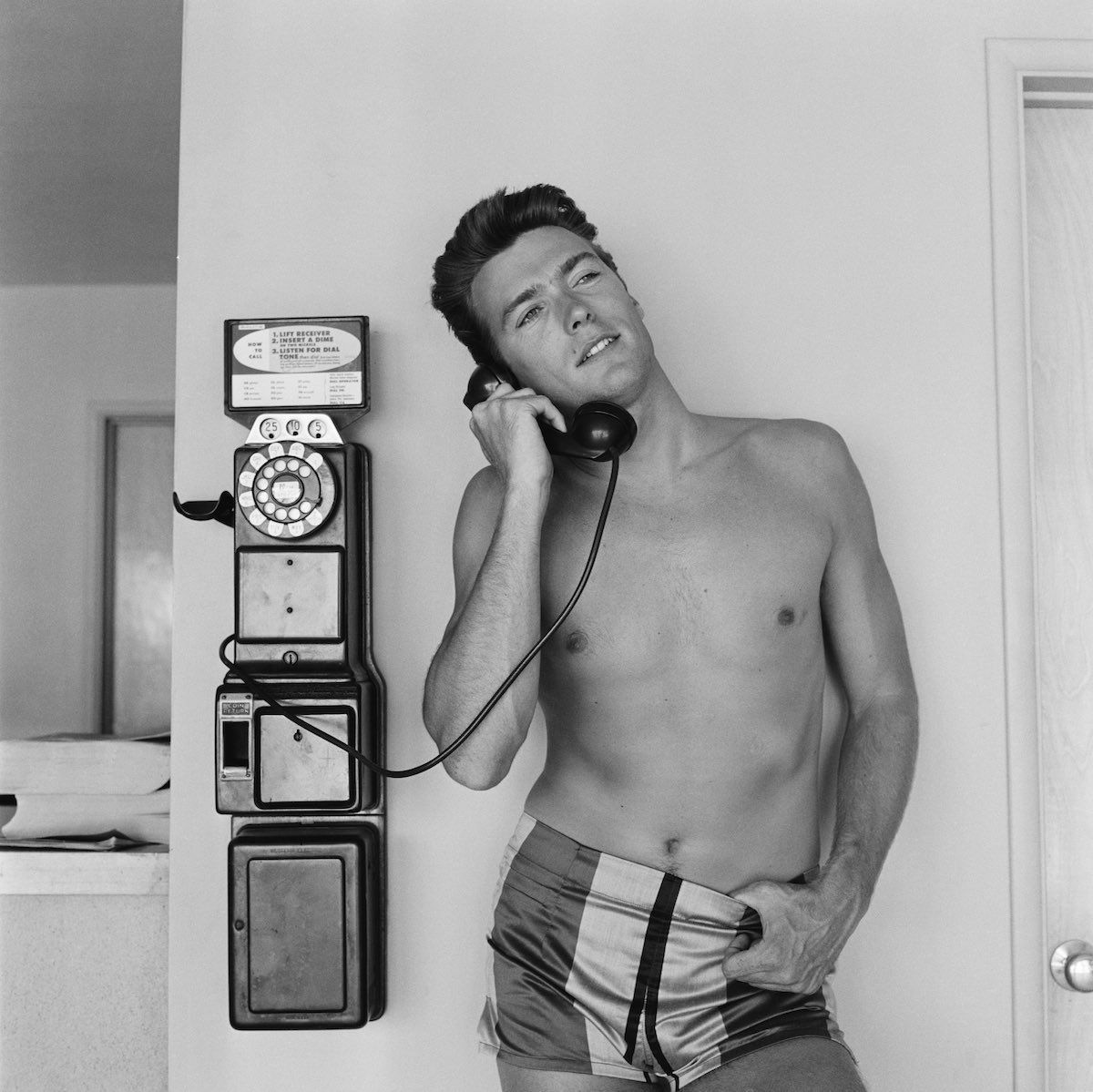
Back in the 50s and 60s, Clint was just another tall kid from San Francisco trying to figure out if he should be a swimming instructor or an actor. Most people forget he was drafted into the Army during the Korean War. He ended up at Fort Ord in California. No combat, luckily. He worked as a lifeguard. There are these rare shots of him from that era—shirtless, lanky but muscular, looking like he just stepped off a surfboard. Honestly, if you didn’t know who he was, you’d just think he was some random heartthrob from a 1952 beach party.
The Rawhide Era: Before the Poncho
If you start digging into young Clint Eastwood pics, you’re going to hit a wall of Western gear. Specifically, the Rawhide years. From 1959 to 1965, Clint was Rowdy Yates. He actually hated the name "Rowdy." He thought the character was a bit of a "clod"—too young, too naive, too much of a "white hat" hero who kissed old ladies and saved puppies.
The publicity photos from this time are fascinating because you can see him trying to find his "look." He’s got the clean-shave, the boyish grin, and the perfectly tilted Stetson. It’s Clint, but it’s not Clint yet. It’s the studio version of him.
Universal had him on a $75-a-week contract early on. Think about that. One of the biggest box-office draws in history was once making basically pocket change to stand in the back of B-movies like Tarantula (1955). If you find the still of him as a lab assistant in Revenge of the Creature, it’s almost a jump scare. He looks so... normal.
Transitioning to the Man With No Name
The real shift—the moment the "young Clint" we all recognize actually appeared—happened in Spain. Not Hollywood.
In 1963, Eric Fleming (his Rawhide co-star) turned down a low-budget Italian Western. He thought it was beneath him. Clint, who was bored to tears with the "good guy" routine, jumped at it. He flew to Europe for $15,000 and a promise of a Mercedes.
This is where the iconic imagery comes from:
- The squint (which he reportedly did because of the bright Spanish sun and the cheap cigars he hated smoking).
- The unshaven scruff that became his trademark.
- The sheepskin vest and that famous brown poncho he never washed during the entire trilogy.
Basically, he created a silhouette. When you see young Clint Eastwood pics from the Dollars trilogy, you aren't just looking at an actor. You're looking at the invention of the anti-hero. Sergio Leone, the director, famously said Clint had only two expressions: "one with a hat and one without." It was a joke, but it captured the stoic, minimalist style that changed everything.
What People Get Wrong About Early Clint
There’s a common misconception that he was an overnight success. He wasn't. He was 34 when A Fistful of Dollars came out in Italy, and 37 by the time it finally hit U.S. theaters in 1967. He had a decade of "who is that tall guy?" bit parts before anyone actually cared about his name.
- The Model Myth: You’ll see plenty of photos of him looking like a professional model. While he was married to model Maggie Johnson in the 50s, Clint wasn't really a "model" in the traditional sense. Those were mostly studio-mandated "beefcake" shots to try and market him to teenage girls before they realized he was better at playing a killer.
- The Smoke and Mirrors: Despite the constant cigarillo in his mouth in every 1960s photo, Clint never actually smoked habitually. He’s been a health nut and a meditator since his youth. The squint was partially a tool to hide the fact that the smoke was irritating his eyes.
- The Height: In almost every group shot from the 60s, he towers over everyone. At 6'4", he had to be filmed carefully so he didn't make his leading ladies look like children.
Where to Find the Real Archives
If you're looking for high-quality, authentic young Clint Eastwood pics for a project or just for the aesthetic, don't just rely on Pinterest. The best stuff is buried in:
- The John Kobal Foundation: They hold some of the most striking portraits from his early Universal days.
- Warner Bros. Archives: Since he basically built that studio in the 70s, their internal library is the gold standard for Dirty Harry era shots.
- Getty Images (Editorial): Search for "Rawhide set 1962" or "Clint Eastwood 1956" to find the candid, non-posed stuff.
How to Tell a Real Vintage Print from a Fake
If you're a collector, be careful. The market is flooded with "reprints" that are just low-res scans from the internet printed on glossy paper.
A real publicity still from the 60s will usually have a "sniped" caption on the back—a glued piece of paper explaining the scene—or a studio credit printed directly on the bottom margin of the front. Look for the "RKO" or "Universal" or "United Artists" stamps. If it looks too perfect and smells like a fresh ink-jet printer, it probably is.
The Scott Eastwood Factor
We can't talk about young Clint without mentioning his son, Scott. Around 2013, a photo of Scott went viral because the resemblance was almost eerie. It sparked a whole new wave of interest in young Clint Eastwood pics. While Scott definitely has the jawline, there’s something about the original 1960s Clint—that weathered, "I’ve seen too much" intensity—that's hard to replicate.
It wasn't just the face. It was the era. The grain of the 35mm film, the natural light of the Spanish desert, and the fact that he was actually doing his own stunts.
Moving Forward With Your Search
If you're putting together a mood board or just want to dive deeper into the legend's early years, try searching for "Clint Eastwood 1954 screen test." It’s a rare look at a guy who had no idea he was about to become the face of a century.
Next Steps for Enthusiasts:
- Check out the Criterion Collection releases of the Dollars trilogy; they often include galleries of rare onset photography that you won't find on Google Images.
- Look into the photography of Ken Regan, who captured some of the most intimate shots of Clint during the 70s when he was transitioning into directing.
- Compare the early Rawhide publicity shots with the Dirty Harry (1971) stills to see the literal evolution of "Hollywood's Tough Guy" in real-time.