You’ve seen the face. It’s etched into the American psyche like a granite cliffside. Squinted eyes, a cigarillo clenched between teeth, and that low, gravelly rasp that makes everyone else in the room sound like they’re shouting. But before he was the "Man with No Name" or the world’s most dangerous San Francisco inspector, there was a skinny kid from San Francisco nicknamed "Samson" by the hospital nurses because he weighed 11 pounds, 6 ounces at birth.
Honestly, when you look at young Clint Eastwood photos, you aren't just looking at a Hollywood heartthrob. You're looking at a guy who spent a decade failing. He was the king of the bit part. A man who was once told his Adam's apple was too big and that he spoke too slowly to ever make it.
The Fort Ord Era: Lifeguarding and Near-Death
Before the cameras started rolling, Eastwood was in the U.S. Army. It was 1951. The Korean War was raging, but Clint didn't end up on the front lines. Instead, he was stationed at Fort Ord in Northern California.
His job? Swimming instructor.
There are these amazing, rare shots of him from this era—basically a tall, rangy kid in military fatigues or swimming trunks. He looks like a classic 1950s athlete. But there’s a story behind that smile. While hitching a ride on a Navy torpedo bomber, the plane ran out of fuel and crashed into the Pacific Ocean near Point Reyes. Eastwood and the pilot had to swim over two miles through shark-infested waters to reach the shore.
Basically, the "tough guy" persona wasn't just acting. It was forged in the cold water of the Pacific long before he ever stepped onto a studio backlot.
The Universal Contract Years (1954–1958)
If you dig into the archives for young Clint Eastwood photos from the mid-50s, you’ll find a lot of "pretty boy" studio portraits. Universal Pictures signed him for $75 a week in 1954. They didn't really know what to do with him. He was 6'4", which was actually considered too tall for some lead actors who didn't want to be towered over.
His early filmography is a weird trip through B-movie history:
- Revenge of the Creature (1955): He plays a lab technician.
- Tarantula (1955): He’s a jet pilot (wearing a mask, so you can't even see his face).
- Francis in the Navy: Just another bit part.
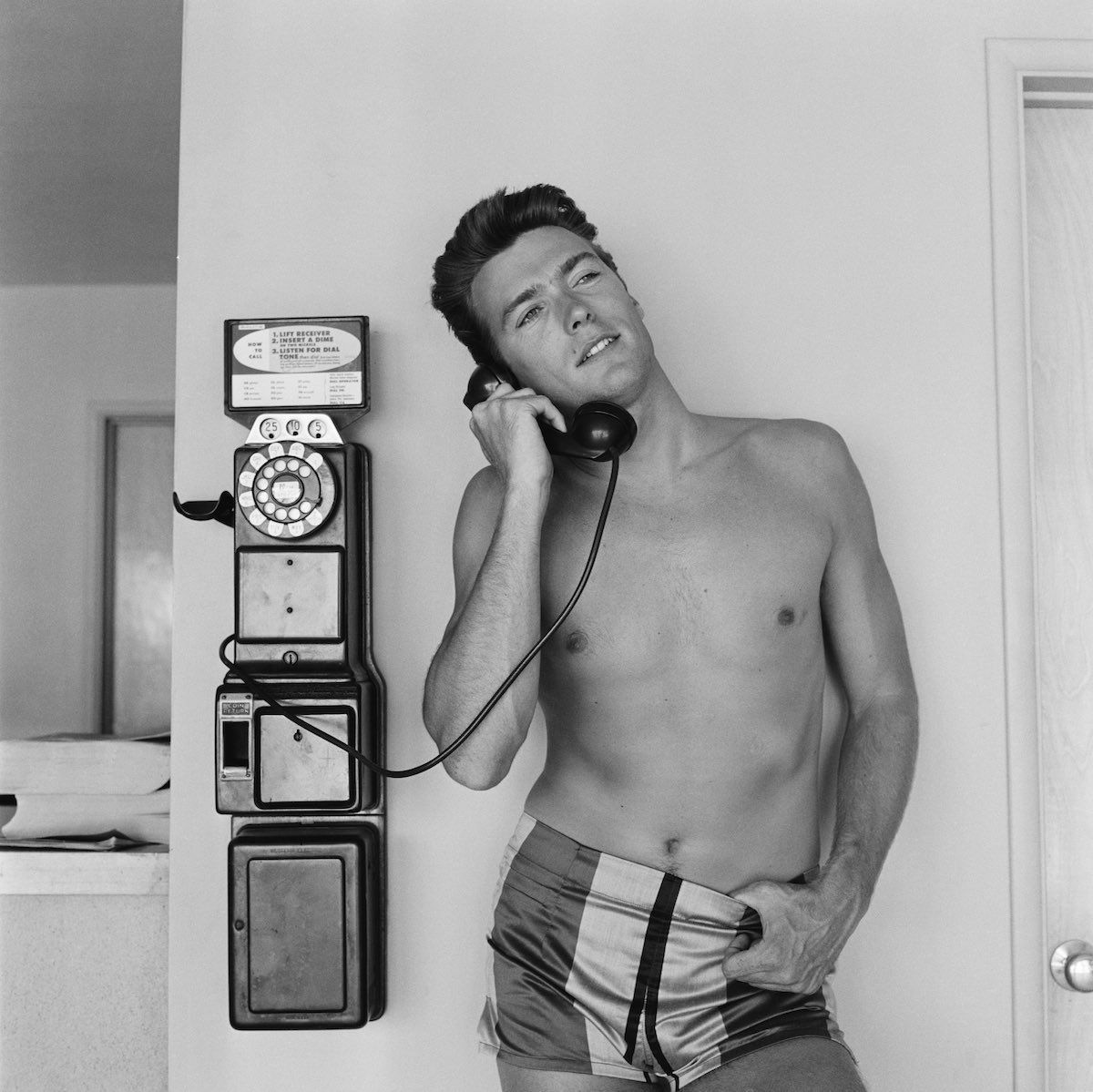
There’s this famous 1956 photo shoot by Earl Leaf where Clint is just hanging out at his L.A. home. He’s drinking coffee, talking on a payphone, and working out with dumbbells. He looks incredibly modern. You could put him in a 2026 fashion magazine and he wouldn't look out of place. It’s that timeless, lean look. But at the time, Universal dropped him. They thought he was a "dud."
Rawhide and the Birth of Rowdy Yates
Everything changed in 1959. Clint was visiting a friend at CBS when an executive spotted him. He had that "look." They cast him as Rowdy Yates in Rawhide.
Now, if you look at photos from this period, he’s starting to look like the Clint we know. He’s got the cowboy hat, the vest, and that distinctive lean. But here’s the kicker: Clint actually hated the character of Rowdy Yates. He called him "the chocolate-covered hero" and "the boob of the plains." He felt the character was too young, too naive, and too much of a "goody-two-shoes."
He spent six years on that show. While his costars were out partying, Clint was behind the scenes, learning how to direct. He was watching the camera angles, the lighting, and the editing. He was biding his time.
Why the Italian Photos Changed Everything
In 1964, a guy named Sergio Leone was looking for a cheap American actor to star in a "Spaghetti Western" in Spain. He wanted Charles Bronson. Bronson said the script was the worst thing he’d ever read. He turned it down.
Leone eventually saw a clip of Clint in Rawhide. He liked the way Clint leaned against a fence.
The photos from the set of A Fistful of Dollars are iconic. This is where the squint comes from. The sun in Spain was so bright, and the lighting was so harsh, that Clint spent the whole shoot squinting. He also bought his own poncho and his own black cheroots from a shop in Beverly Hills.
He didn't smoke in real life. He hated it. But he knew that the cigarillo made him look older and meaner.
When those films—A Fistful of Dollars, For a Few Dollars More, and The Good, the Bad and the Ugly—finally hit the U.S. in 1967, the image of "Young Clint" was shattered. He wasn't the "pretty boy" from the Universal portraits anymore. He was a stone-cold killer.
The Personal Side: Maggie and the Early Life
Away from the set, Clint was married to Maggie Johnson (from 1953 to 1984). Photos of them together in the late 50s show a very different side of him. They look like a standard, happy Hollywood couple. But even then, there was a restlessness to him.
He was a jazz fanatic. He spent his nights in Oakland clubs watching Charlie Parker. He even considered being a professional musician before the acting bug bit.
How to Authenticate Vintage Eastwood Prints
If you're a collector looking for real-deal vintage photos, here’s what you need to know:
- Check the Agency Stamps: Authentic publicity stills from the 50s and 60s will almost always have a "Silver Screen Collection" or "Globe Photos" stamp on the back.
- Look for the Grain: Real film photography from that era has a specific grain structure. Digital reprints often look "too smooth" or have weird pixelation in the shadows.
- The "Rowdy" vs "Joe" Test: Photos where he looks clean-shaven and boyish are almost always Rawhide era (1959–1965). The grizzled, stubbled look is the Leone era (1964–1966).
What We Can Learn from Early Clint
The biggest misconception about young Clint Eastwood is that he was an overnight success. He wasn't. He was a 34-year-old "TV actor" when he went to Italy to film A Fistful of Dollars. He was considered "over the hill" by many Hollywood standards of the time.
His career is a masterclass in persistence. He took the "pretty boy" looks that the studios wanted to exploit and intentionally roughed them up. He leaned into the squint. He leaned into the silence. He realized that in cinema, what you don't say is often more powerful than what you do.
Your Next Steps for Exploring the Eastwood Legacy
- Research the Earl Leaf 1956 Session: These are the most candid photos of him before fame hit. Look for the "at home" shots—they show his real personality.
- Watch the "Francis in the Navy" bit part: It’s a great exercise to see how a "bad" actor (by his own admission) can evolve into an Oscar-winning director.
- Compare the 1954 Universal portraits to the 1964 Leone stills: Notice the shift in body language. He goes from "standing for the camera" to "owning the space."
Clint Eastwood’s early years weren't just about a handsome face. They were about a guy who was willing to swim through sharks—literally and figuratively—to get where he wanted to be.
The photos are just the evidence he left behind.
Actionable Insight: If you're interested in the visual history of cinema, start a collection of "Malpaso" era production stills. These are the first films where Eastwood had total creative control (starting with Hang 'Em High in 1968), and they represent the bridge between his "young" look and the legendary icon he became. Focus on finding prints with original studio markings to ensure historical value.