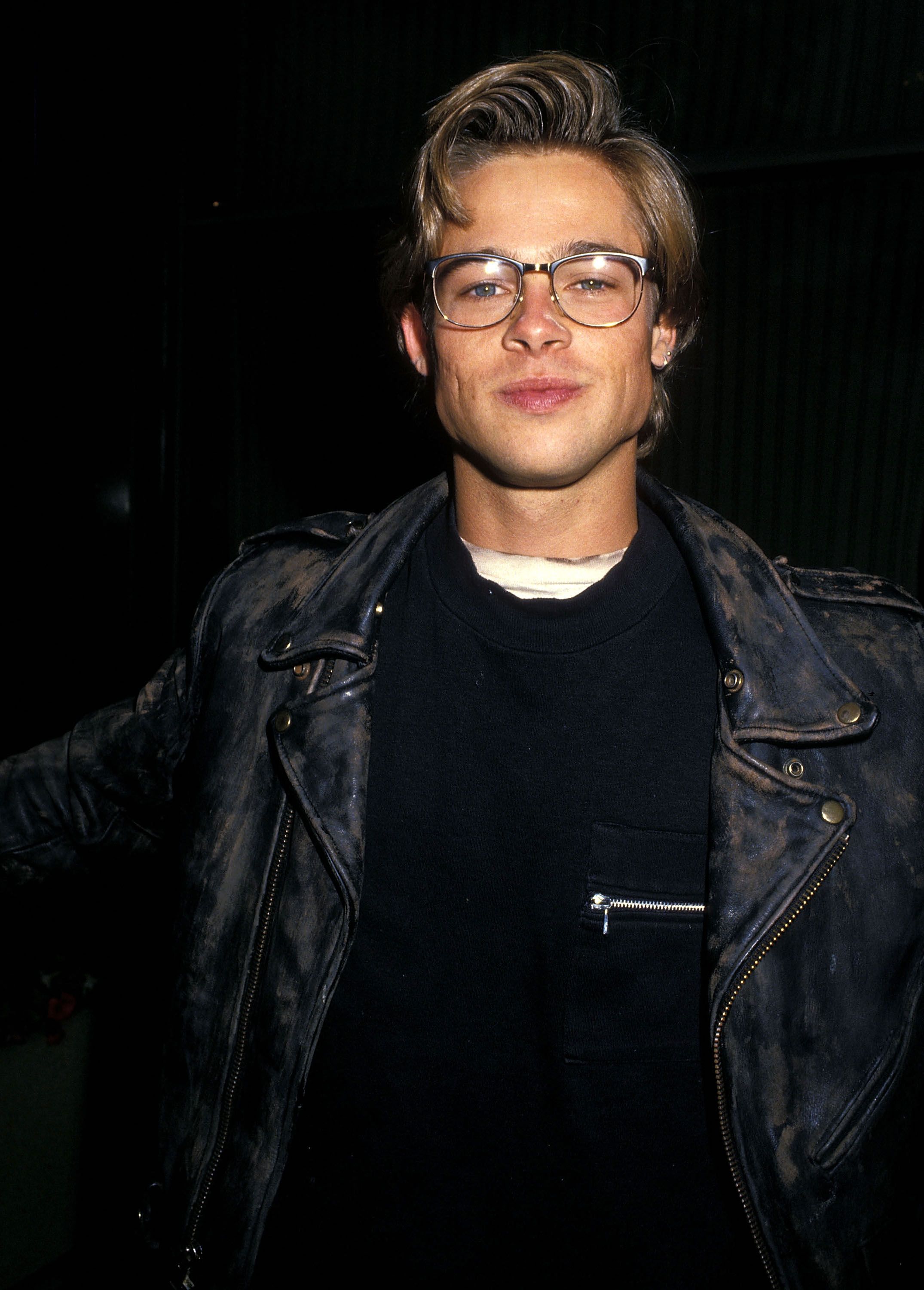
If you spend any time on Pinterest or "Old School Cool" subreddits, you’ve seen them. The grainy, high-contrast young Brad Pitt images from the late 1980s and early '90s. He’s usually wearing a thrashed leather jacket, or maybe a thrift-store cowboy hat, looking like he just rolled out of a haystack but somehow also deserves a Vogue cover.
It’s a specific kind of magnetism.
Honestly, it wasn't just about him being "pretty." It was the vibe. Before he was an Academy Award-winning producer and a global elder statesman of cinema, William Bradley Pitt was a kid from Missouri who moved to Los Angeles with $325 in his pocket. Those early photos capture a transition that feels almost impossible today—the birth of the last great traditional movie star.
The Photos That Changed Everything
Most people point to Thelma & Louise (1991) as the big bang. You know the one: J.D. the hitchhiker, shirtless in the rain, holding a hairdryer like a weapon. That single scene created a visual template for 90s masculinity. But if you dig into the archives, the "real" young Brad Pitt images start a few years earlier.
Take the 1988 Beverly Hills premiere of Red Heat. He’s standing there in a leather jacket that looks three sizes too big, hair bleached by the sun, looking slightly confused to be on a red carpet. Or the "Teen Beat" shoots where he’s wearing pink bandanas and yellow tank tops. It’s glorious, campy, and completely human.
Mark Seliger and the "Gender Fluid" 1999 Shoot
One of the most discussed sets of images comes much later in his "young" era. In 1999, photographer Mark Seliger shot Pitt for Rolling Stone. Pitt came to Seliger with a "weird idea." The result? Brad Pitt in various sequined mini-dresses, posing in front of pink backgrounds.
It was a massive risk at the time.
Today, we see Harry Styles or Timothée Chalamet leaning into gender-neutral fashion constantly. But in '99? This was a heartthrob at the peak of his Fight Club fame deliberately messing with his "macho" image. Those photos remain some of the most analyzed editorial images in Hollywood history because they showed he wasn't afraid to break the very mold that made him rich.
The Evolution of the "Pitt Aesthetic"
It is wild to see how much his look changed every six months. You can basically date any young Brad Pitt image based on the length of his hair.
- 1987-1989: The "Boy Next Door" phase. Think guest spots on Growing Pains and Dallas. Floppy hair, clean-shaven, lots of denim.
- 1991-1992: The "Grunge Cowboy." After Thelma & Louise, it was all about the rugged, unwashed look. This peaked with A River Runs Through It.
- 1994: The "Gothic Romantic." Long, dark-blonde hair for Interview with the Vampire and Legends of the Fall. This is the era of the "Sexiest Man Alive" title (1995).
- 1997-1999: The "Bleach and Buzz" phase. Short, spiky, peroxide blonde for Seven Years in Tibet and Fight Club.
Photographers like Bruce Weber and Herb Ritts loved him because he had "the light." That’s a real thing in photography—some people just reflect light differently. In the early '90s, Pitt had this translucent quality that made even low-res paparazzi shots look like high art.
What Most People Get Wrong About His Early Fame
There's a myth that he was just an overnight success who got lucky because of his jawline. If you look at the rare images of him as a "small-time model" in the mid-80s, you see a guy doing the grunt work. He worked as a giant chicken for El Pollo Loco. He was a driver for strip-o-grams.
The early headshots show a guy who was trying too hard. He had the "big hair" of the late 80s, trying to look like Ricky Nelson (which he actually did for the movie Johnny Suede). It wasn't until he stopped trying to look like a star and started looking like a "character" that the images became iconic.
The "Pitt-Aniston" Era Images
We have to talk about the 1998-2000 era. The images of Brad and Jennifer Aniston at the 2000 AFI Awards or just shopping in LA are the peak of "Y2K Minimalist Chic." Matching sunglasses, cargo pants, and tinted lenses. These images aren't just celeb gossip fodder; they are literally the mood board for every Gen Z fashion brand in 2026.
Why We Are Still Obsessed
Nuance matters here. We aren't just looking at a handsome guy. We’re looking at a specific moment in time before social media.
In the 90s, you only saw "Young Brad" in movies, on a physical magazine in a grocery store, or on a poster on a bedroom wall. There was a distance. That distance created a "cool" factor that is basically impossible to replicate now when every star posts their breakfast on Instagram.
Those film-stock photos have a grain and a color depth that digital sensors can't quite mimic. The way the sun hits his face in the Legends of the Fall stills—that’s 35mm magic.
How to Use These Aesthetics Today
If you’re looking to capture that "90s Pitt" energy in your own photography or style, it’s actually pretty simple. Forget the "perfect" look.
- Prioritize Texture: The best images of him featured heavy textures—distressed leather, chunky knit sweaters, or raw denim.
- Natural Lighting only: Almost all the iconic candid shots of young Brad were taken in "golden hour" light or harsh mid-day sun. No ring lights.
- The "Non-Pose": He rarely looked directly at the camera with a "model face." He was usually laughing, looking down, or caught mid-motion.
- Embrace the Mess: If your hair is too perfect, you’ve already lost the vibe.
Start by looking for high-resolution archives from the Ron Galella Collection or Mark Seliger’s "The Shapeshifter" series. Those are the gold standard for high-quality reference.
Analyze the color grading in Se7en or Fight Club. You’ll notice the shadows are often crushed and the highlights are blown out. If you're editing your own photos to match that '90s film look, lean into the greens and yellows in the shadows rather than a clean "modern" white balance.
Next time you're scrolling through those vintage galleries, look past the face. Look at the framing, the grain, and the complete lack of "influencer" polish. That’s where the real magic lives.