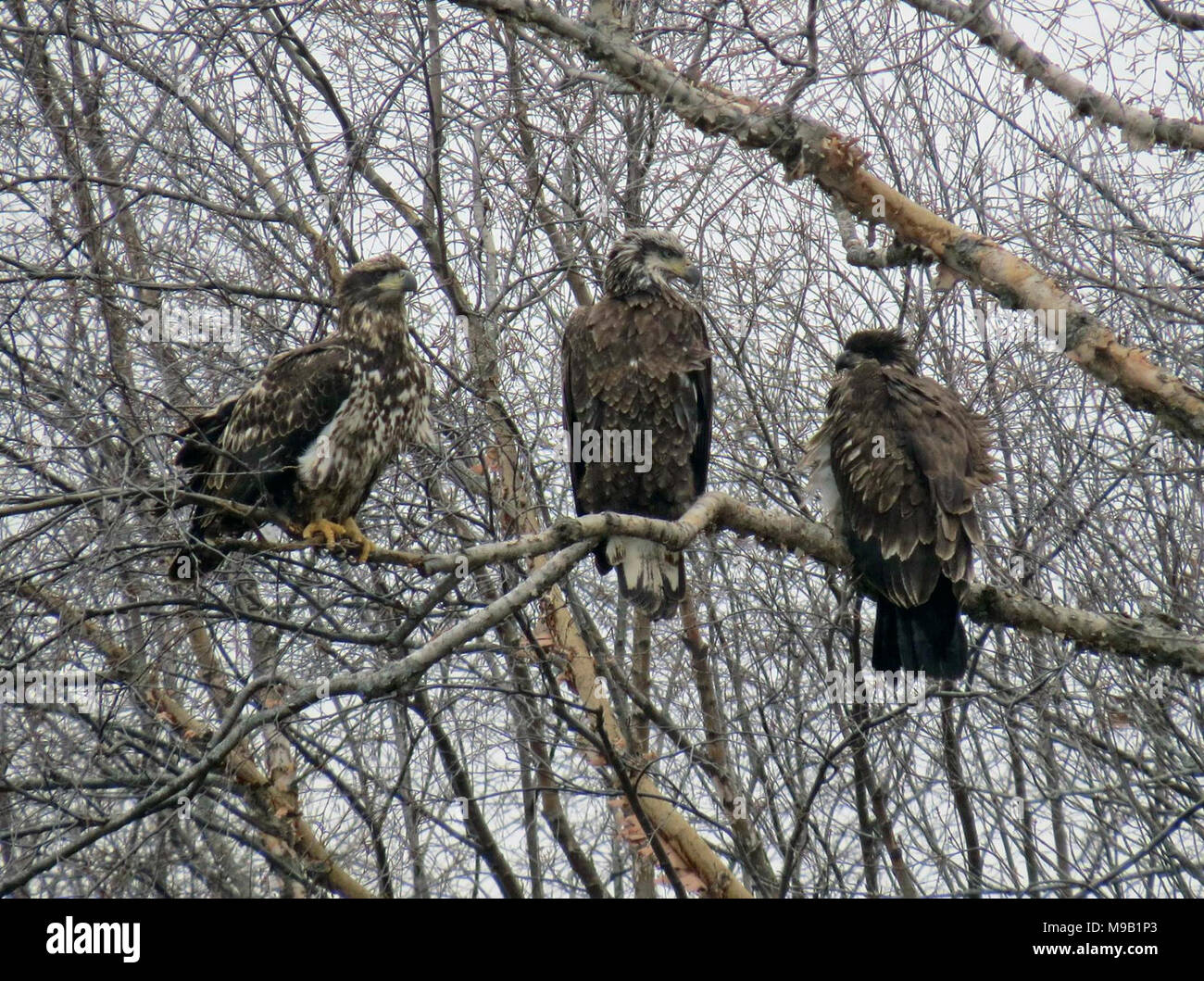
You’re scanning the treeline near a river, hoping for that flash of white. That iconic, snowy head that screams "America." Instead, you spot a massive, mottled brown bird that looks more like a messy hawk than a national symbol. Honestly, if you took some pics of young bald eagles and showed them to the average person, they’d probably guess they were looking at a golden eagle or maybe just a very confused buzzard.
They’re huge. Bigger than you think.
It takes about five years for a bald eagle to actually get its "bald" (white) head. Until then, they go through a chaotic series of wardrobe changes that baffle amateur photographers. These birds are the awkward teenagers of the sky.
The messy reality of juvenile plumage
When they first leave the nest, juvenile bald eagles are almost entirely chocolate brown. No white head. No white tail. Just a dark, heavy-set raptor with a black beak. If you’re trying to snap pics of young bald eagles during their first year, you’ll notice they actually look larger than their parents.
This is a weird optical illusion caused by their feathers. Juvenile flight feathers are actually longer than adult feathers. It’s basically nature’s version of training wheels; the extra surface area helps them stay aloft while they’re still figuring out how the whole "flying" thing works.
By year two, things get weird. They start getting white mottling on their bellies and under their wings. This is often called the "Basic I" plumage. Ornithologists like those at the Cornell Lab of Ornithology note that this is the stage where they are most frequently misidentified as golden eagles. However, if you look at the legs, a bald eagle’s "tarsus" (the lower leg) is bare, while a golden eagle is feathered all the way down to the toes.
Why the beak changes color
It isn't just the feathers. The beak is a dead giveaway for age.
A fledgling starts with a dark, almost black beak. As the bird matures, the cere (the fleshy part at the base) turns yellow first. Slowly, that yellow spreads across the entire beak. If you see a bird with a "salt and pepper" head and a beak that’s half-gray and half-yellow, you’re looking at a three or four-year-old bird. It’s a transition. It’s messy.
Identifying them in the field
When you're out there with a camera, look at the wing pits. That’s the secret.
Even a very dark young bald eagle will usually have white mottling in the "axillaries"—the bird version of armpits. Golden eagles don’t have that. If you're looking through a long lens and see white splotches near the body under the wing, you’ve got a bald eagle.
Movement matters too. Bald eagles soar with their wings held flat, like a plank. Golden eagles—and even turkey vultures—tend to hold their wings in a slight "V" shape, known as a dihedral. If the bird looks like it’s struggling to stay balanced and wobbling in the wind, it might be a vulture. If it’s steady as a rock and flat as a table, it’s likely your eagle.
The white tail myth
Most people think the tail turns white at the same time as the head. Not quite.
Usually, the tail is the last thing to fully clear up. You’ll often see a bird that looks like a perfect adult from the front, but when it flies away, the tail has a dark terminal band at the tip. That’s a "sub-adult." It’s almost there. It’s likely four and a half years old and looking for a mate for the first time.
Where to find them for the best shots
Young eagles are less territorial than adults. While the "parents" are guarding a specific stretch of river, the juveniles are often found in "bachelor pads" or large congregations where food is easy.
- The Mississippi River (Winter): Areas like Lock and Dam 18 in Illinois are legendary. When the water freezes, the eagles congregate near the open water churned up by the dams.
- Haines, Alaska: The Chilkat Bald Eagle Preserve can host thousands of birds. You’ll see every age class imaginable here.
- Conowingo Dam, Maryland: This is arguably the best place in the lower 48 for high-action pics of young bald eagles catching fish.
Wait for the "theft." Juvenile bald eagles are notorious kleptoparasites. They aren’t as skilled at fishing as the adults yet, so they spend a huge amount of time chasing older birds to scream at them until they drop their catch. It’s dramatic. It’s loud. It makes for incredible photos because you get two birds in the frame, often in a high-speed aerial pursuit.
The survival stakes
Life is hard when you're brown and mottled.
Statistics from the U.S. Fish and Wildlife Service suggest that a significant percentage of bald eagles don't make it to their fifth birthday. Starvation is the biggest threat in that first winter. They have to learn to scavenge. You'll often see young eagles hanging out with crows or vultures around deer carcasses. It’s not "majestic," but it’s how they survive.
They also face lead poisoning. Because they scavenge on gut piles left by hunters, they often ingest lead fragments. Even a tiny piece can be fatal. This is why many conservationists push for non-lead ammunition. If you’re photographing these birds and notice one that seems lethargic or can’t hold its head up, it needs a raptor rescue immediately.
Setting up your gear
Don't bother with a phone. You need reach.
A 400mm lens is the bare minimum for decent pics of young bald eagles. 600mm is better. Because these birds are often backlit against a bright sky, you’ll want to overexpose your shot by one or two stops. If you don't, the eagle will just be a black silhouette. You want to see the detail in those brown feathers.
Fast shutter speeds are non-negotiable. 1/2000th of a second is your baseline if they are moving. Even when they’re perched, they twitch. They preen. They scan the water.
Ethical photography
Don't be that person who flushes the bird to get a "flight shot."
Eagles, especially young ones in winter, are living on a razor-thin calorie margin. Every time they take flight because a human got too close, they burn energy they might not be able to replace. Use a long lens. Stay in your car if possible—birds often view cars as part of the landscape but flee the moment a human door opens.
How to take better photos of young eagles
Stop looking for the perfect "postcard" shot. The beauty of a juvenile is the grit.
Focus on the eyes. A young eagle’s eye is dark brown. As they age, it lightens to a piercing, pale yellow. If you can get a sharp shot of a juvenile with those dark, intense eyes, it tells a much different story than the standard adult portrait. It’s a story of a survivor.
Look for the "tundra" look. Sometimes, year-three eagles get so much white on their bodies they look almost like snowy owls from a distance. These are often the most striking subjects for pics of young bald eagles because the patterns are unique to every individual bird. No two look exactly alike.
Actionable next steps for birders
If you want to master the identification and photography of these birds, do this:
- Download the Merlin Bird ID app. It’s free, and the "Photo ID" feature is shockingly good at distinguishing between a first-year bald eagle and a golden eagle.
- Check eBird. Look for "hotspots" in your area. If someone reported 50 eagles, half of them are likely juveniles.
- Watch the beak. Use it as your primary aging tool. Dark beak = baby. Yellow beak = adult. Anything in between = a teenager.
- Volunteer at a local raptor center. There is no better way to learn the nuances of plumage than seeing a bird up close during a health check or rehab release.
- Switch to manual focus. Sometimes, when an eagle is perched in a thicket of branches, your camera’s autofocus will hunt. Learning to "tweak" the focus manually will save shots you’d otherwise lose.
The transition from a brown fluff-ball to a white-headed sovereign is one of the most dramatic transformations in the animal kingdom. It’s a five-year apprenticeship in survival. Next time you see a big, mottled brown bird by the river, don't look away just because it doesn't have the white head yet. You're looking at the future of the species.
Capture the mottled feathers. Capture the dark eyes. That's where the real story lives.



