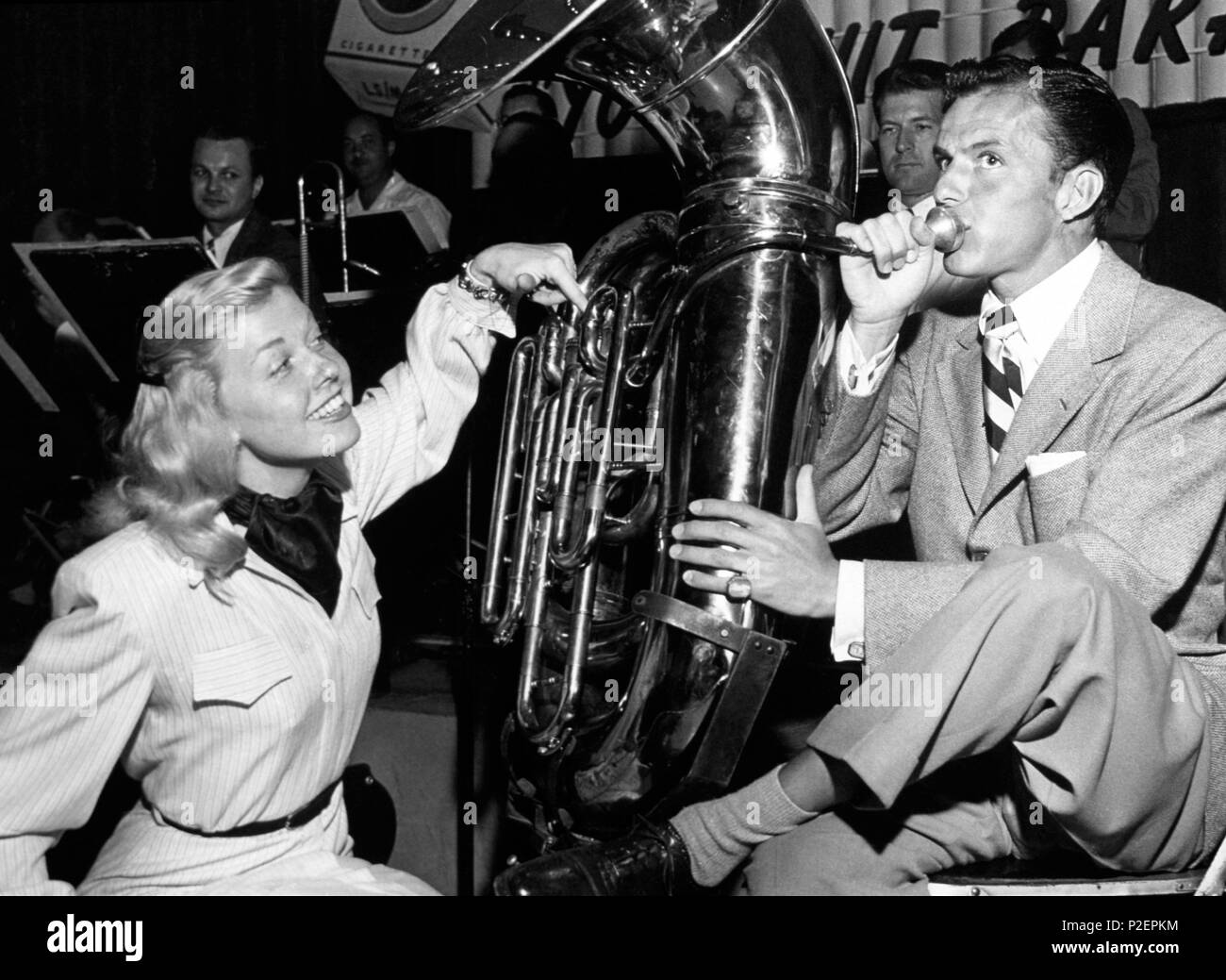
They were the two biggest voices in the world. Seriously. In 1954, if you turned on a radio, you were hitting a Doris Day track or a Frank Sinatra ballad within three minutes. It’s wild to think they only ever made one film together. Just one. That movie was Young at Heart, a Warner Bros. musical drama that somehow captured lightning in a bottle despite the fact that both stars were at completely different, almost clashing, points in their careers.
Most people assume they were a natural pair. They weren't.
The Strange Timing of Young at Heart
To understand why this frank sinatra doris day movie is such a relic, you have to look at the mess that was 1954. Doris Day was the "Girl Next Door." She was the queen of the box office, fresh off Calamity Jane, and essentially the personification of post-war sunshine. Sinatra? He was the "has-been" who had just clawed his way back from the brink. He’d just won an Oscar for From Here to Eternity, but the industry was still wary of his "bad boy" reputation and those infamous mood swings.
Warner Bros. basically took a huge gamble. They decided to remake a 1938 film called Four Daughters. The original was a straightforward, sweet family drama. But for the remake, they needed grit. They needed a guy who looked like he’d seen the bottom of a glass and didn’t much care for the view. That was Barney Sloan. That was Frank.
Why Barney Sloan Changed Everything
Sinatra didn't just play the role; he hijacked the movie. If you watch Young at Heart today, the tonal shift is jarring. You have the Tuttle family—Doris Day and her sisters—living in this idyllic, white-picket-fence world of music and laughter. Then Sinatra walks in. He’s wearing a slouchy hat, a cigarette dangling from his lip, and he looks like he just stepped out of a film noir.
He was the "cynical piano player." It’s a trope now, but back then, it was a revelation.
Doris Day, ever the professional, reportedly found him fascinating but a bit intimidating. In her later years, she spoke about how Frank would just "show up and do it." He hated rehearsing. He wanted the first take to be the one. Doris, coming from a background of meticulous preparation, had to adapt to his jazz-like approach to acting. This friction actually made the on-screen chemistry better. It wasn't the bubbly, synchronized energy she had with Howard Keel or Gordon MacRae. It was something more mature. Something a bit darker.
The Ending Controversy: Frank Didn't Die
Here is the bit of trivia that most casual fans miss: the movie was supposed to be a tragedy. In the original Four Daughters, the cynical character dies. That was the plan for Young at Heart too.
Frank Sinatra said no.
Actually, he didn't just say no; he basically gave an ultimatum. Having just resurrected his career, he wasn't about to let his character die in a "comeback" musical. He argued that the audience wanted to see him find happiness, especially alongside someone as beloved as Doris. The studio buckled. They filmed a new ending where—spoiler alert—Barney survives a suicide attempt/car crash and finds redemption.
Purists hated it. They thought it felt cheap. But looking back? It’s pure Hollywood gold. It’s the moment Frank Sinatra realized he had the power to dictate his own narrative again.
The Music That Saved the Script
We can't talk about a frank sinatra doris day movie without talking about the soundtrack. This wasn't just a collection of songs; it was a chart-topping event. The title track, "Young at Heart," became one of Sinatra's definitive anthems.
- "Someone to Watch Over Me": Sinatra sings this with a vulnerability that Doris Day later admitted moved the crew to silence on set.
- "Ready, Willing, and Able": Doris brings the high-energy pop that balanced Frank's gloom.
- "Hold Me in Your Arms": A classic Day ballad that showcased her incredible technical range.
Honestly, the plot of the movie is almost secondary to the way these two voices interact. They don't actually sing together as much as you'd think. It's more of a duel. A vocal passing of the torch.
The Behind-the-Scenes Reality
There were rumors, of course. There are always rumors when two icons share a trailer block. Some tabloids at the time tried to suggest a romance, but it just wasn't there. Doris was married to Marty Melcher, who was notoriously protective (and, as we later found out, notoriously bad with her money). Sinatra was in the throes of his chaotic relationship with Ava Gardner.
They were colleagues. Respectful, distant, and professional.
Gordon Douglas, the director, had the unenviable task of balancing these two massive egos. Douglas was a journeyman director—the kind of guy who just got the job done. He didn't try to be an "auteur." He just let the camera roll and stayed out of the way. That’s probably why the movie works. It doesn't feel over-directed. It feels like we're eavesdropping on a very talented, very strange family.
Legacy of the "One and Only" Collaboration
Why didn't they make more? It’s the question every TCM fan asks.
The answer is boringly practical: money and scheduling. After Young at Heart, Sinatra became a supernova again. He started his "Rat Pack" era, moved into heavier dramatic roles like The Man with the Golden Arm, and eventually started his own label, Reprise. Doris Day stayed the queen of the romantic comedy, eventually pairing up with Rock Hudson for the "Pillow Talk" era that defined the late 50s.
They went in opposite directions. Sinatra went toward the neon lights of Vegas; Day went toward the sophisticated, colorful world of CinemaScope comedies.
But Young at Heart remains this weird, beautiful middle ground. It’s a movie that smells like cigarette smoke and apple pie at the same time. It captures a version of Sinatra that was still hungry and a version of Day that was beginning to show her depth as a dramatic actress.
What Most People Get Wrong About the Film
You’ll often see Young at Heart listed as a "Lightweight Musical."
It’s not.
If you actually sit down and watch it, it’s a pretty heavy meditation on depression, artistic failure, and the feeling of being an outsider in your own skin. Sinatra’s character, Barney, is legitimately miserable for 80% of the runtime. He’s self-destructive. He’s nihilistic. For a 1954 audience, seeing "The Girl Next Door" fall for a guy who thinks the world is a rigged game was subversive.
It wasn't a "cutesy" movie. It was a movie about how love sometimes has to drag someone out of a very dark hole.
How to Watch It Today
If you’re looking to find this frank sinatra doris day movie, it’s widely available on streaming platforms like Amazon Prime and Apple TV, and it frequently rotates through the TCM schedule.
Don't go in expecting La La Land. Expect a slow burn.
- Pay attention to the lighting: Notice how Frank is often in shadow while Doris is bathed in high-key light. It’s a classic visual metaphor for their characters' outlooks.
- Listen to the phrasing: Both singers were masters of "singing the story." They don't just hit notes; they act through the lyrics.
- The supporting cast: Gig Young and Ethel Barrymore (yes, the Ethel Barrymore) provide a solid foundation that keeps the movie from drifting into pure star-vehicle territory.
Practical Steps for the Classic Film Buff
If you want to dive deeper into this specific era of Hollywood, don't just stop at the movie. To really appreciate what happened on that set, you should:
- Listen to the "Young at Heart" 1954 Original Soundtrack: Compare the studio recordings to the film versions. The film versions are often rawer.
- Read "Doris Day: Her Own Story": She goes into detail about her interactions with Sinatra and her surprise at his acting style.
- Watch "Four Daughters" (1938): Seeing the original allows you to see exactly how much Sinatra changed the "DNA" of the story.
- Track the Chart History: Look up the Billboard charts from January 1955. It’s a fascinating snapshot of how this movie dominated the cultural zeitgeist.
Young at Heart isn't just a movie; it's the only time the two greatest stylists of the Great American Songbook shared the screen. It was a collision of two different Hollywoods. And honestly? We’re lucky we got even one.



