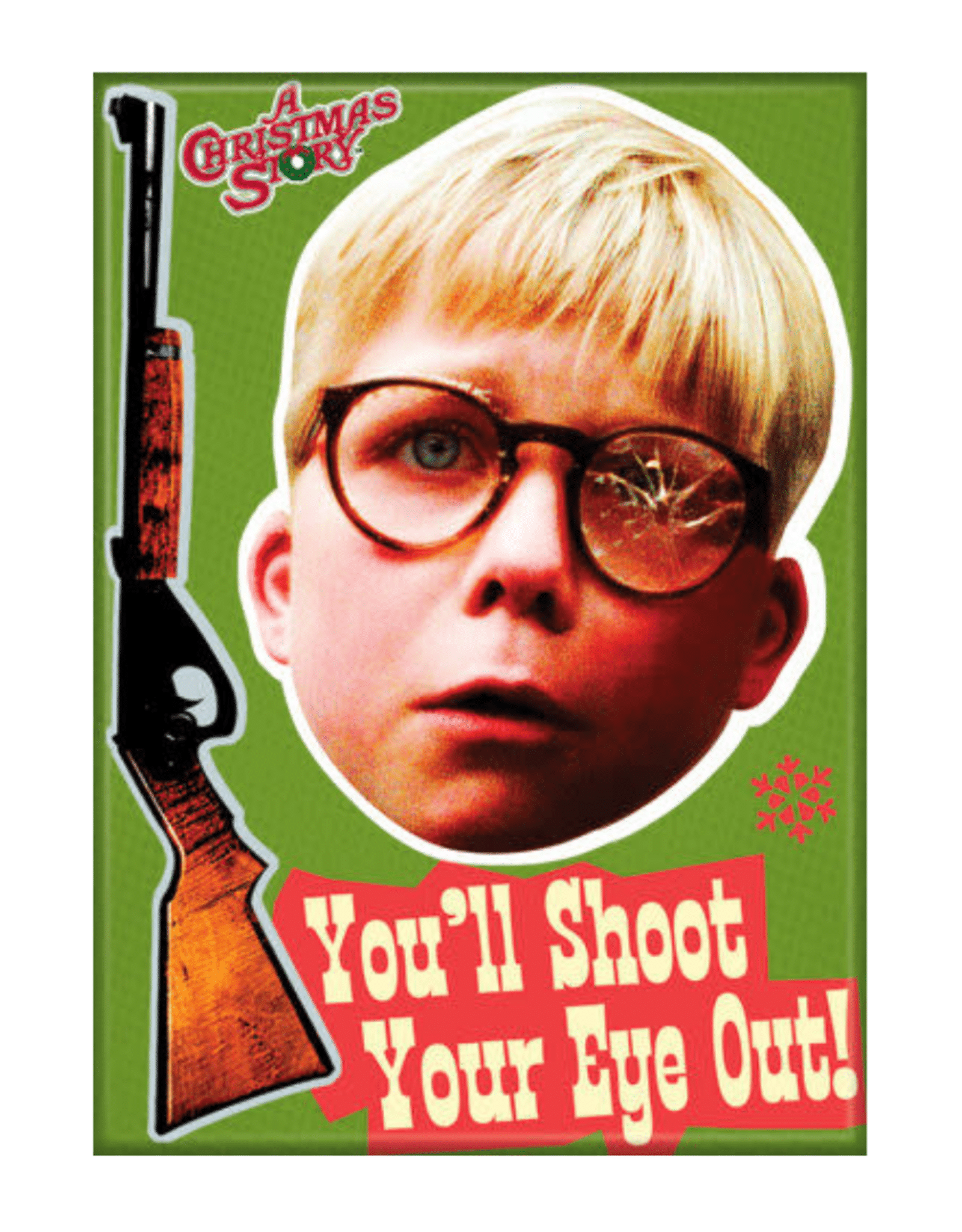
You’ve heard it. Honestly, even if you’ve never sat through the full 24-hour marathon on TBS, you know the line. "You'll shoot your eye out!" It’s the ultimate parental shutdown. It's the verbal equivalent of a brick wall. When Mrs. Parker drops that line on Ralphie, she isn't just worried about his ocular safety—she's participating in a specific kind of Mid-century American mythology that Jean Shepherd captured so perfectly in his writing.
Red Ryder BB guns were the "it" toy, but the phrase became something much bigger than a warning about a projectile. It became a cultural shorthand for the gap between childhood ambition and adult pragmatism.
The Reality of the Red Ryder BB Gun
Let’s be real for a second. The Red Ryder Carbine-action, 200-shot, Range Model air rifle with a compass in the stock and "this thing which tells time" wasn't just a prop. It was a real product made by Daisy Outdoor Products. But here is the thing: the specific model Ralphie describes—with the compass and the sundial—didn't actually exist in that exact configuration until the movie made it famous. Daisy had to custom-build filmmaker Bob Clark’s vision.
In the 1940s, when the story is set, a BB gun was a rite of passage. It represented the first taste of real responsibility. Or, in the eyes of every adult in Ralphie's life, the first taste of a trip to the emergency room.
The phrase you'll shoot your eye out wasn't just a screenplay invention. Jean Shepherd, the narrator and author of In God We Trust: All Others Pay Cash, based the story on his own upbringing in Hammond, Indiana. He spent years honing these semi-autobiographical "tall tales" on the radio. When he spoke those words, he was channeling the collective voice of every nervous mother from 1930 to 1950.
Why we still quote it today
Most movies from 1983 haven't aged this well. Think about it. A Christmas Story wasn't even a massive hit when it first premiered in theaters. It did okay, sure, but it didn't become a "classic" until cable television started looping it. Now, you can't go through December without seeing the memes.
The brilliance is in the timing. The delivery by Melinda Dillon (the mother) is pitch-perfect—it's dismissive yet genuinely concerned. Then you have the department store Santa. He doesn't just say it; he sneers it. He kicks Ralphie down the slide with a boot to the face, punctuating the dream's death with that same repetitive warning.
It resonates because everyone has had their "Red Ryder." Maybe for you, it was a dirt bike. Maybe it was a chemistry set your parents were convinced would blow up the garage. We all know the feeling of wanting something so badly it hurts, only to be met with a logical, terrifying reason why we can’t have it.
The Physics of Shooting Your Eye Out
Is it actually possible? Well, yeah.
Ophthalmologists have been using the movie as a cautionary tale for decades. According to data from the Consumer Product Safety Commission, thousands of eye injuries related to air rifles occur every year. BBs are notorious for ricocheting. Unlike pellets, which are often made of soft lead and flatten upon impact, steel BBs are hard and bouncy. If you hit a hard surface—like, say, a metal sign—that BB is coming right back at you.
In the film, Ralphie actually does almost shoot his eye out. The BB hits a metal target, bounces back, and knocks his glasses off. It’s a moment of pure cinematic terror followed by the frantic "I'm blind!" panic.
- The Ricochet Factor: Steel BBs maintain high kinetic energy after bouncing.
- Safety Glasses: Ralphie wasn't wearing them. If he had been, the movie would have lost its tension.
- The Lens Save: His spectacles actually saved his vision, which is a bit of irony Shepherd likely enjoyed.
Beyond the Meme: The Jean Shepherd Legacy
Jean Shepherd was a master of the "armchair philosophy" style. He didn't just write funny stories; he wrote about the "Great Depression" of the soul. He understood that being a kid is mostly a series of negotiations with powerful, slightly insane adults.
When he wrote about the you'll shoot your eye out phenomenon, he was poking fun at the hysteria of safety-conscious parents. But he also showed that the "danger" was part of the allure. If it weren't dangerous, Ralphie wouldn't have wanted it so badly.
The film's director, Bob Clark, had to fight to get this movie made. People didn't think a cynical, slightly grimy look at Christmas would work. They wanted Miracle on 34th Street. Instead, they got a kid getting his tongue stuck to a frozen flagpole and a leg lamp that caused a domestic cold war.
The Phrase as a Sales Tool
Interestingly, Daisy Outdoor Products didn't shy away from the reputation. They leaned into it. Today, you can buy the "Christmas Story" edition of the Red Ryder. It literally comes with the compass and the sundial. They turned a warning into a marketing goldmine.
It’s kind of funny. The very thing that was meant to stop the sale of the toy became the reason the toy is still in production 80 years later.
What Most People Get Wrong About the Ending
People remember Ralphie getting the gun. They remember the line. But they often forget that the "shot" actually happened. Ralphie lied to his mother, telling her a falling icicle broke his glasses.
This is the turning point of the movie. It’s not about the gun; it’s about the loss of innocence. Ralphie learns to navigate the adult world of deception to protect his prize. He survives the very thing everyone warned him about, but he has to give up a piece of his "good kid" persona to do it.
That’s why the movie stays relevant. It isn't a sugary-sweet Hallmark card. It’s a story about a kid who wants something, gets it, nearly hurts himself, lies about it, and then falls asleep with the object of his affection. It's honest.
Actionable Insights for Fans and Parents
If you're planning on introducing your kids to the world of air rifles (or just re-watching the movie for the hundredth time), keep a few things in mind:
- Eye protection is non-negotiable. Even modern, low-velocity BB guns can cause permanent retinal damage. Ralphie got lucky. Your kid might not.
- Understand the history. Read Jean Shepherd’s original short stories. They are darker and much more complex than the movie. "In God We Trust: All Others Pay Cash" is the best place to start.
- Check the model. If you are buying a Red Ryder as a gift, make sure you know the difference between the standard model and the "Adult" version, which has a longer stock for a more comfortable pull.
- Embrace the nostalgia, but teach the safety. The phrase is funny because it’s true. Use the movie as a teaching moment rather than just a meme.
The next time someone tells you that you're going to shoot your eye out, just remember: they’re probably right. But that hasn't stopped any of us from taking the shot anyway. It’s the thrill of the risk that makes the reward worth it, even if you end up with a broken pair of glasses and a fake story about a falling icicle.
In the end, Ralphie’s journey isn't about the gun at all. It’s about the "Electric June" of childhood and the realization that the world is a dangerous, chaotic, and wonderful place where, occasionally, you get exactly what you asked for—danger and all.



