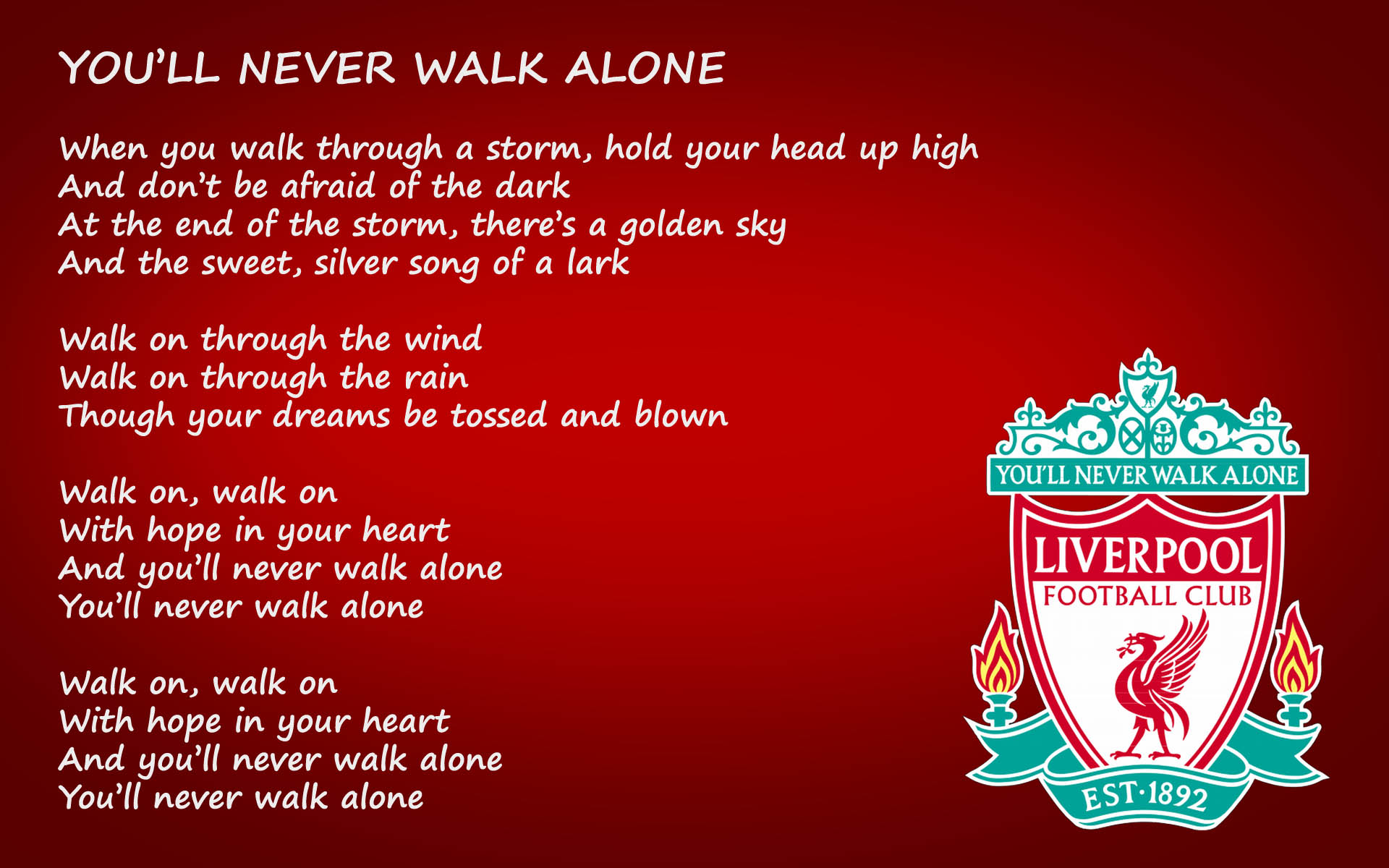
It starts with a single, lonely clarinet note. Then the vocals kick in, soft and tentative, almost like a prayer whispered in a dark room. Most people think of You’ll Never Walk Alone as a football chant, a wall of sound hitting you from the Kop at Anfield. But honestly? It’s a show tune. It was written by Richard Rodgers and Oscar Hammerstein II for the 1945 musical Carousel. It’s a song about grief. It’s a song about pushing through a storm when you can't see your hand in front of your face.
The transition from Broadway to the mud-caked pitches of English football wasn't planned. It was a fluke of history involving a local band, a broken PA system, and a crowd that refused to stop singing.
How a Broadway Ballad Conquered the Kop
In 1963, Gerry Marsden and his band, Gerry and the Pacemakers, recorded a cover of the song. At the time, Liverpool FC had a tradition where the stadium DJ would play the week’s top ten hits in descending order. The crowd would sing along to everything from The Beatles to Cilla Black. When You’ll Never Walk Alone hit number one, the fans sang it. Then it dropped out of the charts.
The fans didn't care. They kept singing it anyway.
Bill Shankly, the legendary Liverpool manager, reportedly fell in love with the track the moment Gerry Marsden handed him a recording. There’s a famous story—likely true given the witnesses—where Shankly told Marsden, "Gerry, my boy, I am amazed at that song. I’ve heard it before, but you’ve made it something else." It became the club's heartbeat. It wasn't just music anymore; it was a pact between the players and the city.
The lyrics are simple. Almost too simple. But that’s why they work. You don't need a music degree to understand "walk on through the rain." Everyone has a "rain." Everyone has a "storm." When 54,000 people scream those words together, it stops being a song and becomes a physical force.
The Hillsborough Connection
You can't talk about You’ll Never Walk Alone without talking about the Hillsborough Disaster of 1989. It is the darkest chapter in English football. 97 fans went to a game and never came home. In the days following the tragedy, the song shifted. It wasn't about winning a trophy anymore. It was about survival.
It was a communal scream of defiance against a system that was trying to blame the victims. When the fans sang it at the first game back, it wasn't a celebration. It was a funeral dirge that somehow felt like a hug. It provided a vocabulary for a grief that was otherwise unspeakable.
It’s Not Just Liverpool
Liverpool fans might claim it as their own, but they don't own the copyright on the emotion it evokes. Celtic fans in Glasgow sing it with just as much fervor. They claim they were doing it first, though the timeline usually favors the Mersey side of the argument. It doesn't really matter who was first. What matters is how it travels.
Borussia Dortmund fans adopted it. Feyenoord fans in the Netherlands sing it. It’s even found a home in Japan with FC Tokyo. There is something universal about the idea of communal struggle. It crosses language barriers because the melody feels like an ascent. It starts low and ends on a high note that most casual singers can't actually hit—leading to that wonderful, slightly off-key screeching you hear at the end of every match.
The song has been covered by everyone. Frank Sinatra. Elvis Presley. Pink Floyd sampled the Kop singing it on their track "Fearless." Even Aretha Franklin gave it a go. Each version brings something different, but the Gerry Marsden version remains the definitive one for sports fans because of that driving, optimistic tempo.
The Psychology of the Anthem
Why does it work? Why don't we sing "Happy Birthday" or some random pop song with the same intensity?
Psychologists often point to "musicking," a term coined by Christopher Small. It’s the idea that music isn't just something you listen to, but something you do. When you sing You’ll Never Walk Alone, you are participating in a ritual. Your heart rate actually synchronizes with the people standing next to you. It reduces cortisol. It creates a "collective effervescence," a term sociologist Émile Durkheim used to describe the harmony felt during religious ceremonies.
For 90 minutes, you aren't a plumber or a lawyer or a student. You’re part of a massive, loud, vibrating organism.
The Rodgers and Hammerstein Legacy
It’s easy to forget the song’s theatrical roots. In Carousel, the character Nettie Fowler sings it to her cousin Julie Jordan after Julie’s husband, Billy Bigelow, kills himself to avoid capture by the police. It’s a heavy moment.
Hammerstein was a master of the "inspirational" lyric, but he often walked a fine line between poignant and cheesy. With this song, he nailed it. He wrote it during World War II, a time when everyone was losing someone. The "golden sky" at the end of the storm wasn't a metaphor; it was a literal hope for the end of the blitz.
- 1945: Premiere of Carousel.
- 1963: Gerry and the Pacemakers hit #1 in the UK.
- 1989: The song becomes a symbol of the Hillsborough justice campaign.
- 2020: Captain Tom Moore records a version during the pandemic to raise money for the NHS.
During the COVID-19 lockdowns, the song saw a massive resurgence. Radio stations across Europe played it simultaneously one morning in March 2020. People were singing it from balconies in Italy. It became the anthem for frontline workers. It’s the ultimate "crisis" song.
Common Misconceptions
People think the song is about football. It’s not. It’s about resilience.
Another mistake? Thinking the lyrics are "at the end of the road." It’s "at the end of a storm." That distinction matters. A road ends. A storm passes. The song is about the temporary nature of suffering. It’s also not meant to be sung fast. When crowds rush it, they lose the gravitas. The best renditions are the ones that breathe, where the silence between the lines is filled by the sound of thousands of people inhaling at the same time.
Why the Song Matters in 2026
We live in a pretty fragmented world. Digital bubbles, political divides—you know the drill. There are very few places left where you can stand next to a stranger and scream your lungs out in total agreement.
The stadium is one of those last secular cathedrals. You’ll Never Walk Alone is the liturgy. It reminds us that being "alone" is often an illusion. Even if you're physically by yourself, the song suggests you’re part of a lineage of people who have faced the same wind and the same rain.
Honestly, it’s kinda cheesy if you think about it too hard. "A lark" and "sweet silver song"? It’s pure 1940s sentimentality. But in a world that’s often cynical and cold, a little bit of earnest sentimentality is probably a good thing.
Actionable Ways to Experience the Song
If you want to actually "get" why this song matters, don't just listen to it on Spotify.
- Watch a live recording of a "European Night" at Anfield. The roar before a match against Barcelona or Real Madrid is unlike anything else in sports.
- Listen to the Nina Simone version. It’s instrumental for the first half and incredibly soulful. It strips away the stadium bombast and focuses on the loneliness.
- Read the lyrics as poetry. Forget the melody. Just read the words. "Walk on, walk on, with hope in your heart." It’s a simple command. It’s a piece of advice that is actually quite difficult to follow when things go wrong.
The next time you hear those opening chords, pay attention to the person singing next to you. They probably aren't thinking about the chords or the history of Broadway. They’re probably thinking about a struggle they’re going through right now. And for three minutes, they aren't going through it by themselves. That’s the power of the song. It doesn't fix the problem, but it makes the walk a little less terrifying.
To truly understand the impact, look into the "Justice for the 97" campaign. Seeing how the lyrics transitioned from a football chant to a legal and social battle cry gives the music a weight that no other anthem in the world possesses. It is a rare example of art becoming a tool for real-world change.
Next Steps for the Reader
- Listen to the original 1945 Broadway cast recording to hear the song as Rodgers and Hammerstein intended it—as a piece of operatic drama rather than a pop hit.
- Research the "Justice for the 97" movement to understand how this song became the soundtrack to one of the longest legal battles in British history.
- Find a local supporters' club if you ever get the chance to watch a high-stakes match. Singing it in a room full of people is the only way to feel the "vibration" that makes it famous.