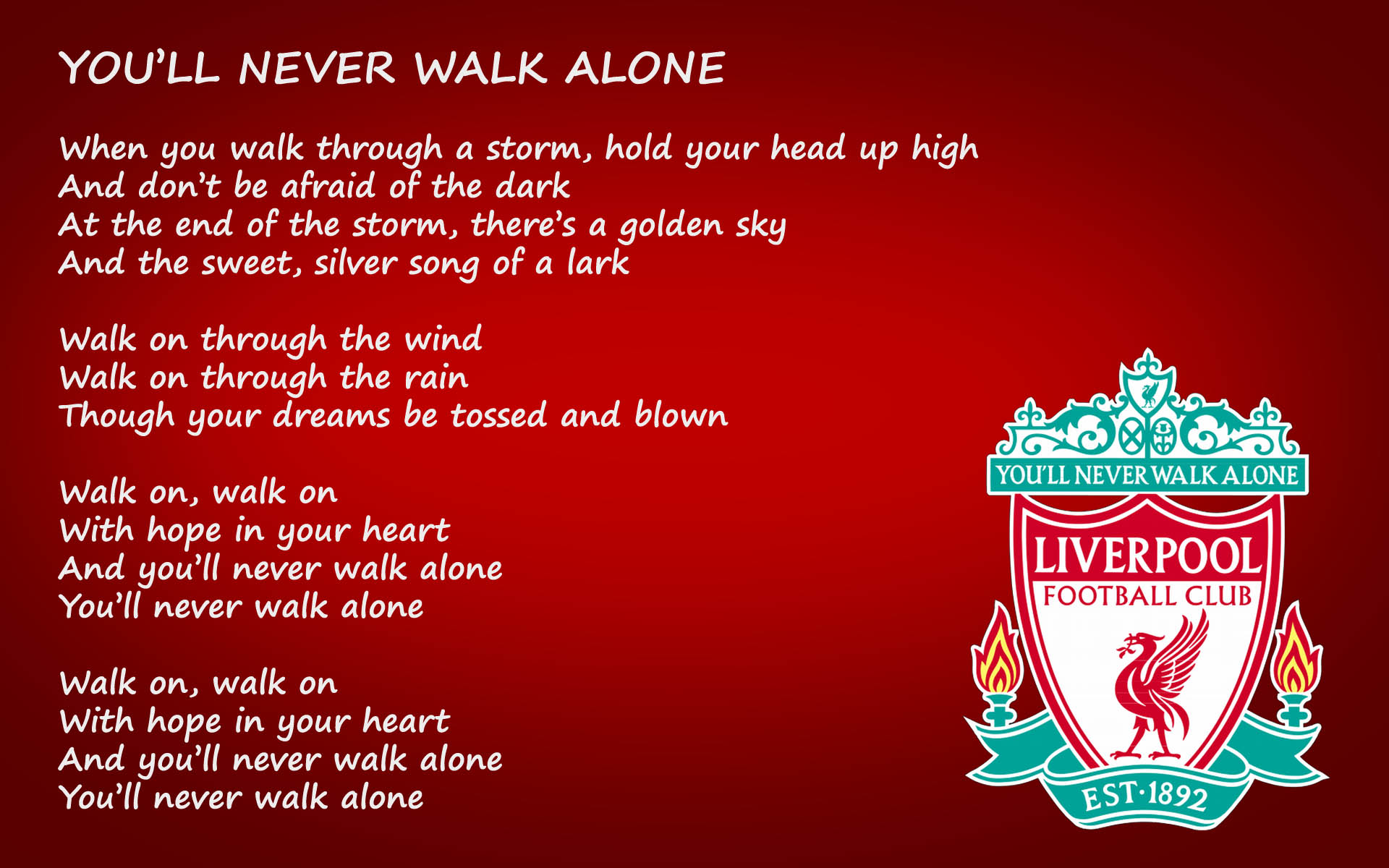
It starts with a single, lonely person on a dark stage. That’s the irony. Most people know You’ll Never Walk Alone as a thunderous roar from 50,000 voices at Anfield or Celtic Park, but its origins are actually rooted in a 1945 Broadway musical called Carousel. It wasn't written for a trophy lift or a victory parade. It was written for a funeral.
In the second act of the Rodgers and Hammerstein classic, the character Billy Bigelow dies. His cousin, Nettie, sings this song to his widow, Julie Jordan, to comfort her. Think about that for a second. The most famous "sports song" in history is actually a piece of musical theater about grief, resilience, and moving through a storm.
How a Broadway Ballad Met Liverpool FC
You can thank Gerry Marsden for the song's leap from the stage to the terraces. In 1963, Gerry and the Pacemakers—a Merseybeat group that was honestly just as big as the Beatles for a fleeting moment—recorded a cover. It hit number one on the UK charts.
Back then, Anfield (Liverpool's home ground) had a DJ who would play the top ten hits over the PA system before kickoff. The fans would sing along to whatever was popular. When You’ll Never Walk Alone eventually dropped out of the top ten, the fans didn't want to stop. They kept singing it. They basically forced it into the club's DNA.
It’s hard to overstate how weird that was at the time. Soccer fans in the early 60s usually chanted short, aggressive things. Suddenly, you had thousands of Scousers singing a slow, soaring ballad with their scarves held high. It changed everything about how fans interact with their clubs.
The Hillsborough Tragedy and the Song's Transformation
While it was already a staple by the 80s, the song took on a haunting, sacred meaning after the Hillsborough disaster in 1989. For those who don't know the history, 97 fans lost their lives due to a fatal crush and gross negligence by authorities.
In the weeks of mourning that followed, the lyrics stopped being about "walking through a storm" in a metaphorical sense. It became a literal promise to the families of the victims. When the Pink Floyd-esque "You'll Never Walk Alone" resonates through a stadium today, it isn't just about football. It’s a massive, collective act of remembrance.
It's about survival.
It’s Not Just a Liverpool Thing (Kinda)
Liverpool fans might get annoyed if you say this, but they don't own the song. Not exclusively. Celtic fans in Scotland claim they were the first to adopt it, though most historians lean toward the Liverpool timeline.
Then you have Germany. Borussia Dortmund fans sing it with a fervor that rivals the English. In fact, if you go to a European night at the Westfalenstadion, the "Yellow Wall" creates a wall of sound that is frankly terrifying in its beauty. Feyenoord in the Netherlands, FC Tokyo in Japan, and even Mainz 05 have all adopted it.
Why? Because the lyrics are universal. Most pop songs are about love or dancing. This song is about the "golden sky" at the end of a storm. It’s basically a secular hymn.
The Technical Brilliance of the Composition
Richard Rodgers was a genius, honestly. The song starts in a low register, almost a whisper. It builds slowly, adding tension, until it hits that final, high crescendo. It’s designed to make your hair stand up.
Musically, it’s a bit of a beast to sing. Most terrace chants are three notes. This one requires range. When a crowd hits that "Walk on, walk on" section, they are hitting major chords that naturally evoke a sense of hope and triumph. It’s physiological. You feel it in your chest.
More Than Just Sports: Pink Floyd and Elvis
The song’s reach is massive. Elvis Presley did a version. Aretha Franklin did a gospel-tinged rendition that will blow your mind. Even Pink Floyd sampled the Anfield crowd singing it at the end of their track "Fearless" on the Meddle album.
During the 2020 lockdowns, the song saw a huge resurgence across Europe. Radio stations in dozens of countries played it simultaneously to show solidarity for healthcare workers. It’s become the go-to anthem whenever the world feels like it’s falling apart.
Misconceptions People Have
A lot of people think the song was written for Liverpool. Nope. Some think it was written by Gerry Marsden. Wrong again—he just popularized the definitive version. There’s also a common myth that the song was first sung at a Manchester United game after the Munich air disaster. While United fans did sing it occasionally in the late 50s, it never became their "anthem" the way it did for the Reds in the 60s.
Actionable Ways to Experience the Anthem
If you actually want to understand why this song matters, you can't just listen to it on Spotify. You have to see it in context.
- Watch the 2005 Champions League Final Intro: Go to YouTube and find the footage of Liverpool fans singing it at halftime in Istanbul when they were 3-0 down. That's the song in its purest form—defiant hope when everything is lost.
- Visit the Shankly Gates: If you’re ever in Liverpool, the words are literally forged in iron above the entrance to Anfield.
- Listen to the Nina Simone Version: For a totally different vibe, her 1958 instrumental/vocal take is haunting and stripped back. It shows the song's versatility outside of a stadium.
- Check out the "Carousel" Original: Listen to the 1945 cast recording. It’s much slower and more operatic, which makes you realize how much Gerry Marsden "rock-and-rolled" it up to make it catch on with the public.
The reality is that You’ll Never Walk Alone is one of the few pieces of art that has successfully escaped its original medium. It isn't just a song from a play anymore. It’s a social contract. When you sing it, you're promising the person next to you that no matter how bad things get, they aren't going through it by themselves. That's a pretty heavy thing for a 1940s showtune to carry, but it does it perfectly every single weekend.