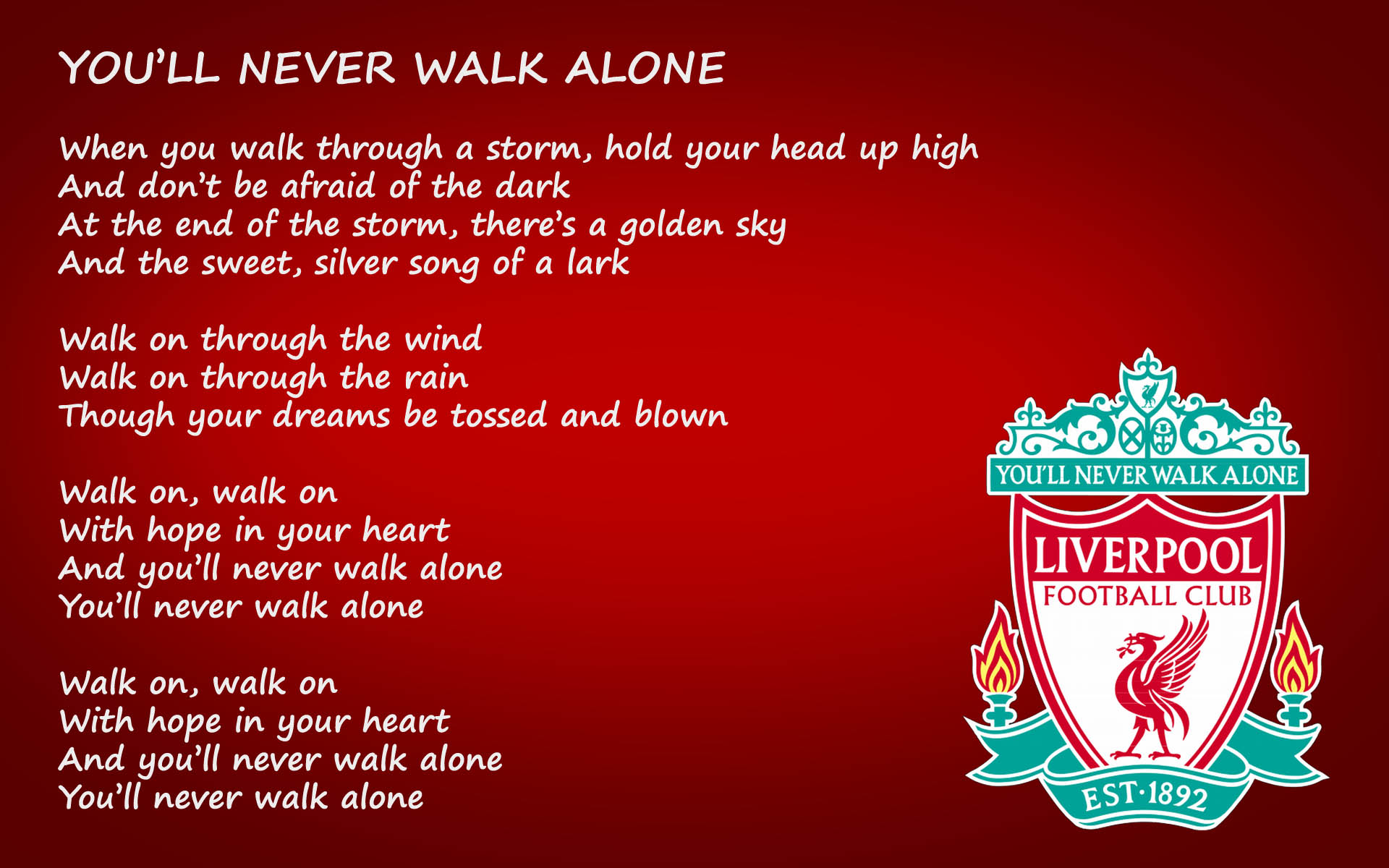
It’s just a song from a 1945 musical about a carnival barker who dies in a botched robbery. Sounds pretty bleak, right? Yet, if you stand in the middle of Anfield or Signal Iduna Park today, You’ll Never Walk Alone feels less like a piece of musical theater and more like a religious experience. It’s loud. It’s haunting. It’s enough to make grown men sob in the stands while spilling overpriced Bovril on their shoes.
Most people think of it as a "football song." That’s a massive oversimplification. Honestly, the journey of this track from the Broadway stage to the front lines of global tragedies is one of the weirdest, most organic evolutions in music history.
Where the Hell Did It Actually Come From?
Before the scarves and the stadiums, there was Oscar Hammerstein II and Richard Rodgers. They wrote it for Carousel. In the play, the song shows up twice. First, to comfort the protagonist Julie Jordan after her husband, Billy Bigelow, kills himself. Then, it reappears at the end during a graduation scene.
It was meant to be a message of resilience. Hammerstein was grieving the death of his own stepmother at the time, which explains why the lyrics feel so heavy yet hopeful. When Christine Johnson first sang those words on Broadway, she wasn't thinking about offside traps or league titles. She was singing about the crushing weight of grief.
Then came 1963.
Gerry Marsden—frontman of the Merseybeat group Gerry and the Pacemakers—decided to cover it. You have to remember the context of the early 60s. Everything was changing. The Beatles were exploding. Liverpool was the center of the universe. Marsden grew up watching Carousel films and loved the tune. He convinced his band and their legendary producer, George Martin (yes, that George Martin), to record a version.
It hit number one on the UK charts in October 1963. That’s the spark.
The Anfield Connection: Not Just a Coincidence
Back then, the PA system at Anfield, the home of Liverpool FC, would play the Top 10 hits before kickoff. The crowd would sing along to whatever was popular. Because You’ll Never Walk Alone stayed at the top of the charts for about four weeks, the fans got used to belting it out.
When it finally dropped out of the Top 10, the fans didn't stop. They kept singing it. They liked the way it sounded. They liked the message.
It’s basically the first example of a viral trend, but without the internet. It was just thousands of Scousers deciding, "Yeah, this is ours now."
The Hillsborough Tragedy and the Weight of the Lyrics
If you want to understand why this song is so sacred to Liverpool fans, you have to talk about April 15, 1989. The Hillsborough disaster, where 97 fans were unlawfully killed due to a massive failure of policing and stadium safety.
In the aftermath, the song shifted. It wasn't just a pre-game ritual anymore. It became a prayer. When the fans sang "Walk on through the wind, walk on through the rain," they weren't talking about a literal storm. They were talking about the decades-long fight for justice against a government and a press that had lied about them.
The song provided a communal language for grief. It’s the same reason you heard it played across European radio stations simultaneously in 2020 during the COVID-19 lockdowns. It’s a survival anthem.
Beyond Liverpool: A Global Takeover
It’s not just an English thing. Far from it.
- Celtic FC: The Scottish giants claim they were the first to adopt it, or at least did so shortly after Liverpool. The debate is fierce, but honestly, both sets of fans do it justice.
- Borussia Dortmund: In Germany, "Die Gelbe Wand" (The Yellow Wall) sings it with a precision that’s almost terrifying.
- Feyenoord: The Dutch fans have their own soul-stirring rendition.
Why does it work in so many languages? Because the core sentiment is universal. Everyone, at some point, feels like they are walking through a storm. The song promises that the "golden sky" is real, even if you can't see it yet.
The Musical Mechanics: Why It Sticks in Your Head
Musically, the song is a slow build. It starts in a relatively low register, making it easy for the average person—who probably can’t sing for a lick—to join in.
Then comes the "climb."
When the melody jumps up on the word "Sky," it forces a physical reaction. You have to push more air out of your lungs. When ten thousand people do that at the same time, the acoustic pressure is literally enough to make your skin crawl. It’s a crescendo designed to elicit an emotional release. Rodgers was a genius at this. He knew exactly how to manipulate a listener's heartstrings through chord progressions.
Common Misconceptions About the Song
People get stuff wrong about this track all the time.
First off, Frank Sinatra didn't make it famous first. He covered it, sure, but his version was more of a crooner ballad. It lacked the raw, communal power of the Marsden version.
Second, it’s not just a "sad" song. It’s a defiant one. Look at the lyrics again. It tells you to "Hold your head up high." That’s a command. It’s about dignity in the face of absolute disaster.
Third, some people think it’s a religious hymn. While it’s sung in churches and at funerals, it has zero mentions of God. It’s a secular piece of music that functions as a hymn because of how people treat it.
The Best Versions You Need to Hear
If you only know the stadium chants, you're missing out on some incredible artistry.
Aretha Franklin recorded a version in 1972 on her Amazing Grace album that will absolutely wreck you. It’s pure gospel soul. She takes her time with it, stretching out the syllables until you feel every bit of the struggle.
Then there’s Nina Simone. Her version is mostly instrumental piano work that eventually bleeds into the lyrics. It’s moody and jazz-inflected, highlighting the loneliness of the "walk" before the "hope" kicks in.
Elvis Presley did it too. It’s fine, but it feels a bit "Vegas" compared to the raw emotion of the others.
Why We Still Care in 2026
In an era of digital isolation and fragmented communities, the song serves as a rare bridge. It’s one of the few things left that can make a crowd of 50,000 strangers feel like a single unit.
It’s about solidarity.
Whether it’s being played at a memorial for a fallen leader or blasted over the speakers at a local pub on a Tuesday night, it reminds people that they aren't isolated units. We’re social creatures. We need that reassurance.
Honestly, it’s probably the most successful piece of music ever written in terms of its social utility. It does a job. It heals.
Actionable Insights for the Curious
If you’re looking to dive deeper into the history or just want to experience the power of the song yourself, here is how you should actually approach it.
Watch the 1956 Film Version of Carousel See the context. Understand that this song was written for a woman standing over a dead body. It changes how you hear the "hopeful" parts.
Listen to the 1963 Gerry and the Pacemakers Original Pay attention to the string arrangement. It’s actually quite sophisticated for a pop record of that era. George Martin’s influence is all over it.
Experience it Live (If You Can) Recordings don't do it justice. If you’re ever in Liverpool or Dortmund, get a ticket. Stand up. Don't worry about being a "fan" of the team. Just listen to the noise. It’s a physical force.
Check out the 1985 "Crowd" Version After the Bradford City stadium fire, a supergroup of artists (including Gerry Marsden) recorded a charity version. It’s a stark reminder of how the song is used to rebuild communities after trauma.
Moving Forward With the Music
The next time you hear those opening notes, don't just dismiss it as a sports cliché. Think about the Broadway stage in 1945. Think about the kids in the 60s looking for an identity. Think about the families at Hillsborough fighting for the truth.
Music usually fades. Styles change. Production techniques become dated. But You’ll Never Walk Alone persists because the storm never really ends—and we’re always going to need someone to walk through it with.
To truly appreciate the legacy, start by comparing the Aretha Franklin gospel version with the Gerry and the Pacemakers pop version. The contrast between the two reveals exactly why the song’s structure is so indestructible across different genres and cultures.



