It’s 1963. Liverpool is the absolute center of the musical universe. If you aren't in a band, you’re probably dating someone who is. In the middle of this explosion, a guy named Gerry Marsden decides to record a show tune from 1945. His bandmates aren't sure. His producer, the legendary George Martin, is skeptical. Even Brian Epstein has his doubts.
They record it anyway.
The result? Gerry and the Pacemakers You’ll Never Walk Alone didn't just become a hit; it became a secular hymn. It’s the song that defines a city, a football club, and a million moments of grief and triumph. But honestly, the way it became an anthem was almost a total accident involving a rainy afternoon and a broken PA system.
The Rainy Afternoon that Changed Music History
Most people think Gerry Marsden picked this song because he was some deep, soul-searching artist. Kinda, but not really. The real story is that Gerry was a huge Laurel and Hardy fan. He went to a cinema in Liverpool to see a double feature of the comedy duo, but it started pouring rain outside.
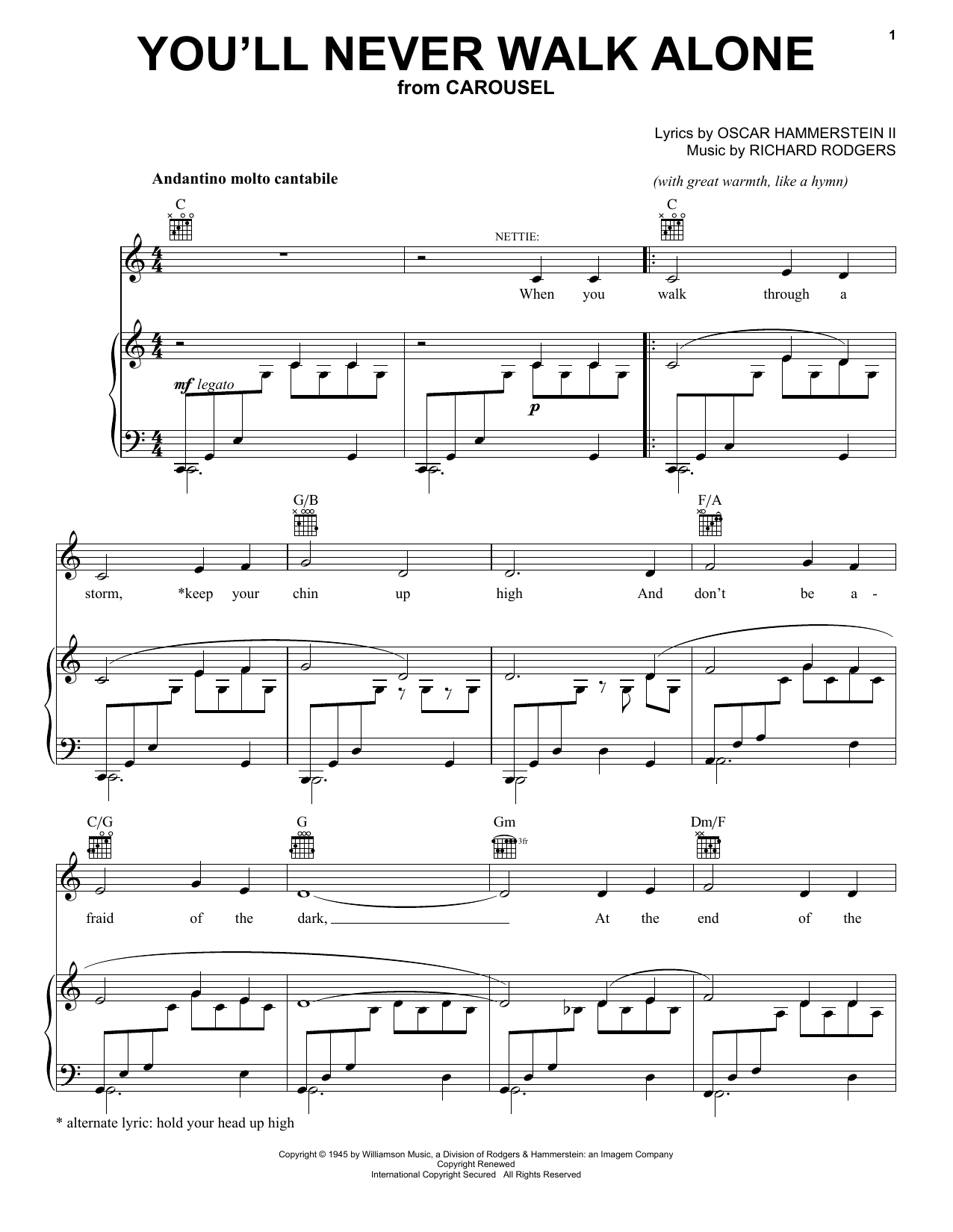
Instead of walking home in a soak, he stayed for the movie playing in between: Carousel.
He actually fell asleep. When he woke up, the character of Nettie Fowler was singing "You'll Never Walk Alone" to comfort Julie Jordan after her husband’s death. Gerry was floored. He went back to the Pacemakers and told them they were covering it. They thought he was nuts. "A Broadway ballad? We’re a Merseybeat band, Gerry!"
But he insisted. He brought it to George Martin at EMI, who had just finished working with some guys called The Beatles. Martin eventually gave in, added a swell of strings that felt like a tidal wave, and the rest is history. It hit Number 1 in October 1963, making Gerry and the Pacemakers the first act ever to reach the top spot with their first three singles.
How Anfield Stole the Song
There’s a popular myth that the Liverpool FC fans just "knew" this was their song the moment they heard it. That's a bit of a stretch. The reality is much more practical.
Back then, the PA announcer at Anfield would play the Top 10 hits in descending order before kickoff. The fans would sing along to everything—The Beatles, Cilla Black, Dusty Springfield. Since Gerry and the Pacemakers You’ll Never Walk Alone stayed at Number 1 for four weeks, it was the last song played before the match started for a month straight.
Then, it dropped out of the Top 10.
The DJ stopped playing it. The crowd? They went ballistic. They started chanting, "Where’s our song?" They just kept singing it a cappella, 25,000 voices in the Kop alone, forcing the club to keep playing the record. It wasn't a marketing decision. It was a terrace takeover.
Why this version stuck (and others didn't)
You’ve gotta remember, Frank Sinatra covered this. So did Elvis. Even Doris Day had a go. But Gerry’s version has a specific "walk" to it. It’s not just a ballad; it’s a march.
- The Tempo: It’s slow enough for a crowd of 50,000 to keep time without a conductor.
- The Build: It starts with that lone, slightly reedy vocal and builds into a massive orchestral finish.
- The Local Connection: Gerry was one of them. He was a Scouser. That mattered.
Beyond the Pitch: A Song of Resilience
If you think this is just about football, you’re missing the point. The song took on a hauntingly different meaning after the Hillsborough disaster in 1989. When 97 fans went to a match and never came home, the lyrics—"Walk on through the wind, walk on through the rain"—stopped being about a game. They became about survival.
In 2012, when the truth about the disaster finally came out in the Independent Panel report, the song re-entered the charts. It wasn't about nostalgia. It was about justice. People in Liverpool don't just "like" this song. They rely on it. It’s sung at funerals, weddings, and in hospital wards.
It’s even crossed borders. You’ll hear it at Celtic Park in Glasgow, at Borussia Dortmund in Germany, and even at FC Tokyo. But ask any of those fans where it started, and they’ll point back to a 2:40 minute recording from 1963.
What Most People Get Wrong
One big misconception is that the song was "written for Liverpool." It wasn't. Rodgers and Hammerstein wrote it for a musical about a carnival barker who kills himself. Pretty dark, right?
Another thing: people think the "golden sky" and the "silver song of a lark" are just pretty metaphors. In the context of the original play, they represent the afterlife. But when Gerry sang it, he stripped away the Broadway theatricality and made it sound like a guy at the pub telling you it’s going to be okay. That’s the magic. He took a high-art theatre piece and turned it into folk music for the masses.
Real-World Impact
If you’re looking for evidence of its power, look at the COVID-19 pandemic. In 2020, radio stations across Europe played the song simultaneously at 8:45 AM one Friday morning to show solidarity for healthcare workers. Gerry Marsden was still alive to see that. He died just a few months later in early 2021.
He always said that of all his hits—"Ferry Cross the Mersey," "I Like It"—this was the one. He knew he didn't own it anymore. The people did.
Actionable Insights for Music and History Buffs
If you want to truly appreciate the depth of Gerry and the Pacemakers You’ll Never Walk Alone, don't just listen to it on Spotify.
First, go find a video of the Anfield crowd singing it a cappella after the music cuts out. You can actually feel the frequency of the stadium shaking. Second, compare it to the 1945 original Broadway cast recording. You'll notice how Gerry simplified the melody to make it "singable" for a crowd that’s had a few pints.
Finally, if you're ever in Liverpool, go to the Shankly Gates. The words are literally forged into the iron. It's a rare case where a pop song didn't just top the charts—it became part of the local architecture.
Next Step: You should listen to the 1963 mono version versus the modern stereo remasters; the raw energy of the original EMI recording captures the "Mersey Sound" far better than the polished later edits.



