Elvis Presley stood at a piano in Nashville. It was September 11, 1967. Outside the studio, the world was vibrating with psychedelic rock and political unrest, but inside RCA Studio B, the King was looking for something else. He started playing a few chords. No sheet music. No complex arrangements. Just a man and a melody he’d loved since he was a kid in Tupelo.
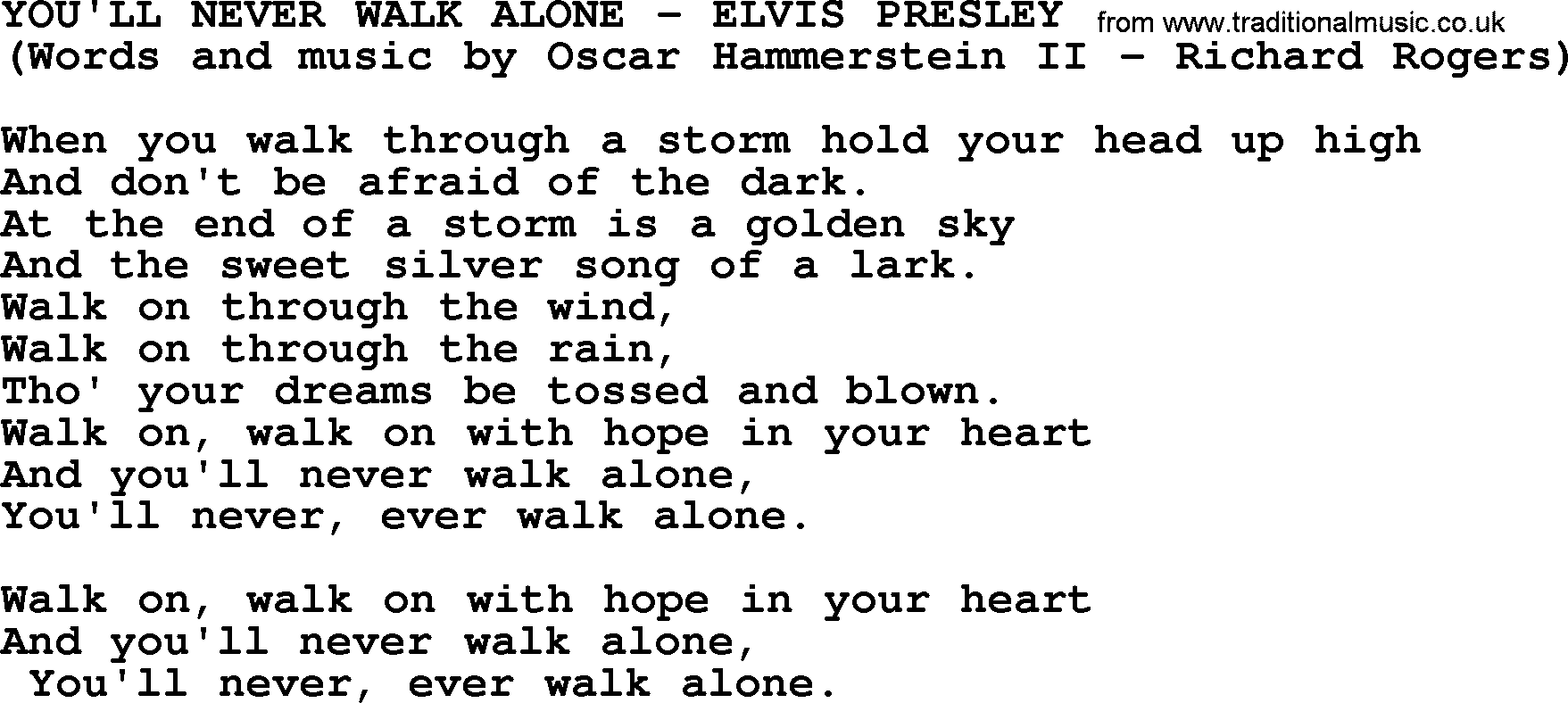
The song was You’ll Never Walk Alone.
Most people associate this anthem with soccer stadiums or the Rodgers and Hammerstein musical Carousel. Honestly, if you ask a person on the street today, they’ll probably mention Liverpool FC before they mention Elvis. But for Presley, this wasn't just another track to fill an album. It was a raw, impromptu moment that basically summed up his entire spiritual life.
The Messy Magic of the 1967 Session
You’ve got to understand how weird this recording session was. Usually, Elvis sessions were structured, even if they were loose. But this particular take on You’ll Never Walk Alone was almost an accident. Elvis just sat down and started pouring his soul into the keys.
His producer, Felton Jarvis, realized something special was happening. He didn't have time to get the band perfectly synced up. The result? A recording that feels remarkably human because it’s slightly unpolished. Elvis’s voice cracks with genuine emotion. He wasn't trying to be the "King of Rock and Roll" here; he was a guy seeking comfort.
Actually, the recording you hear on the records is a "splice." Felton Jarvis had to take two different takes and stitch them together to get a master. It was a bit of a Frankenstein job in the editing room, but it worked. The song eventually earned Elvis a Grammy nomination, proving that his gospel instincts were often sharper than his pop ones.
Why This Song Wasn't Just "Another Hit"
By 1967, Elvis was in a bit of a creative rut. He was churning out movie soundtracks that, frankly, weren't great. Songs about dancing dogs and bikini parties. It was soul-crushing for him.
You’ll Never Walk Alone was the antidote.
He had grown up in the Assembly of God church. That Southern spirituality never left him. When he sang gospel, he wasn't acting. You can hear the difference. Compare his vocal on a track like "Old MacDonald" (yes, he really sang that) to the booming, desperate hope in You’ll Never Walk Alone. It’s night and day.
A Budget Album with Big Impact
In 1971, RCA released a budget compilation titled You’ll Never Walk Alone. It wasn't a "prestige" release. It was meant to be cheap. It cost about two bucks at the time.
But fans didn't care about the price tag. They cared about the feeling. The album pulled together gospel tracks he’d recorded over the years, including the title track from that 1967 session. While it didn't set the world on fire immediately, it became a slow-burn juggernaut. It eventually went 3x Platinum.
People needed to hear that they weren't alone. In a decade defined by the Vietnam War and massive social shifts, Presley’s voice offered a sort of steady ground. He sounded like he’d been through the storm himself.
The Liverpool Connection and the Elvis Twist
It’s impossible to talk about this song without mentioning the UK. In England, You’ll Never Walk Alone is sacred. Gerry and the Pacemakers had a massive hit with it in 1963, and it became the anthem for Liverpool fans.
Elvis knew this. He loved the British music scene, even if he never got to tour there. His version is different, though. It’s slower. More deliberate.
While the "Kop" at Anfield sings it as a roar of defiance, Elvis sings it as a prayer. He emphasizes the "walk on" part, sure, but he really lingers on the "silver song of a lark" and the "golden sky." He’s looking for the light at the end of the tunnel.
What Really Happened in the Studio?
There’s a common misconception that Elvis recorded everything in one take because he was a "natural." Kinda true, but mostly a myth. He was a perfectionist. He’d do thirty takes of a song if the "vibe" wasn't right.
For You’ll Never Walk Alone, the spontaneity was the point.
- He sat at the piano himself.
- The Jordanaires, his long-time backup singers, had to basically improvise their harmonies on the fly.
- There was no orchestra.
- The power comes from the simplicity.
If you listen closely to the 1967 recording, you can hear the room. You can hear the space between the notes. It’s one of the few times we get to hear Elvis the musician, not just Elvis the icon.
The Legacy of the "Lost" Gospel King
We often focus on the jumpsuits and the Las Vegas lights. We talk about the movies and the screaming fans. But if you want to know who the man actually was, you listen to the 1971 You’ll Never Walk Alone compilation.
It contains "Peace in the Valley," "I Believe," and "It Is No Secret." These weren't songs he sang for the money. He sang them because he had to. He once said that gospel music was the only thing that put his mind at rest.
The track You’ll Never Walk Alone remains a staple for fans today because it bridges the gap. It’s a show tune, a sports anthem, and a hymn all at once. Elvis just happened to be the one who could pull all those threads together with a single, trembling vibrato.
Your Next Steps to Experience the Track
If you’ve only heard the radio hits, you’re missing the best part of the story. Go back and listen to the original 1967 take. Don’t just put it on in the background while you’re cleaning. Sit down. Use headphones.
Listen for the moment he hits the high note toward the end. It’s not a "pretty" note. It’s a struggle. And that struggle is exactly why the song works.
To dive deeper, look for the Where No One Stands Alone album released a few years back. They took his original vocals and backed them with new, lush arrangements and even a duet with his daughter, Lisa Marie. It gives a whole new perspective on how his gospel voice aged and evolved.
Check out the 1968 "Comeback Special" outtakes too. You’ll find him humming these types of melodies between sets. It’s the clearest window into his soul we’ll ever get.
Actionable Insight: Start with the 1971 RCA Camden budget album. It’s the most authentic way to hear the curation of his spiritual journey. Pay attention to "Who Am I?"—it’s a hidden gem on that record that perfectly complements the title track.



