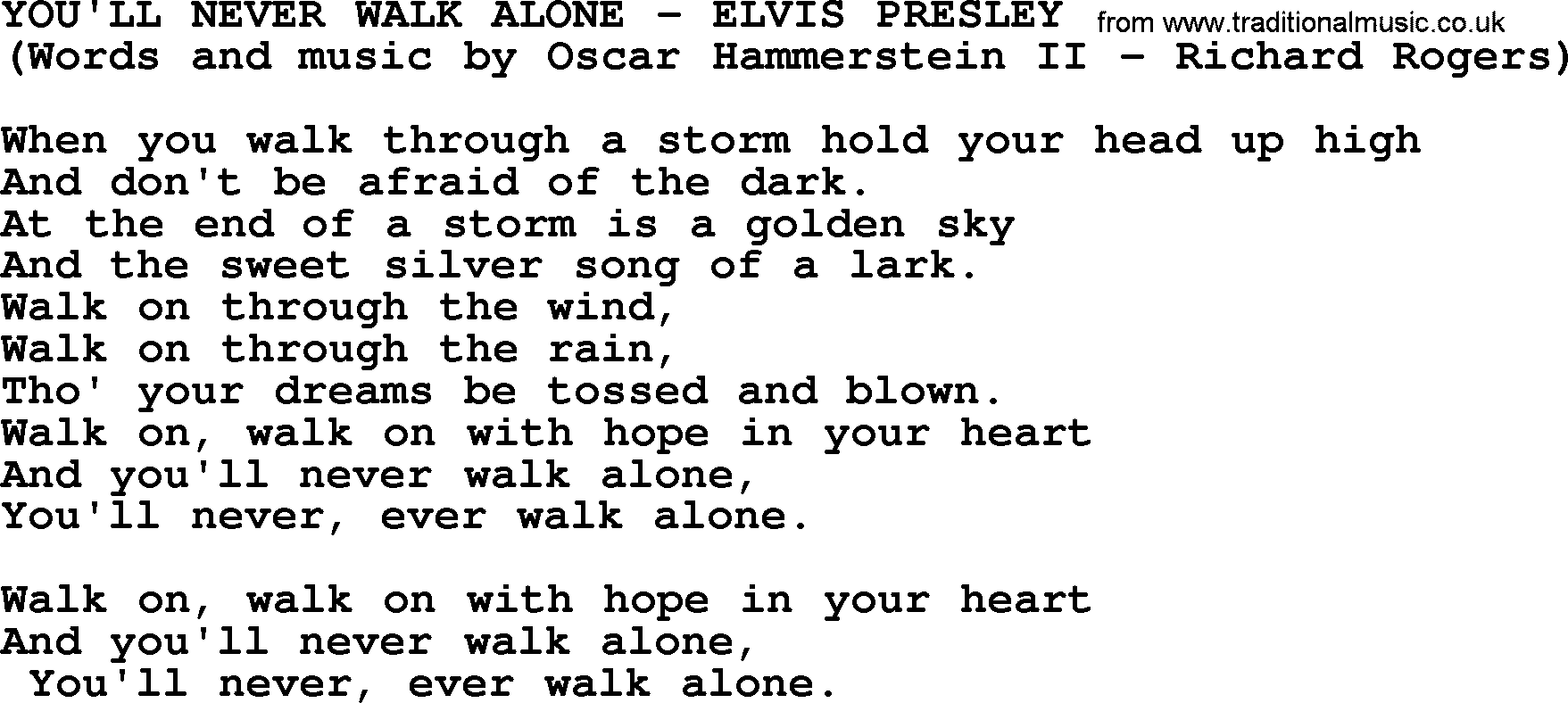
It starts with a single, lonely clarinet. Or maybe it’s the sound of 50,000 scousers clearing their throats in the freezing Merseyside rain. If you’ve ever stood on the Kop at Anfield, you know that the You'll Never Walk Alone lyrics aren't just words on a page or lines in a musical. They are a physical force. It’s a secular hymn. It’s a collective scream into the void. Honestly, it’s probably the most famous piece of music in the history of global sport, but its origins have nothing to do with football.
Most people think it’s just a Liverpool thing. They’re wrong. The song has traveled from the glitz of 1940s Broadway to the muddy terraces of the Eredivisie and the Bundesliga. It has been covered by everyone from Elvis Presley to Aretha Franklin. Yet, every time those first few notes of the Gerry and the Pacemakers version hit the PA system, time kinda stops.
Where the Hell Did These Lyrics Come From?
Before it was a football anthem, it was a Broadway showtune. Oscar Hammerstein II wrote the lyrics, and Richard Rodgers composed the music for their 1945 musical, Carousel. It’s a heavy play. Darker than most people realize. In the show, the song is performed to comfort the character Julie Jordan after her husband, Billy Bigelow, kills himself to avoid capture by the police.
Think about that for a second.
The song wasn't written for a trophy parade. It was written for a funeral. It was written for the absolute lowest point of a human life. That’s why the imagery is so visceral. When Hammerstein wrote about walking through a storm and keeping your head up high, he wasn't being metaphorical about a bad day at the office. He was talking about surviving the unthinkable.
The lyrics are actually quite simple. They don't use big, flowery words. They use elemental concepts: storms, wind, rain, golden skies, and hope. It’s that simplicity that makes it so universal. You don't need a degree in literature to feel the weight of "toss'd and blown." Everyone has felt like that.
The Liverpool Connection: How it Hit the Terraces
So, how did a Broadway ballad become the pulse of Liverpool Football Club? It happened in 1963. Gerry Marsden, a local lad and leader of Gerry and the Pacemakers, decided to cover the track. At the time, Liverpool was a city defined by the "Merseybeat" sound. The Beatles were exploding. The city was the center of the cultural universe.
Back then, Anfield used to play the top ten hits of the week over the speakers before kickoff. Marsden’s version of the You'll Never Walk Alone lyrics hit number one and stayed there for about four weeks. The fans loved it. They sang along because it was a local hit. But then, the song dropped out of the charts.
The stadium DJ stopped playing it.
The fans didn't care. They kept singing it anyway. They shouted for it. They made it theirs. It became an organic part of the stadium's DNA. It wasn't a marketing gimmick. It wasn't "forced fan engagement" like you see in modern American sports with "Make Some Noise" graphics on a jumbotron. It was a choice made by the people on the terraces.
Bill Shankly, the legendary Liverpool manager, supposedly fell in love with the song after hearing it during pre-season. Marsden gave him a copy of the record. Shankly was a man who understood the power of the collective. He saw that the lyrics mirrored his socialist philosophy of football—that the team and the fans were one inseparable unit.
Beyond Anfield: A Global Phenomenon
If you go to a Borussia Dortmund game at the Westfalenstadion, you’ll hear 80,000 Germans singing those same lyrics in English. It’s surreal. The "Yellow Wall" turns into a sea of scarves. Celtic fans in Glasgow claim they were actually the first to sing it, though the timeline usually favors Liverpool. Regardless of who "started" it, the song has become the universal language of European football solidarity.
During the COVID-19 pandemic in 2020, radio stations across Europe played the song simultaneously at 8:45 AM one Friday morning. It was a moment of genuine, non-ironic connection. When the world was terrified and isolated, the message of "you'll never walk alone" stopped being about football and went back to its Carousel roots. It was about survival.
Notable Covers and Variations
- Gerry and the Pacemakers (1963): The definitive version for sports fans. It’s got that 60s pop production—soaring strings and a steady beat.
- Pink Floyd (1971): They actually sampled the Anfield crowd singing the song at the end of their track "Fearless" on the album Meddle. It’s a trippy, haunting inclusion.
- Elvis Presley: He recorded a gospel-heavy version. It’s beautiful, but it lacks the raw, communal grit of a stadium crowd.
- Aretha Franklin: She turned it into a powerhouse soul anthem.
The Lyrics That Changed Everything
Let’s look at the actual words.
"Walk on through the wind, walk on through the rain, tho' your dreams be tossed and blown..."
It’s an instruction manual for resilience. The most important part of the You'll Never Walk Alone lyrics isn't the "golden sky" at the end. It’s the "walking" part. It’s the movement. The song doesn't promise that the storm will stop immediately. It doesn't say the wind will die down. It just says you have to keep moving.
For the families of the 97 victims of the Hillsborough Disaster, these lyrics became a battle cry for justice. For thirty years, they walked through a legal and political storm that would have broken almost anyone else. When they finally saw the "golden sky" of the truth being acknowledged, the song took on a weight that no other anthem can match. It ceased to be a song and became a testament.
Why Does it Work So Well in Sports?
Football is a game of heartbreak. Most fans spend 90% of their lives watching their team lose, or draw, or play terribly. We are masochists. We show up in the rain to watch people we don't know kick a ball around.
The song works because it acknowledges the pain.
Most American sports anthems are about winning. "We Are The Champions." "All I Do Is Win." They’re arrogant. They’re about the destination. But You'll Never Walk Alone is about the journey, specifically the parts of the journey that suck. It’s a song for when you’re 3-0 down at halftime in Istanbul—which, as any Liverpool fan will tell you, is exactly when the song matters most.
Common Misconceptions and Trivia
People get things wrong about this song all the time.
First, people think it’s easy to sing. It’s not. It has a massive range. It starts low and builds to a crescendo that requires a lot of lung capacity. When a stadium of people hits the "HOPE!" in "with hope in your heart," they are usually screaming it because they can't actually hit the note.
Second, many believe it was written for Liverpool. As we’ve established, it wasn't. It was written by two guys from New York City who probably never saw a game of "soccer" in their lives.
Third, there's the "who sang it first" debate between Celtic and Liverpool. While Celtic fans certainly popularized it in Scotland, the 1963 recording by Marsden is the clear catalyst for its widespread adoption in English football.
Actionable Steps for the Full Experience
If you really want to understand the power of these lyrics, you can't just read them. You have to experience them in context.
- Watch the 1945 film version of Carousel: See the scene where the song is introduced. It gives the lyrics a tragic gravity that you don't get from a highlight reel.
- Listen to the Pink Floyd version: "Fearless" provides a weirdly intimate look at how the crowd noise sounds from the pitch level.
- Go to a match: If you can’t get to Liverpool, find a local supporters' club. Being in a room with 100 people screaming these words at a TV screen at 7:30 AM on a Saturday is a transformative experience.
- Read the Hillsborough accounts: Research the "Hillsborough Justice Campaign" to understand why the line "Hold your head up high" means so much to the city of Liverpool specifically.
- Listen to the silence: The most powerful way to hear the song is often right after it ends, when the referee blows the whistle to start the game. The transition from the melodic roar to the tension of the match is where the magic happens.
There are no shortcuts to feeling this one. It’s a piece of music that demands you bring your own baggage to it. Your own losses. Your own storms. Only then do the lyrics actually make sense.
Practical Insight: To truly appreciate the song's impact, listen to the "Live at Anfield" recordings rather than the studio versions. The imperfections in the crowd's timing and the raw emotion in their voices provide a much more authentic representation of why the song has endured for over eighty years. Focus on the final thirty seconds of the song where the music usually drops out, leaving only the voices of the fans—it is in this moment of acapella vulnerability that the lyrics' true meaning of community is most visible.