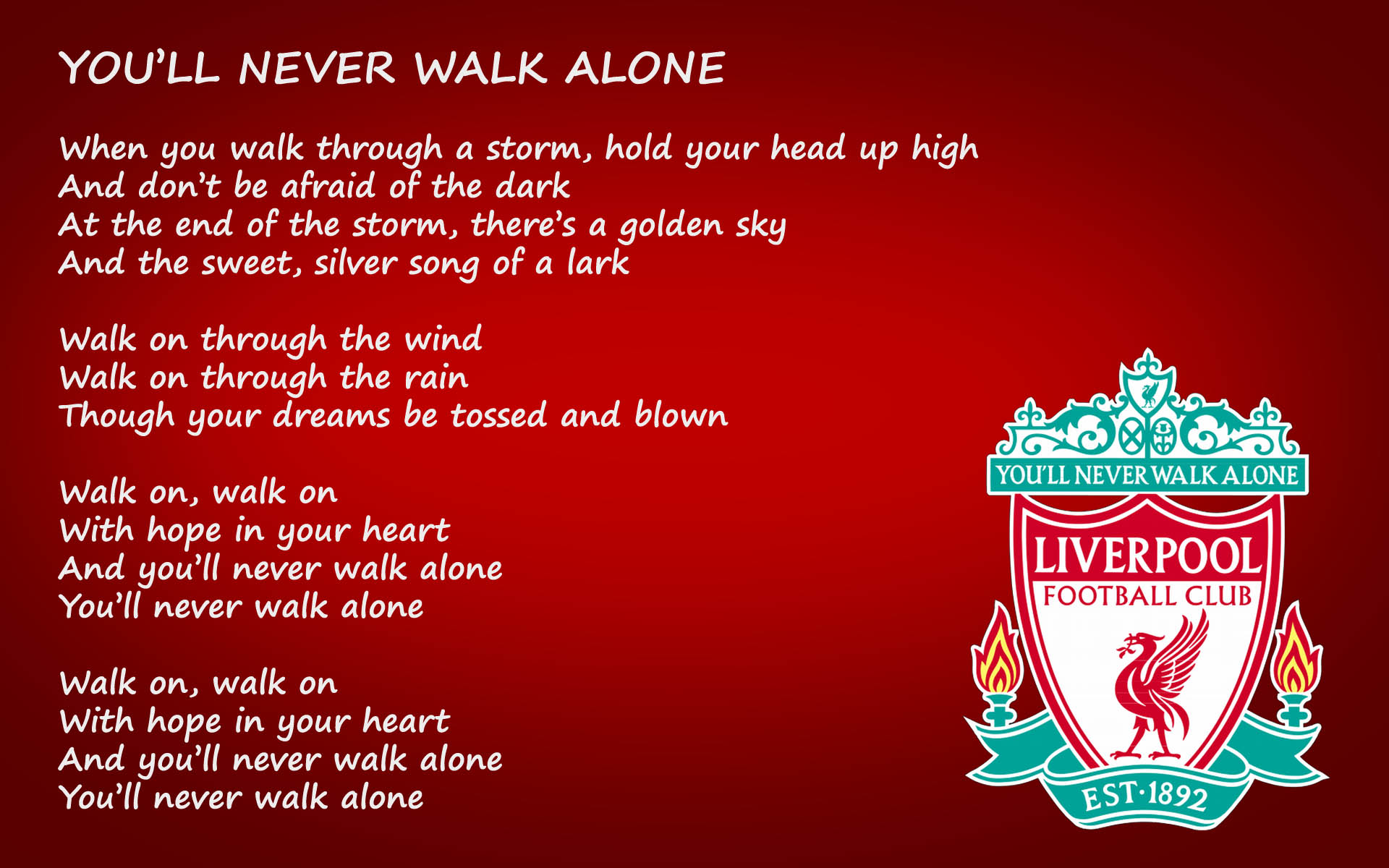
It starts with a simple, lonely C major chord. Most people don't even realize they’re listening to a piece of musical theater history when those first few notes of the You'll Never Walk Alone lyrics kick in. They just feel it. It’s that visceral, chest-tightening sensation that happens when 50,000 people in a stadium start singing in unison. Honestly, it’s kinda weird if you think about it. How did a song written for a 1945 Broadway musical called Carousel end up being the definitive anthem for Liverpool FC, Borussia Dortmund, and countless people facing the hardest moments of their lives?
The song wasn't meant for a football terrace. It was written by Richard Rodgers and Oscar Hammerstein II for a scene where a character named Nettie Fowler comforts her cousin Julie Jordan after the death of the male lead, Billy Bigelow. It’s a funeral song, basically. But it’s a funeral song that refuses to stay in the graveyard.
The Story Behind the You'll Never Walk Alone Lyrics
When Oscar Hammerstein II sat down to write these words, he wasn't thinking about league titles or European nights. He was thinking about grief. If you look at the You'll Never Walk Alone lyrics, the imagery is surprisingly dark for a "hopeful" song. You’ve got storms, wind, rain, and dreams being "tossed and blown." It’s not a sunshine-and-rainbows type of track. It’s a "we’re in the trenches" type of track.
The opening line—When you walk through a storm—immediately sets the stakes. It acknowledges that life is going to be objectively terrible sometimes. It doesn't lie to you. It doesn't say the storm will go away instantly. It just tells you how to walk through it: Hold your head up high and don't be afraid of the dark. That’s the hook. That’s why it works.
In the original play, the song is reprised at the end during a graduation ceremony. It was meant to inspire a sense of community and resilience. But the transition from the stage to the Anfield turf happened almost by accident in the early 1960s. Gerry Marsden, lead singer of the Merseybeat band Gerry and the Pacemakers, picked up the tune. He told legendary Liverpool manager Bill Shankly that he wanted to cover it. Shankly, apparently, loved it. The fans at Anfield already had a habit of singing the top hits of the week, and when "You'll Never Walk Alone" hit number one in 1963, they just... never stopped singing it.
Why the Lyrics Hit Different at 3:00 PM on a Saturday
There is something deeply spiritual about the way the You'll Never Walk Alone lyrics function in a sporting context. Sport is, by its nature, a cycle of hope and disappointment. Mostly disappointment.
Take the middle section: Walk on through the wind, walk on through the rain, tho' your dreams be tossed and blown. If you’re a football fan, your "dreams" are tossed and blown every other weekend. But the song shifts the focus from the result of the game to the act of endurance. It’s about the "walking," not the destination. This is why the song became so intertwined with the tragedy of the Hillsborough disaster in 1989. After 97 fans lost their lives, the lyrics stopped being about football and started being about survival, justice, and collective mourning. It became a promise to the families of the victims.
It’s not just a Liverpool thing, though. Celtic fans in Glasgow claim they were the first to sing it (though the timeline usually favors the Scousers). Borussia Dortmund fans sing it with a fervor that rivals anyone in England. It has been covered by everyone from Frank Sinatra and Elvis Presley to Pink Floyd (who sampled the Anfield crowd in their song "Fearless").
A Breakdown of the Key Verses
Most people know the chorus, but the buildup is where the real magic is.
At the end of a storm, there's a golden sky, and the sweet silver song of a lark. That’s the payoff. It’s the "light at the end of the tunnel" metaphor but written by a man who knew how to structure a dramatic crescendo. Rodgers’ music climbs higher and higher here. The melody literally ascends as the lyrics talk about the "golden sky." By the time you get to the final Walk on, walk on, with hope in your heart, the song has transitioned from a quiet whisper to a roar.
Interestingly, the lyrics are remarkably gender-neutral and universal. There’s no "he" or "she" or "me." It’s "you." It’s an address to the listener, which makes it feel like a personal pep talk from a friend.
Common Misconceptions About the Words
A lot of people actually get the lyrics slightly wrong when they’re screaming them in a pub.
- The "Lark" vs. "Dark": Some people swap these. The lark is at the end of the storm; the dark is what you shouldn't be afraid of at the start.
- The "Tossed and Blown" part: It’s often slurred into one big syllable in stadiums, but in the sheet music, it’s a distinct, rhythmic phrase that’s supposed to mimic the sound of a ship at sea.
The Global Impact and Beyond
During the 2020 lockdowns, the You'll Never Walk Alone lyrics saw a massive resurgence. It wasn't about football then; it was about the medical professionals and the people isolated in their homes. It was played simultaneously by radio stations across Europe as a gesture of solidarity.
Why? Because "never walk alone" is perhaps the most fundamental human desire. We are social animals. The fear of being alone in our "storm" is the ultimate fear. The song provides a linguistic shield against that.
The track has been used in countless movies and TV shows to signal a moment of emotional triumph or devastating loss. From The West Wing to Ted Lasso, the cultural footprint is massive. It’s a rare example of a song that has transcended its medium. It’s no longer a "song" in the traditional sense; it’s a social tool.
How to Actually "Use" This Song
If you’re looking at the You'll Never Walk Alone lyrics because you’re going through a rough patch, don't just read them. Listen to the 1963 Gerry and the Pacemakers version first to get the "standard" feel. Then, look up the 1945 original Broadway cast recording to hear the operatic weight it was intended to have.
There’s a nuance in the phrasing that gets lost in the stadium roar. Notice the pauses. The silence between "Walk on" and "Walk on" is where the "hope" is supposed to breathe.
Actionable Insights for the Weary
- The Power of Collective Singing: Science actually backs this up. Singing in a group releases oxytocin and reduces cortisol. If you’re feeling isolated, finding a community that shares a "song" (metaphorical or literal) is a proven way to build resilience.
- Embracing the Storm: The lyrics suggest that the storm is a prerequisite for the golden sky. Stop trying to avoid the wind and rain of life; focus on the "walking" part.
- Historical Context Matters: Understanding that this was a song for a grieving widow gives it more weight than just a "sports chant." Use that perspective when you need to find strength.
The legacy of these words is still being written. Every time a new tragedy hits or a massive underdog wins a trophy, someone, somewhere, is going to start singing. And they’ll keep singing until the "sweet silver song of a lark" actually shows up.
To truly understand the power of these lyrics, you should compare the different versions of the song. Each artist brings a different emotional texture to the "storm." Start by listening to the Aretha Franklin version for a gospel-infused take on resilience, then move to the Nina Simone version for a haunting, more intimate interpretation. By seeing how these words adapt to different voices, you can better apply their message of perseverance to your own life. Identify your own "storm" and consciously decide what "walking on" looks like for you today—whether that's finishing a difficult project or simply reaching out to a friend.
The anthem works because it’s a choice. You choose to believe you aren't alone. You choose to keep walking. That’s the only way anyone ever gets to the golden sky.