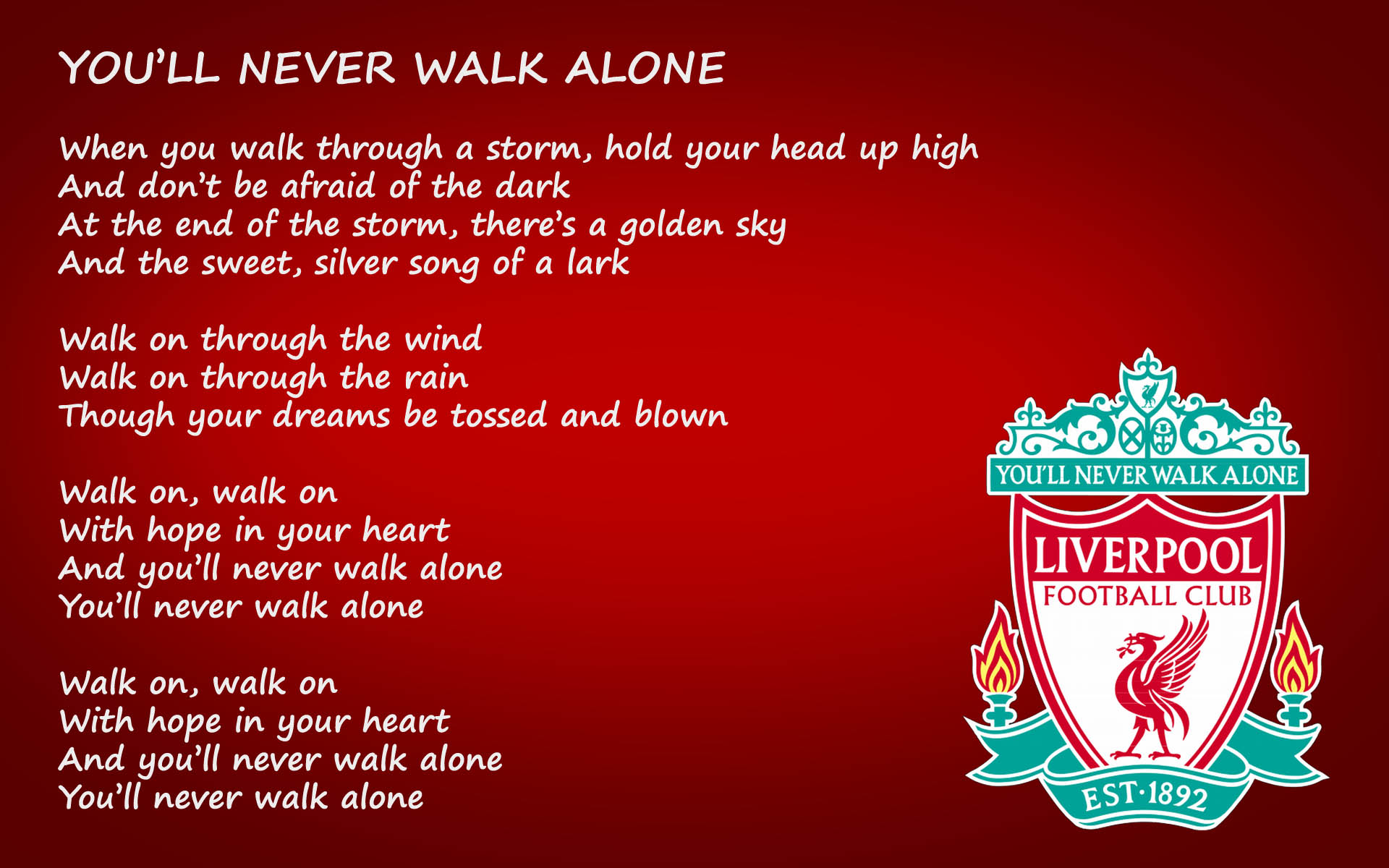
It’s just a song from a 1945 Broadway musical. On paper, that makes no sense. Why would a track from Rodgers and Hammerstein’s Carousel—a show about a carnival barker in Maine—become the loudest, most tear-jerking anthem in global sports? If you’ve ever stood in the Kop at Anfield or joined a crowd in Dortmund, you know the feeling. It’s a physical weight. The song lyrics You'll Never Walk Alone aren't just lines on a page; they are a manifesto of survival.
Most people think it’s a football song first. It isn't. It started as a piece of musical theater intended to comfort a character named Julie Jordan after her husband, Billy Bigelow, dies. It was about grief. Real, heavy, gut-wrenching grief. But somehow, over the last eighty years, those lyrics migrated from the stage to the terraces, and then to the very heart of public mourning and celebration.
The Surprising Origin of the Lyrics
Oscar Hammerstein II was a master of the "conditional love song," but with this one, he went somewhere else entirely. He went for hope. When you look at the song lyrics You'll Never Walk Alone, the imagery is surprisingly dark for a "hopeful" song. It talks about storms. It talks about wind and rain. It mentions dreams being "tossed and blown."
It’s dark.
The brilliance of the writing lies in the transition. It doesn't promise that the storm will go away immediately. Instead, it tells the listener to keep their head up high. It’s a literal instruction for dignity during a crisis. Christine Johnson was the first to sing it on Broadway, but the version that changed everything arrived in 1963.
Gerry Marsden, leader of the Merseybeat group Gerry and the Pacemakers, was looking for a follow-up to their hits. Legend has it he saw Carousel in a cinema and was floored. He took the song to his producer, the legendary George Martin (the man behind the Beatles), and they recorded a version that stripped away the operatic theater vibrato and replaced it with a raw, Mersey sound. It hit number one in the UK.
Then, Anfield happened.
Why the Kop Adopted the Song
Back in the early 60s, the PA system at Liverpool FC’s stadium used to play the top ten hits of the week. The fans would sing along to everything from the Beatles to Cilla Black. When "You'll Never Walk Alone" hit number one, the fans sang it. But when it dropped out of the charts, they didn't stop.
They kept singing it.
There’s a specific cadence to the Gerry and the Pacemakers version that fits the rhythm of a crowd perfectly. It starts slow. It builds. By the time you get to the "Walk on, walk on" section, the swell of sound is massive. It became a badge of identity. It wasn't just about the music anymore; it was about the collective. If you’re a Liverpool fan, these lyrics are your birthright. But it’s fascinating how it spread. Celtic fans in Scotland claim they had it first (they didn't, but the debate is fierce). Borussia Dortmund fans in Germany sing it with a passion that rivals the English.
It’s universal because the sentiment is bulletproof. Everyone, at some point, feels like they are walking through a storm.
Deconstructing the Lyrics: A Verse-by-Verse Look
Let’s actually look at what Hammerstein wrote, because it’s easy to gloss over the words when you’re screaming them at a TV screen.
"When you walk through a storm, hold your head up high..."
This is the opening gambit. It’s an acknowledgement of struggle. It’s not "if" you walk through a storm, it’s "when." Life is going to be hard. That’s a fact. The instruction is postural—keep your head up. It’s about not letting the weight of the world crush your spirit.
"And don't be afraid of the dark..."
Simple. Childlike, almost. But in the context of losing a loved one or facing a massive defeat, the "dark" is a very real metaphor for the unknown.
"At the end of a storm, there's a golden sky, and the sweet silver song of a lark."
Here’s the payoff. The "lark" and the "golden sky" are classic poetic tropes, but they work because they provide a visual contrast to the "dark" of the previous line. It’s the light at the end of the tunnel.
"Walk on through the wind, walk on through the rain, tho' your dreams be tossed and blown."
This is the most "football" part of the song. It’s about persistence. It’s the "grind." The idea that your dreams can be "tossed and blown" is a sophisticated way of saying things won't go your way. You might lose the league on the final day. You might lose your job. You walk anyway.
"Walk on, walk on, with hope in your heart, and you'll never walk alone."
This is the crescendo. The repetition of "walk on" serves as an anthem of endurance. And that final line—the title—is the promise of community. Whether it's a fan base, a family, or a ghost, you have company.
Beyond the Pitch: The Song in Times of Crisis
The song lyrics You'll Never Walk Alone have taken on a much heavier meaning in the wake of tragedies. Most notably, after the Hillsborough Disaster in 1989, where 97 Liverpool fans lost their lives. The song stopped being a pre-match ritual and became a prayer. It was sung at funerals, at memorials, and during the decades-long fight for justice.
It’s been used during the COVID-19 pandemic to honor healthcare workers. It’s been sung at the Eurovision Song Contest as a plea for peace. Pink Floyd even sampled the Anfield crowd singing it on their track "Fearless" from the album Meddle.
It has this weird, almost magical ability to adapt to the situation. If you sing it at a wedding, it’s about partnership. If you sing it at a funeral, it’s about legacy. If you sing it at a match, it’s about loyalty.
Common Misconceptions About the Song
A lot of people think Frank Sinatra wrote it. He didn't, though he did a gorgeous, sweeping cover of it. Elvis Presley covered it too. So did Johnny Cash, Aretha Franklin, and even Judy Garland.
Another misconception is that the song belongs to one specific group. While Liverpool FC is the most famous "owner" of the anthem, it is a shared piece of cultural heritage. In the Netherlands, Feyenoord fans sing it. In Japan, FC Tokyo fans have their own version. It belongs to anyone who needs it.
Some critics find the song overly sentimental. They call it "schmaltz." Honestly? They’re kinda right, in a strictly musical theater sense. It is unashamedly emotional. But that’s exactly why it works. In a world that often demands we be cynical or detached, "You'll Never Walk Alone" demands that we feel something. It’s a vulnerable song. To sing it is to admit that you need hope.
The Cultural Impact of the 1963 Recording
The Gerry and the Pacemakers version is the "definitive" one for a reason. It’s the tempo. If you listen to the original cast recording of Carousel, it’s much more of a ballad. It’s slow. It’s pretty.
Gerry Marsden added a certain "swing" to it. He turned the waltz-like structure into something that felt like a march. That change in arrangement is what allowed it to survive in stadiums. You can’t really march to a slow Broadway ballad, but you can definitely sway and shout to the 1963 version.
Actionable Takeaways for Music Lovers and Fans
If you’re looking to truly appreciate the depth of the song lyrics You'll Never Walk Alone, there are a few things you should do to understand its place in history.
- Listen to the 1945 Original: Find the original Broadway cast recording. Notice how different the emotional weight is when it’s sung by a female voice (usually the character Nettie Fowler) in a theatrical setting. It feels much more intimate.
- Watch the Anfield 2005 Version: Look up footage of the Liverpool fans singing it during the Champions League final in Istanbul or the semi-final against Chelsea that same year. The sheer volume is a masterclass in how music can influence a physical environment.
- Read the Play: If you can, read the script for Carousel (or the original play it was based on, Liliom by Ferenc Molnár). Understanding the tragic circumstances surrounding the song makes the lyrics "hold your head up high" much more poignant.
- Learn the Second Verse: Most people only know the main chorus. But the transition from the "storm" to the "golden sky" is where the real poetry happens.
- Compare the Covers: Listen to the Aretha Franklin version. She turns it into a gospel powerhouse. Then listen to the Johnny Cash version for a completely different, rugged take on the same words.
The longevity of these lyrics isn't an accident. It’s the result of a perfect alignment between a universal human need—connection—and a melody that is easy enough for 50,000 people to sing in unison, even if half of them are out of tune. It’s a song that reminds us that while the "wind and rain" are inevitable, staying in the dark is a choice we don't have to make by ourselves.
Next time you hear those opening chords, don't just think of it as a sports chant. Think of it as eighty years of people trying to find a way through the storm. It’s a piece of history that still breathes every time a crowd clears their throat to sing.



