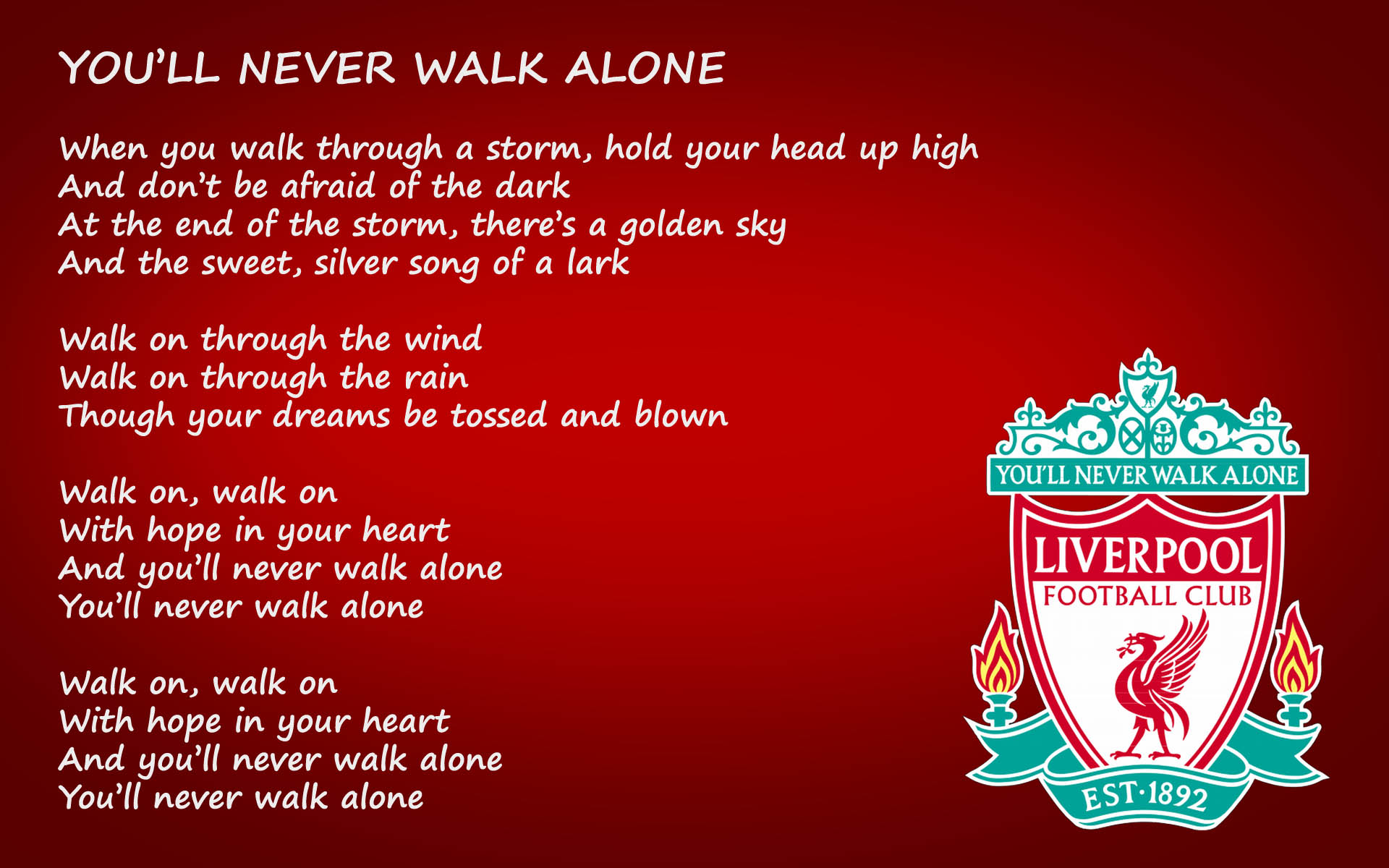
It starts with a simple, lonely C major chord. Then the words kick in: "When you walk through a storm, hold your head up high." Most people today hear those lines and immediately think of a muddy football pitch in Liverpool or a tear-jerking moment at a funeral. But honestly? The song shouldn't have worked. It’s a show tune from 1945 written for a musical about a carnival barker who commits suicide. Talk about an unlikely origin story for a global hymn of hope.
The You'll Never Walk Alone lyrics have a weird, almost magnetic power. They’ve been covered by everyone from Elvis Presley to Aretha Franklin, and Pink Floyd even sampled the sound of a crowd singing it on their Meddle album. It’s the kind of song that makes grown men cry in public. Why? Because it doesn’t lie to you. It doesn't say the storm is going to vanish instantly. It just says you aren’t going to be by yourself when the wind starts howling.
The Broadway Roots Most Fans Forget
In 1945, Richard Rodgers and Oscar Hammerstein II were the kings of Broadway. They were working on Carousel, an adaptation of a play called Liliom. The plot is dark. It’s heavy. At the end of the show, the protagonist, Billy Bigelow, has died, and his widow, Julie Jordan, is left grieving while their daughter graduates from school.
The song was written to comfort Julie. Christine Johnson, the operatic contralto who first played the role of Nettie Fowler, was the first person to ever belt out those famous lines on stage. Hammerstein was a master of the "simple but profound" school of lyric writing. He didn’t use fancy metaphors. He used the weather. A storm. A golden sky. A lark. It’s basically a nature walk through a panic attack.
The lyrics aren't actually about winning a trophy. Not even close. They’re about survival. When you look at the lines "Walk on through the wind / Walk on through the rain," you’re looking at a raw acknowledgement of suffering. Rodgers’ music matches this perfectly by starting low and quiet, then slowly climbing in pitch and volume—a technique called a "crescendo"—until it hits that massive, lung-bursting peak on the word "alone."
How Liverpool FC "Stole" the Song
If you go to Anfield today, you'll see "You'll Never Walk Alone" forged in iron above the Shankly Gates. But the song didn’t migrate from New York to the North of England because of some marketing genius. It happened because of a guy named Gerry Marsden.
In the early 1960s, the "Merseybeat" scene was exploding. Gerry and the Pacemakers were rivals to the Beatles. Gerry grew up watching Carousel and loved the song. He decided to record a pop version. His producer, the legendary George Martin (the same guy who produced the Beatles), actually thought it was too slow. He wanted something upbeat. Gerry insisted.
The story goes that Gerry gave a copy of the record to Liverpool manager Bill Shankly during a pre-season trip in 1963. Shankly loved it. The local DJ at Anfield, Stuart Bateman, used to play the top ten hits in descending order before kickoff. Gerry’s version hit Number 1 and stayed there for weeks. When it finally dropped out of the charts, the fans in the Kop—who had grown used to singing along—kept singing it anyway.
They just wouldn't let it go.
A Linguistic Breakdown of the You'll Never Walk Alone Lyrics
Why do these specific words stick in our brains?
"Walk on, walk on, with hope in your heart"
It’s the repetition. "Walk on" serves as a rhythmic command. It’s active. Most songs about sadness are passive; they’re about sitting in a room and feeling bad. This song demands movement. Even if the sky is dark, you’re supposed to keep your legs moving.
"And you'll never walk alone"
The use of the double negative "never... alone" is a powerful linguistic tool. It’s more emphatic than saying "you will always have a friend." It suggests the complete absence of solitude.
Interestingly, there’s a common misconception about the lyrics. People often get the "golden sky" part mixed up. The lyric is: "At the end of a storm, there's a golden sky / And the sweet silver song of a lark." It’s incredibly visual. It paints a picture of the "golden hour" after a thunderstorm when the light hits the wet pavement. It’s cinematic.
More Than Just Football: The Song as a Prayer
While Liverpool made it famous in sports, the song has a massive life outside the stadium. During the COVID-19 pandemic, it became a global anthem again. Captain Tom Moore, the British veteran who raised millions for the NHS, recorded a version with Michael Ball. It hit Number 1.
In the 1960s, it became an anthem for the Civil Rights movement in the U.S. to some extent, though "We Shall Overcome" was more prominent. Still, its universal message of endurance meant it was sung at rallies and church services.
It’s been used to mark some of the darkest moments in history:
- After the Munich Air Disaster (though Manchester United fans have a complicated relationship with the song now).
- Following the Hillsborough Disaster in 1989, where it became a solemn vow of solidarity for the victims' families.
- In the wake of the 9/11 attacks in New York.
- After the 2017 Manchester Arena bombing.
It’s a "utility song." You use it when your own words fail. It bridges the gap between secular pop music and religious liturgy. You don't have to be a believer to feel the "hope in your heart" line.
The Technical Challenge of Singing It
Ask any professional singer: this song is a trap. It starts so low that you think it’s easy. You’re just whispering. But then comes the bridge. "Walk on, walk on..." The notes start climbing. By the time you get to "ALONE," you’re hitting a high note that requires serious breath support.
Frank Sinatra recorded it. His version is very "Old Blue Eyes"—cool, detached, slightly swingy. It doesn't really work. You can't be cool when singing these lyrics. You have to be vulnerable. That’s why Judy Garland’s version is often cited as one of the best. You can hear her voice trembling. She sounds like she’s actually in the middle of a storm, not just singing about one.
Common Misconceptions and Trivia
- Did Pink Floyd really use it? Yes. At the end of the track "Fearless" on the 1971 album Meddle, you can hear a field recording of the Liverpool Kop singing the song. It’s eerie and beautiful.
- Is it only Liverpool? No. Celtic FC in Scotland also claims it as their own, and there’s a long-standing (and very polite) debate about who sang it first. Borussia Dortmund fans in Germany also belt it out with incredible passion.
- The "Lost" Verse? There isn't really a lost verse, but in the original musical, the song is reprised twice. The context changes from a private moment of grief to a public declaration of community.
How to Truly Experience the Song
If you really want to understand the You'll Never Walk Alone lyrics, don't listen to a studio recording. Go to YouTube and search for "Anfield 2005 Champions League semi-final vs Chelsea."
Listen to the sound of 40,000 people singing it a cappella. The instruments drop out. It’s just human voices. You can hear the cracks in people's throats. It’s not about being a "good" singer. It’s about the collective roar. That is where the song lives. It’s a piece of folk music that happened to be written by two guys in a fancy New York office.
Actionable Takeaways for Music Lovers and History Buffs
If you're looking to dive deeper into the history or usage of this anthem, here are a few things you can actually do:
- Compare the Versions: Listen to the 1945 original cast recording, then Gerry Marsden’s 1963 version, then Nina Simone’s piano-heavy instrumental. Notice how the meaning shifts from "theatrical" to "pop" to "spiritual."
- Read the Script: Look up the ending of the musical Carousel. Understanding that the song is sung to a girl whose father has just died changes how you hear the "storm" metaphor. It's much darker than a football match.
- Visit the Gates: If you’re ever in Liverpool, the Shankly Gates are a public site. Seeing the lyrics literally written in iron gives you a sense of how a piece of art can become part of the architecture of a city.
- Practice the Breathing: If you’re a singer, work on the "low to high" transition. The secret is in the "Wait" before the final chorus. Don't rush it. The tension is what makes the resolution feel so earned.
The reality is that "You'll Never Walk Alone" is one of the few songs that has successfully escaped the confines of its own creation. It no longer belongs to Rodgers and Hammerstein. It doesn't even really belong to Gerry Marsden anymore. It belongs to anyone who is having a particularly rough Tuesday and needs to be reminded that the rain eventually stops.



